Breaking News
Breaking News
from Washington and beyond

Iran’s Oil Exports Are Making Trump Look Pretty Foolish Right Now

Oil shipments through the Strait of Hormuz have halted—except for Iran’s.

Two commercial ships sit in waters off the coast of Dubai, with towers in the background.
AFP/Getty Images

Donald Trump’s war on Iran is backfiring in a critical area: Iran is exporting more oil through the Strait of Hormuz than before.

The Wall Street Journal reports that Iran has taken control of the key waterway and effectively shut out the rest of the oil-producing countries in the Persian Gulf. Since the war began February 28, Iran has loaded seven tankers, and in the past week, tankers have loaded an average of 2.1 million barrels of oil each day, more than its 2.0 million barrel average in February.

China, one of Iran’s biggest oil importers, appears to be taking most of the oil. And almost all ship traffic moving across the strait is “linked to Iran or China,” Christopher Long, head of intelligence at U.K. maritime-security company Neptune P2P Group, told the Journal.

Trump has claimed that it’s safe for ships to traverse the strait and tried to bully oil companies into challenging Iran, to no avail. He hasn’t followed up on his offer to use the U.S. Navy to escort ships, and even if he did, there are now more stopped ships than the Navy can handle. And now, Iran has reportedly begun laying mines in the strait, complicating naval traffic further.

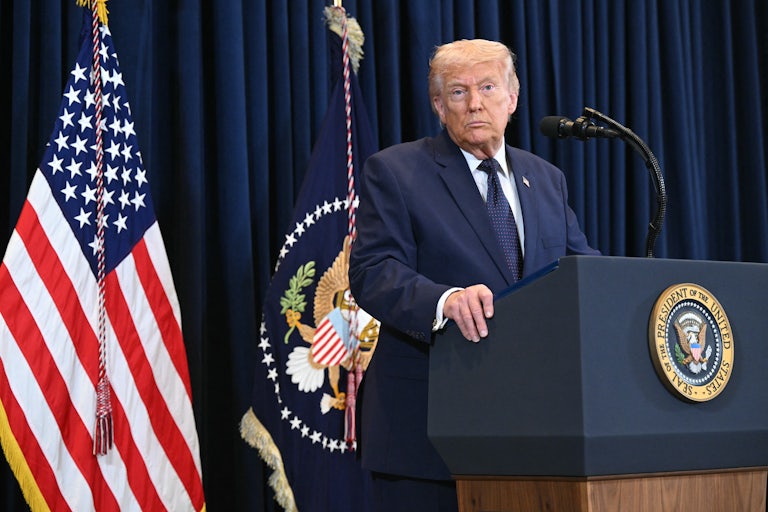
“If for any reason mines were placed, and they are not removed forthwith, the Military consequences to Iran will be at a level never seen before. If, on the other hand, they remove what may have been placed, it will be a giant step in the right direction!” Trump angrily posted on Truth Social Tuesday. On Wednesday, the U.S. Central Command said it had destroyed 16 Iranian mine-laying ships.

But none of that seems to have affected Iran’s control of the strait, and its ability to export oil. It’s a scenario that the U.S. should have seen coming, considering that closing off the strait has been threatened by Iran before and is a long-standing pillar of Iranian defense strategy. To make matters worse, the U.S. decommissioned four anti-mine ships stationed in the Persian Gulf in January. Right now, Iran is controlling one of the world’s most critical shipping lanes for oil, and is exposing Trump’s lack of planning for this war.
Trump Refuses to Answer Key Question on Winning Iran War

Good thing this wasn’t a regime-change war!

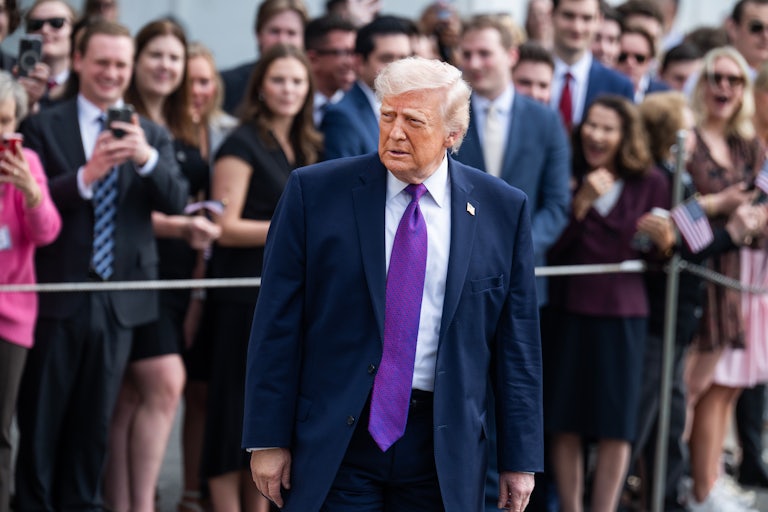
Donald Trump stands outside the White House
Tom Williams/CQ-Roll Call, Inc/Getty Images

We’re almost two weeks into the Iran war, and President Donald Trump still isn’t sure what his goals are.

Asked on Wednesday whether he would be able to declare victory in the Middle East if Ayatollah Mojtaba Khamenei—the son of assassinated Ayatollah Ali Khamenei—becomes the new supreme leader of Iran, Trump balked.

“I don’t want to comment on that,” the president said.

Trump then changed the subject, launching into one of his patented rambling monologues: “I spoke with various countries, the leaders of various countries. You’ll have a list. And they said they’ve never seen anything like it.… We have the greatest military in the world by far.”

In comments given just a few hours later, Trump added that the U.S. “knocked out, twice, [Iranian] leadership. Now they have a new group coming up. Let’s see what happens to them.”

While Ayatollah Ali Khamenei was a brutal ruler, quashing local dissent and sometimes executing citizens who defied his regime, Mojtaba Khamenei may be even worse for regular Iranians. A report from the Atlantic Council noted that Mojtaba is close with the “most ideologically extremist clerics” in Iran, and some experts say he is more likely to sink resources into building nuclear weapons than his father. Mojtaba was closely involved in his father’s decision-making throughout the latter’s time as supreme leader.

Trump said he was “not happy” with the Iranian Council of Experts’ decision to appoint the younger Khamenei as supreme leader last week. “I have to be involved in the appointment,” he told Axios at the time.

By not answering what should be an easy question, Trump is continuing what seems to be his Cabinet’s prevailing strategy surrounding the war: Be as unclear and disorganized as possible. Trump and his officials have not been able to decide whether the Iran war is a war or not, whether it’s over or just getting started, what caused the U.S. to get involved, and what exactly our demands for the people we’re bombing should be.

The Iran war ending would obviously be a good thing. But if all that changed is that we assassinated the ayatollah and now have his even crazier son in charge of the country, then what the hell was all this for?

Trump Plays Dumb About Girls’ School Strike He Discussed 2 Days Ago

A military report indicates the U.S. was responsible for the strike.

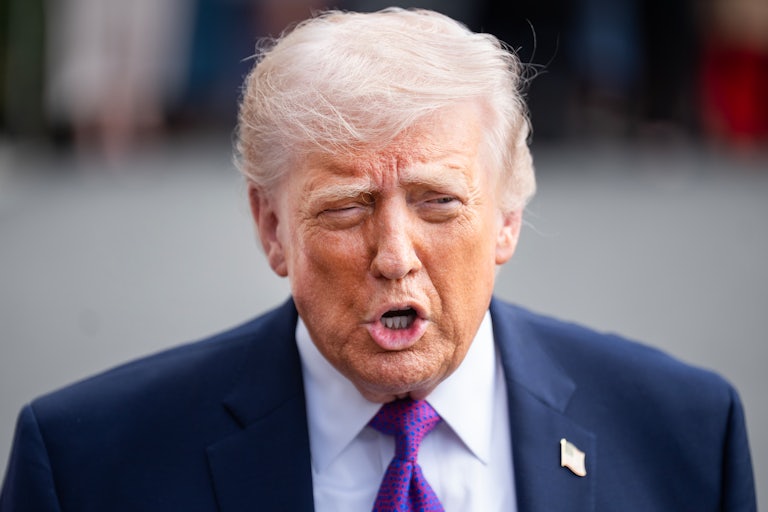
Donald Trump speaks to reporters outside the White House
Tom Williams/CQ-Roll Call, Inc/Getty Images

President Donald Trump has doubled down on playing dumb about killing dozens of school-age girls in Iran.

Outside the White House Wednesday, a reporter asked Trump about a new U.S. military report that found the United States was responsible for a deadly missile strike on a girls’ primary school miles from Tehran. The strike killed 175 people, many of them young girls.

“As commander in chief do you take responsibility for that?” the reporter asked.

“That is—what? What did you—? For what?” Trump said, as a helicopter whirred loudly behind him. The reporter repeated the question.

“I don’t know about it,” Trump said before moving on.

Earlier this week, Trump spoke at length about a report that the strike had involved a Tomahawk missile—a weapon primarily used by the U.S. military—and claimed Iran could be behind it. When pressed on his accusation, he admitted: “I just don’t know enough about it.”

Trump said Saturday that it was his “opinion” that the strike was done by Iran. “They’re very inaccurate, as you know, with their munitions,” he said while on Air Force One. Defense Secretary Pete Hegseth, who stood lurking behind the president, had done his best to dodge the question, saying that the strike was under investigation, “but the only side that targets civilians is Iran.”

The New York Times reported that the February 28 strike on Shajarah Tayyebeh, a girls’ primary school in Minab, was due to a targeting error by the U.S. military as it conducted a strike on the Iranian Revolutionary Guard Corps naval base next door.

U.S. Central Command determined the target using outdated data provided by the Defense Intelligence Agency, people briefed on the investigation told the Times. Satellite images from 2013 showed that the school was previously connected to the IRGC naval base, while more recent satellite images from 2016 showed that the school had been separated from the base by a wall.

Unesco condemned the attack on Shajarah Tayyebeh as a grave violation of international law, which prohibits attacks on schools. But evidently Trump is uninterested in taking responsibility—or accountability—for the brutal war crime.

FBI Warns Iran May Attack California as Trump Stays Silent

The FBI says Iran may be planning a retaliatory attack.

President Donald Trump stands at a podium
SAUL LOEB/AFP/Getty Images
President Donald Trump speaks during a press conference at Trump National Doral in Miami, on March 9.

The FBI warned police departments in California that Iran may be planning a retaliatory drone strike on the state.

“We recently acquired information that as of early February 2026, Iran allegedly aspired to conduct a surprise attack using unmanned aerial vehicles from an unidentified vessel off the coast of the United State Homeland, specifically against unspecified targets in California, in the event that the US conducted strikes against Iran,” a memo obtained by ABC News read. “We have no additional information on the timing, method, target, or perpetrators of this alleged attack.”

The FBI offered no other specifics, and the White House also refused to publicly comment.

“We know Iran has an extensive presence in Mexico and South America, they have relationships, they have the drones and now they have the incentive to conduct attacks,” former Obama administration DHS secretary John Cohen told ABC. “The FBI is smart for putting this warning out so that state and locals can be better able to prepare and respond to these types of threats. Information like this is critically important for law enforcement.”

In a separate warning, Iran’s Islamic Revolutionary Guard Corps on Wednesday threatened to attack U.S. tech companies like Google and Nvidia, both of which are headquartered in California.

White South Africans Flee the U.S. Despite Trump’s Refugee Program

Thousands of Afrikaners are happier not living in the United States.

A white South African woman holds a small blonde child waving a U.S. flag. Other white South african children and adults stand near them.
Chip Somodevilla/Getty Images
South Africans listen to representatives from Homeland Security and the State Department after arriving at Washington Dulles International Airport, on May 12, 2025.

Donald Trump claims that white South Africans face persecution and set up a refugee program to help them immigrate to the United States last year, a remarkable exception in his ban on all other refugees. But in reality, many of them are now returning to South Africa.

In November, the South African government set up a portal for people to check their citizenship status after repealing a law that revoked the citizenship of some South Africans who left the country. So far, 12,000 people have used the portal, and at least 1,000 people have reclaimed their citizenship, the country’s Home Affairs Minister Leon Schreiber ​told Reuters.

“There is definitely a sense of optimism for South Africans abroad,” Schreiber told Reuters. He’s part of the white-led Democratic Alliance party, which has ruled in coalition with the dominant African National Congress for the last two years.

Many of those returning to South Africa are leaving the United States, citing the political situation under the Trump administration. “People are being shot in broad daylight. American citizens are being shot and killed,” 53-year-old Andrew Veitch told Reuters, referring to ICE’s attacks in Minneapolis and elsewhere. “I don’t want to live in a place like this.” Veitch, who moved to California in 2003 after being held up at gunpoint in his car, plans to move back to South Africa later this year.

Trump’s program has taken in 3,500 South Africans since it began in May 2025, with applicants complaining to Reuters that they were victims of racially motivated crime and job discrimination due to employment equity laws attempting to correct decades of racial apartheid that disenfranchised South Africa’s Black majority.

Statistically speaking, though, the unemployment rate in South Africa is 35 percent for Black people as opposed to 8 percent for whites, according to government data. Farm murders, an issue that Trump has highlighted using false information, are actually higher for Black South Africans, as well.

Despite Trump’s best efforts, recruitment agencies are seeing increases in white South Africans overseas interested in finding jobs in the country. Others are interested in returning due to the lower cost of living and scoff at Trump’s claim that they would face a “genocide.”