Breaking News
Breaking News
from Washington and beyond

DOJ Spent Months Emailing Wrong Address in Quest for 2020 Revenge

Donald Trump has attempted to seize voter rolls in multiple states.

Two people vote at a polling station in Oklahoma City
Brett Deering/Getty Images
A voting location in Oklahoma City

Donald Trump’s Department of Justice spent weeks emailing its request for Oklahoma’s voter rolls to the wrong email address. Then it sued Oklahoma for not complying. 

It began in December, when Department of Justice officials wrote a letter demanding that Oklahoma Secretary of State Paul Ziriax turn over the state’s voter registration lists, Democracy Docket reported Thursday.  

There was already a problem: Paul Ziriax isn’t Oklahoma’s secretary of state, and never has been. He is actually the secretary of Oklahoma’s State Election Board. And somehow, that isn’t even the DOJ’s biggest blunder in this tale. 

The agency didn’t hear back, so it sent another email, and then another. Nothing.  

In late January, DOJ officials finally got a response from Oklahoma election official Misha Mohr, who said that her office had only just received the previous emails. 

“The email address was misspelled on the previous correspondence,” she wrote. Instead of sending messages to “info” at the Oklahoma State Election’s office, the government had addressed their demands to “ifo” at the same mail server. 

This gaffe is part of a wider trend of unprecedented prosecutorial missteps by Trump’s Department of Justice, undermining numerous civil and criminal cases. A recent filing included misspelled versions of “voters,” “emergency,” and “United States.” Another filing repeatedly misspelled the name of an elected official. 

The federal government has sued Washington, D.C., and 29 states—including Oklahoma—for not complying with its demands to turn over voter registration forms. Twelve states have provided or pledged to provide the government voter registration lists, with information including license plates and Social Security numbers. Federal judges in California, Michigan, and Oregon have rejected the federal government’s claim to the troves of voters’ personal data. 

Improper disclosure of this highly sensitive information could violate state and federal laws, and raises concerns about risks to Americans’ security and privacy. And clearly, the Trump administration has been less than careful with Americans’ Social Security information. 
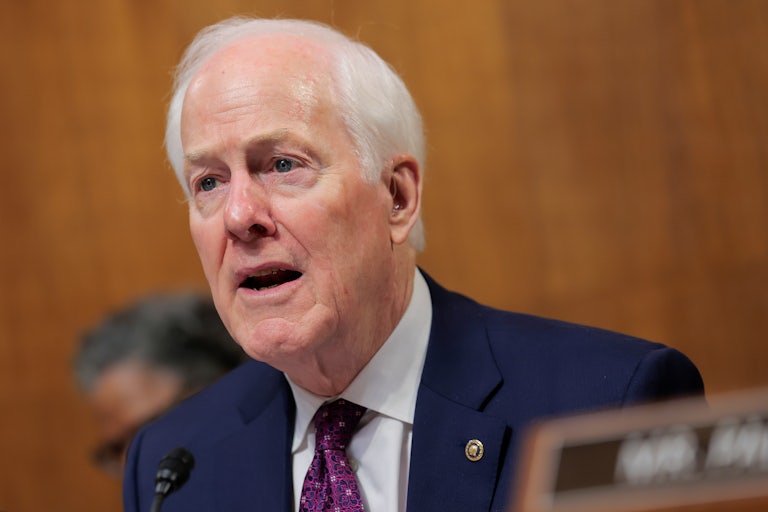
Watch This GOP Senator Learn in Real Time Why the SAVE Act Is Bad

Have Republicans even read the SAVE Act that the president so desperately wants to pass?

Senator John Cornyn
Heather Diehl/Getty Images
Senator John Cornyn

Republican Senator John Cornyn got a firsthand lesson in why the SAVE Act, backed by President Donald Trump, would suppress votes if passed.

At a Senate Judiciary hearing Thursday, Cornyn said, “I don’t understand how [the SAVE Act] could disenfranchise millions of Americans. Maybe you could explain.” His Democratic colleague, Dick Durbin, was happy to oblige. After thanking Cornyn for his question, Durbin explained that the voter ID requirements of the bill are not satisfied by a driver’s license, but only a passport.

“Fifty percent of Americans do not have a passport. Those who want to obtain it so they can vote will pay $186 and wait three or four weeks for that to happen,” Durbin said. “Secondly, you can use a birth certificate, but any person who has changed their name as a result of a marriage … has to find not only their birth certificate but some correction of it to prove that they are eligible to register to vote.

“It’s estimated that 9 percent of the voters in America do not have the identification required by this bill. It means that, ultimately, those people will not be voting. And I think that is the ultimate goal of this administration,” Durbin continued. This was news to Cornyn, who asked if these concerns could be addressed by the amendment process. Durbin responded, “When’s the last time we amended a bill?”

Durbin is correctly pointing out that the SAVE Act seems designed to make it harder to voteparticularly for lower-income Americans and married women who change their names—rather than to tackle voter fraud, which is practically nonexistent anyway. Trump administration officials, such as White House press secretary Karoline Leavitt, have admitted as much. Meanwhile, Trump has made it his priority over everything else, even stuff Americans want, because he wants to rig elections in his favor.

Trump Team Freaks Out Over CBS’s Newest Hire

Donald Trump apparently thinks he also runs CBS News.

The CBS News logo
Spencer Platt/Getty Images

The White House is weighing in on the internal affairs of private business—again.

Trump administration officials are reportedly seething that CBS News hired Jeremy Adler, a communications executive who previously worked for former Wyoming Representative Liz Cheney, according to insiders that spoke with Axios Thursday.

Cheney, a lifelong Republican and the daughter of former Vice President Dick Cheney, stood out among her caucus for her unrelenting critiques of Donald Trump’s performance during his first term. She was one of 10 House Republicans who voted to impeach Trump, repeatedly rejected Trump’s 2020 election conspiracy, and served as the vice chair of the House committee that investigated the January 6 Capitol riot.

Exactly how Adler’s affiliation with Cheney would prevent him from functioning as a communications executive for the news network is not clear, but nonetheless, the decision did not sit well with the people surrounding the president.

Further, the administration’s public derision at Adler’s appointment once again flouts the free-market philosophy that Republicans have championed for decades, highlighting the growing differences between Trump’s MAGA agenda and the larger conservative party.

“The idea CBS would hire Liz Cheney’s flack who has worked to jail President Trump and make it impossible for anybody who supported the president to get hired is insanity. What the hell is Bari Weiss thinking?” a White House official told Axios.

Weiss, the founder of the pro-Israel blog The Free Press and a former New York Times opinion columnist, was tapped as the newsroom’s newest chief late last year, despite the fact that she had never worked in broadcasting, lacked traditional reporting experience, and had never run a major news operation.

In a few short months, her business decisions atop the network have unequivocally and single-handedly divorced CBS News from its decades-long place within America’s prestige news media circuit.

What was once crowned the “gold standard” of broadcasting, and the home of some of journalism’s most venerable names, such as Walter Cronkite and Edward R. Murrow, has since devolved into a graveyard for journalism ethics.

Under Weiss’s stewardship, CBS News has killed critical stories in order to save face for the Trump administration. In December, Weiss pulled the plug on a 60 Minutes segment investigating the result of Trump’s mass deportation program, focusing on Venezuelan immigrants who had been deported to El Salvador’s notoriously brutal CECOT megaprison.

The network has also lost a cadre of veteran journalists, whom Weiss replaced with the likes of Peter Attia (who was ousted from his role as an on-air contributor shortly after his hiring was announced due to his various ties to Jeffrey Epstein).

Yet Weiss’s appointment was merely the cherry on top of a large portion of recent chaos at CBS. In the last year, parent company Paramount undermined itself by settling multimillion-dollar lawsuits with Trump over CBS’s fair and accurate coverage (in an apparent bid to butter up the administration ahead of a multibillion-dollar merger with SkyDance). That resulted in the loss of two storied showrunners, including 60 Minutes producer Bill Owens and CBS News chief Wendy McMahon, who rejected Paramount’s approach to handling the groundless lawsuit.

Air Force General Testifies That Bombing Civilians Always Backfires

Alexus Grynkewich, the top commander of U.S. forces in Europe, testified in Congress on Thursday.

Alexus Grynkewich testifies in Congress.
Anna Moneymaker/Getty Images
General Alexus Grynkewich speaks alongside General Randall Reed during a Senate Armed Services Committee hearing on March 12.

The highest-ranking U.S. commander in Europe told Congress what has been obvious for decades—that bombing civilians is an evil and inhumane tactic that only leads to more long-term problems.  

“What I’ve observed over the course of studying air power in history is that anytime you attack a civilian population, you usually end up finding that it just hardens their resolve,” Air Force General Alexus Grynkewich told the Senate Armed Services Committee at a Thursday hearing regarding Russian assistance to Iran. “We take this all the way back to the London Blitz in World War II. The Brits just had a stiff upper lip and kept on fighting, and I think that’s what we’ve seen in Ukraine, as well.”

While Grynkewich was referring to Russia’s bombing campaign in Ukraine, his statement could be applied to any American act of aggression over the past 20-plus years, from the Iraq War to U.S. support of Israel’s genocide of Palestinians, to the Iranian elementary school bombing that killed more than 100 children. 

Hundreds of Iranian civilians have died in the ongoing war. The same administrations that chastise Iran for chanting “Death to America” are the same ones with no qualms about using American weaponry to kill hundreds of normal people just trying to lead normal lives. If anything, their killings will only lead to further anti-American sentiment and radicalization. You don’t need to be some scholar of military history to recognize that. 

Did Trump Kick Off a Global Food Crisis With Iran War?

The Strait of Hormuz is also a crucial shipping channel for fertilizer.

Donald Trump yells while on stage at an event
Andrew Harnik/Getty Images

The global trade crisis sparked by Donald Trump’s illegal war in Iran may soon become a global food crisis, as farmers facing surging fertilizer prices warn they won’t be able to plant their crops, according to a report from the Carnegie Endowment for International Peace.

Fertilizer prices are rising due to the halt of trade through the Strait of Hormuz, which has been essentially closed since the United States and Israel launched their first wave of attacks on February 28. This abrupt stoppage comes as farmers in the northern hemisphere would typically order fertilizer to arrive next month for the upcoming planting season.

The Trump administration has pushed to resume the flow of energy through the Persian Gulf, but oil wasn’t the only export trapped at sea. One-third of global seaborne fertilizer trade passes through the Strait of Hormuz, and Gulf countries are responsible for producing 13 percent of the world’s fertilizer exports.

Another commodity trapped at the Strait of Hormuz is liquefied natural gas, which is used in the production of nitrogen fertilizers. Twenty percent of all natural gas exports travel through the Persian Gulf’s essential passageway. As a result, the benchmark price of urea, the most common variety of nitrogen fertilizer, surged 30 percent in the last month.

The U.S. produces three-quarters of the fertilizer it consumes, but farmers are concerned about the already record-high prices of materials, which could continue to climb.

In a letter sent to President Donald Trump Monday, the American Farm Bureau Federation warned that the shock to the fertilizer supply chain would drive prices even higher.

“Not only is this a threat to our food security—and by extension our national security—such a production shock could contribute to inflationary pressures across the U.S. economy,” wrote AFBF President Zippy Duvall.

Economists and fertilizer experts anticipate that the disruptions to global trade will further drive up inflation, and the South Carolina Farm Bureau publicly fretted that farmers “are not going to be able to finance planting their crop.”

It appears that Trump’s frivolous military campaign in Iran is threatening to upend the entire northern hemisphere’s food system. That not only includes the United States but also Mexico, Canada, and the European Union, which are the largest agricultural exporters to the United States.

If the Strait of Hormuz remains closed for much longer, it could threaten the entire global agriculture cycle. Smaller agrarian countries that do not produce their own fertilizer would be the first to see widespread crop failures.