Breaking News
Breaking News
from Washington and beyond

Hegseth Bans Reporter Who Covered Aides’ Response to Dead Troops Quip

The Atlantic’s Nancy Youssef said she and all print photographers were blocked from a press briefing.

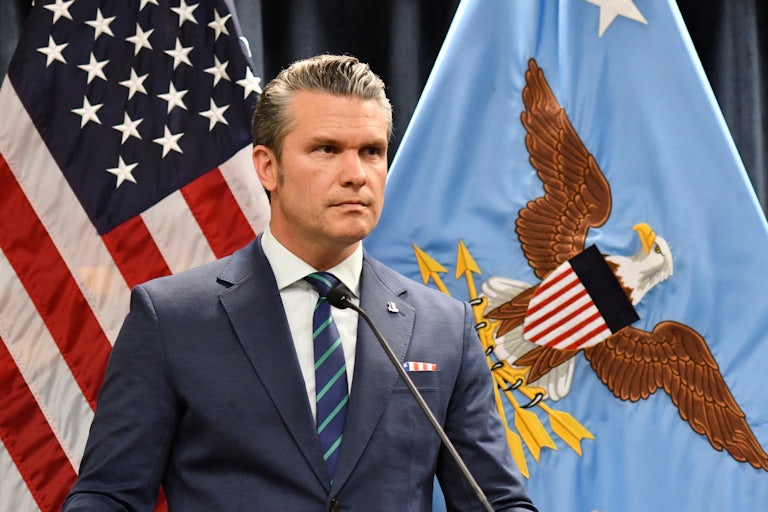
Defense Secretary Pete Hegseth speaks at a microphone during a press briefing
Octavio JONES/AFP/Getty Images

Pete Hegseth’s Pentagon is once again cracking down on the journalists who cover it.

The Atlantic’s Nancy Youssef disclosed Friday that she had been barred from the day’s press briefing, along with a cadre of photographers. The revelation came days after Hegseth’s aides reportedly expressed their dissatisfaction with photographs that had been taken of the secretary since the war with Iran began.

“I, along with print photographers, have been denied entry to cover today’s Pentagon briefing,” Youssef wrote on X. “All other media were allowed in.”

Photographers were also barred from the March 4 and March 10 briefings. Pentagon spokesperson Kingsley Wilson claimed the sudden ban was an attempt to use the room “effectively,” adding that journalists could instead use photographs released by the Defense Department’s own staff.

It was not clear if the ban was permanent, or specifically related to the Iran war briefings.

It’s possible that Youssef was singled out alongside the photographers because she reported on Hegseth’s aides’ reaction to his comment about dead U.S. troops at the start of the war. During a press briefing on March 4, Hegseth claimed that the press was only reporting on the deaths of American soldiers in order to “make the president look bad.”

Youssef, who was present for the briefing, later told her colleague that Hegseth’s comment “sent a stunned silence through the briefing room.” Some members of Hegseth’s staff appeared to flinch at what he was saying, she said, while others ducked their heads.

Youssef said that one person quietly but audibly remarked: “That was one of the most insulting things I have ever heard.”

Hegseth—a former Fox News anchor—has had nothing short of a contentious relationship with the press since he was tapped to run the Pentagon.

Late last year, the defense secretary crafted new rules that required credentialed Pentagon reporters to pledge that they would not report on anything from the department that had not been approved for official release. The new policy, announced in October, forced journalists to choose between reporting government-sponsored propaganda or having their press credentials revoked.

Dozens of journalists walked away from their desks at the Pentagon as a result, refusing to capitulate to Hegseth’s new standard. In turn, Pentagon officials offered those newly vacated spots to conservative outlets ideologically aligned with the Trump administration, including One America News, The Federalist, and LindellTV, a new outlet formed by Mike Lindell, the My Pillow CEO who practically bankrupted himself by broadcasting conspiracies about the 2020 presidential election.

The New York Times sued the department over the restrictions in December, claiming that they “violate the Constitution’s guarantees of due process, freedom of speech and freedom of the press.” In court, Times attorney Theodore Boutrous argued that the public was being “deprived of vital war-based information” in the process.
Hegseth Salivates Over David Ellison’s Planned Takeover of CNN

The defense secretary can’t wait for the planned right-wing takeover of CNN.

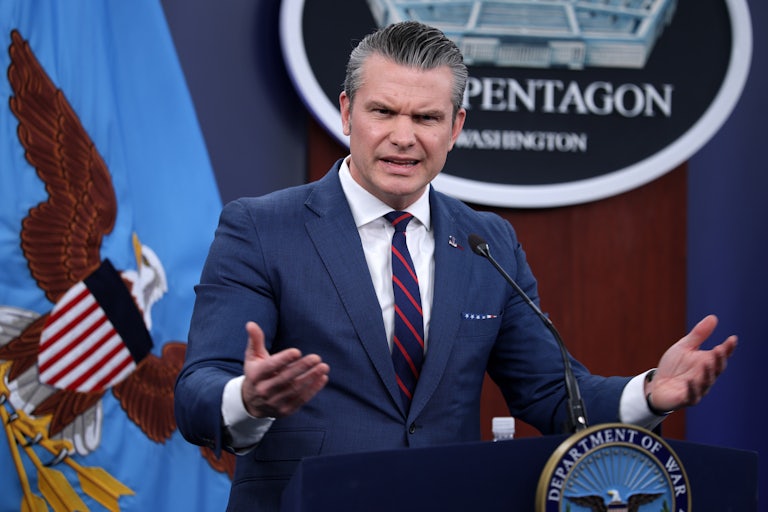
Defense Secretary Pete Hegseth makes a weird face while speaking in a Pentagon briefing.
Alex Wong/Getty Images
Defense Secretary Pete Hegseth speaks during a Pentagon briefing on March 2. Newer photos aren’t up yet since he banned Getty press photographers after that briefing.

Secretary of Defense Pete Hegseth took some pot shots at the media Friday during a press conference and openly salivated over the coming right-wing takeover of CNN.

Hegseth railed against what he described as biased and intentionally misleading graphics and headlines on news reports such as “Mideast War Intensifies,” arguing that such a TV banner should read ‘“Iran Increasingly Desperate’ because they are. They know it, and so do you, if it can be admitted.”

“Or more fake news from CNN: reports that the Trump administration underestimated the Iran war’s impact on the Strait of Hormuz. Patently ridiculous, of course. For decades, Iran has threatened shipping in the Strait of Hormuz,” Hegseth ranted. “This is always what they do, hold the strait hostage. CNN doesn’t think we thought of that. It’s a fundamentally unserious report. The sooner David Ellison takes over that network, the better.”

Hegseth is referring to Trump supporter and billionaire David Ellison’s successful takeover bid for CNN’s parent company, Warner Bros. Discovery, a move that portends a shift to the right for the news network. It’s an open admission that the Trump administration, through its wealthy allies and supporters, is trying to take over the media for more favorable coverage and avenues for propaganda.

To drive the point home, Hegseth criticized another “fake headline that I saw yesterday: War Widening.”

“Here’s a real headline for you, for an actual patriotic press: How about ‘Iran Shrinking, Going Underground’? See, Iran’s leaders are hiding in bunkers and moving into civilian areas. The only thing that is widening is our advantage,” Hegseth said.

The term “patriotic press” alludes to a news media that serves the interests of the Trump administration and U.S. government as opposed to the truth and the public interest. Hegseth and his bosses want a pliant media serving their interests under their control, as evidenced by the fact that they’ve shut out publications that refuse to bend the knee or produce fawning coverage.

Trump’s Inner Circle Is Divided Over Iran War

Donald Trump’s advisers can’t make up their minds over how long to let the war drag on.

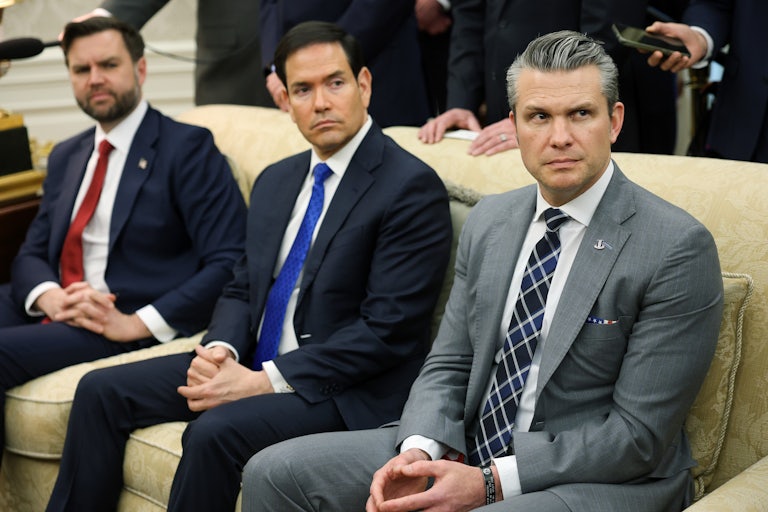
Vice President JD Vance, Secretary of State Marco Rubio, and Defense Secretary Pete Hegseth sit next to each other on a couch in the Oval Office
Win McNamee/Getty Images

Vice President JD Vance appears desperate to create daylight between himself and Donald Trump’s disastrous war in Iran, as the president’s inner circle starts to split over the conflict.

Two senior administration officials who spoke with Politico Friday painted an image of a reluctant vice president who stood by his position against U.S. intervention while sitting courtside to Trump’s military onslaught in Iran.

Vance was “skeptical” of the military campaign and “worried about success,” a senior Trump official said over text message. The vice president “just opposes” the war, they added.

Vance’s role “is to provide the president and the administration, you know, all points of views of what could happen from many different angles and, you know, he does that,” said a second senior Trump official. “But once the decision has been made, he’s fully on board.”

Previous reporting on Vance’s position on the war did not include his supposed skepticism. During a meeting in the Situation Room on February 18, Vance said that if the U.S. did launch a military campaign in Iran, it should “go big and go fast,” people familiar with his remarks told The New York Times.

Several journalists called bullshit on Vance’s sudden change of heart. “Why isn’t he advocating a change in policy rather than leaking to POLITICO about his internal monologue from 2 weeks ago?” wrote The Bulwark’s Tim Miller on X.

Matthew Yglesias suggested on X that “this kind of leaking suggests a White House team that knows things aren’t going to get better soon.”

It’s worth noting that Vance isn’t exactly known for standing by his word. But he is gearing up for a presidential run to succeed Trump in 2028—so an off-ramp to supporting the president’s unpopular war is probably looking pretty good right now.

Vance isn’t alone in looking for an exit: America’s wildly expensive aerial bombing campaign has caused some genuine fractures within the Trump administration, Reuters reported Friday.

Officials from the Treasury Department and the National Economic Council are among those who cautioned Trump that rising gasoline prices could hurt approval for the war at home, an adviser and two others close to decisions told Reuters. Chief of staff Susie Wiles and deputy chief James Blair have also stressed the political fallout of higher gas prices, and urged Trump to say the war is nearly finished.

Trump seems to have taken this to heart as he continues to confusedly claim the war is “won” but that the U.S. must stick around to “finish the job.” On Thursday, he insisted that rising gas prices are actually good, surely a winning political message.

Pete Hegseth Admits They’re Using AI in Iran War

The defense secretary had quite the interesting Pentagon briefing on Iran.

Defense Secretary Pete Hegseth
Octavio JONES/AFP/Getty Images

Defense Secretary Pete Hegseth admitted that the U.S. military is using “every tool of AI” in the war on Iran.

“Every tool of AI, of cyber, of space, EW, counter-UAS, you name it—we’re employing it. Blinding, confusing, and deceiving our enemy. Because we know who the good guys are here. And the American people do too. And that makes my job simple,” Hegseth said at a Friday news briefing. “I serve God, the troops, the country, the Constitution, and the president of the United States. And answer only to those, all in service of victory on the battlefield.”

Hegseth touches on all the hits—good guys versus bad guys; we’re doing this for Jesus Christ and George Washington—while weaving in the implementation of the pernicious AI technology that the government is paying for. Was it AI that bombed a school full of children?

This commitment to using “every tool of AI” also comes just a day after Palantir CEO and government contract–holder Alex Karp declared that his technology would hurt “humanities-trained—largely Democratic—voters,” and help “vocationally trained … often male, working-class voters.”

Damning Report Reveals White House Winging It on Iran War

The Trump administration overlooked a major worst-case scenario.

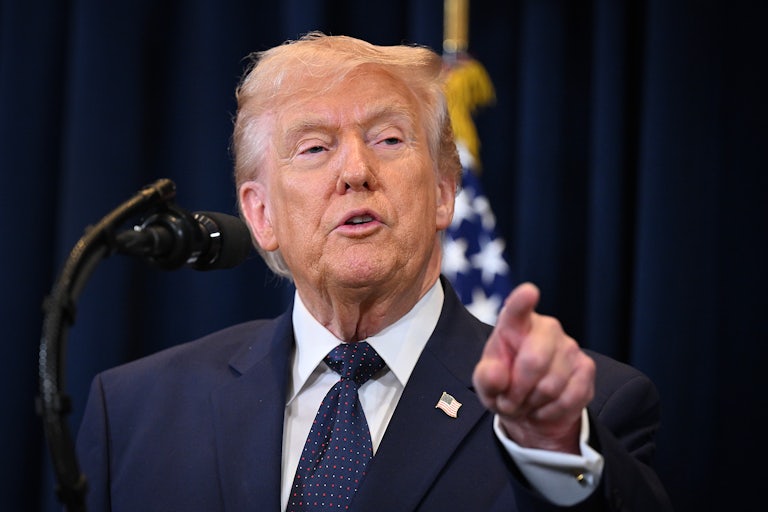
Donald Trump points while speaking
Roberto Schmidt/Getty Images

The Trump administration seems to have been caught off guard by Iran’s ability to close the Strait of Hormuz, once again showing a glaring lack of planning.

CNN reports that President Trump’s national security team wasn’t prepared for a worst case, but somewhat predictable scenario for the war. Analyses from the Treasury and Energy Departments forecasting economic and oil market impacts also weren’t prioritized like they were in previous administrations, unnamed sources told the news outlet.

Meanwhile, six U.S. servicemembers were confirmed dead after a refueling plane crashed in western Iraq Thursday, bringing the official death toll of U.S. military personnel to 13 since the war began February 28.

Trump depended on a small circle of close advisers in deciding to attack Iran, which effectively marginalized discussion and debate within the government over what could happen if Iran took action to close the strait. Now, the White House could spend weeks trying to mitigate the shock to the U.S. and international economy. Oil tankers are stuck in the Persian Gulf, and using the U.S. Navy to escort them out is considered too risky.

Shipping companies have requested naval escorts from the U.S., which has so far turned them down. Diplomats from other countries, business executives, and former government officials are reportedly confused and stunned at the White House’s failure to account for the strait’s closure.

“Planning around preventing this exact scenario — impossible as it has long seemed — has been a bedrock principle of US national security policy for decades,” said one former U.S. official, who has served Democratic and Republican administrations. “I’m dumbfounded.”

White House officials have even tacitly admitted to members of Congress that they didn’t plan for Iran possibly closing the strait as retaliation for U.S. and Israeli airstrikes, sources told CNN. These officials reportedly thought Iran would think closing it would hurt them more than the U.S., especially considering Iran didn’t close the strait during last year’s U.S. strikes.

Now, Iran’s new supreme leader Mojtaba Khamenei said in a statement Thursday that the strait will remain closed as a “tool of pressure.” At the same time, Iran is successfully destroying U.S. missile defenses in the region, and American missile stockpiles are dwindling. Trump’s lack of planning is not only causing ongoing damage to international markets and the U.S. economy, but also putting U.S. troops and interests in harm’s way as this war continues on.

This story has been updated.