Breaking News
Breaking News
from Washington and beyond

Tulsi Gabbard Says U.S. and Israel Have Very Different Goals in Iran

The director of national intelligence testified under oath that Israel isn’t aligned with the Trump administration on the endgame in the Iran war.

Director of National Intelligence Tulsi Gabbard testifies in Congress.
Heather Diehl/Getty Images
Director of National Intelligence Tulsi Gabbard testifies during a House Select Intelligence Committee hearing, on March 19.

National Intelligence Director Tulsi Gabbard admitted that there are key differences in the Israeli and U.S. goals in their joint war on Iran.

At a House hearing on Thursday, Democratic Representative Joaquin Castro asked Gabbard, CIA Director John Ratcliffe, and a panel of other intelligence operatives if the U.S. and Israel are “aligned” on the war. Gabbard used a lot of words to confirm that the answer was essentially “no.”

“The objectives that have been laid out by the president are different from the objectives that have been laid out by the Israeli government,” Gabbard testified. “We can see through the operations that the Israeli government has been focused on disabling the Iranian leadership and taking out several members, obviously beginning with the ayatollah, the supreme leader, and they continue to focus on that.”

“How does that differ from our goals?” Castro continued.

“The president has stated that his objectives are to destroy Iran’s ballistic missile–launching capability, their ballistic missile production capability, and their navy, the IRGC navy, and mine-laying capability,” Gabbard replied.

While both options are destructive, it seems that the stated Israeli objective is a long, drawn-out regime change war—as Prime Minister Benjamin Netanyahu has been pushing for for decades—while the United States, at least initially, seemed to leave the option of an off-ramp open. These two competing aims can only coexist for so long.

Trump Says Surging Iran War Cost Is Worth Keeping Military “Tippy-Top”

Meanwhile, food and gas prices for Americans continue to rise.

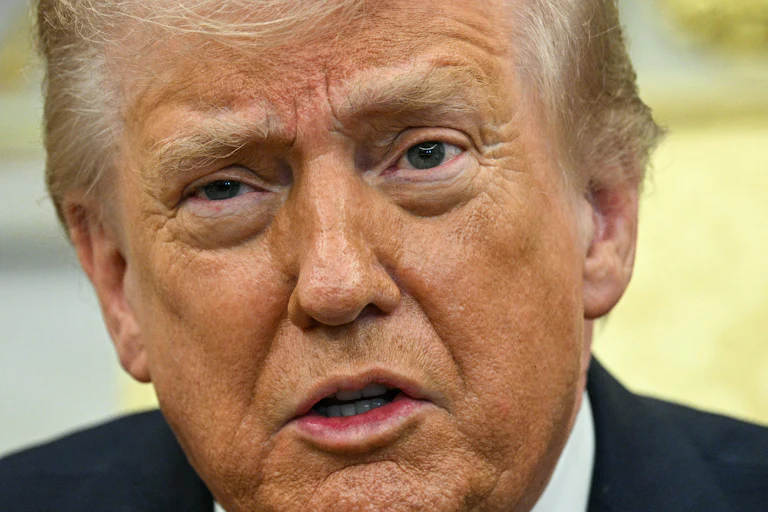
Donald Trump speaks to reporters in the Oval Office
Jim WATSON/AFP/Getty Images

Donald Trump claimed Thursday that $200 billion more going to an unpopular, illegal overseas war wasn’t all that big a deal.

During a White House meeting with Japanese Prime Minister Sanae Takaichi, Trump was asked about the Pentagon’s request to Congress for $200 billion to support the ongoing war in Iran. The request was first reported on Wednesday by The Washington Post.

After waffling about how good U.S. anti-air equipment was at shooting Iranian missiles down, Trump said that the money was “a small price to pay to make sure that we stay tippy-top.”

The Pentagon’s request may struggle to pass Congress, as even some Republicans are beginning to balk at the amount being spent on the unpopular war.

The first six days of the war cost taxpayers over $11.3 billion. In addition to this $200 billion request, Trump has petitioned Congress to increase the defense budget by $500 billion to $1.5 trillion in 2027, which would be by far the highest figure ever. (The Pentagon has yet to submit its official 2027 budget request.)

It all looks like a slap in the face for average Americans, who face a struggling economy at home: Inflation is rising, job creation is low, and gas prices are through the roof. Trump has blown through the money saved by cutting medical research grants and food bank programs, leaving “America First” feeling more and more like a pipe dream.

U.S. Fighter Jet Struck as Trump Brags Iran Is “Close to Demolished”

A jet had to make an emergency landing after being struck by what is believed to be Iranian fire.

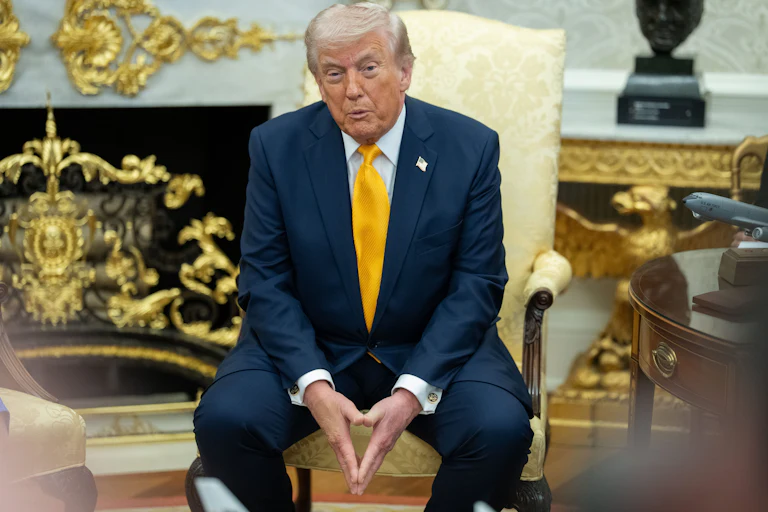
Donald Trump puckers his lips while speaking to reporters. He is seated in an armchair in the Oval Office and has his fingertips pressed together between his legs.
Aaron Schwartz/CNP/Bloomberg/Getty Images

As President Donald Trump bragged once again Thursday about how the war was essentially over, Iran is believed to have hit its first U.S. military jet since the war began.

A U.S. military aircraft flying a combat mission was struck by what is suspected to be an Iranian missile and forced to make an emergency landing in the Middle East. A U.S. F-35 fighter jet costs upward of $100 million. “The aircraft landed safely, and the pilot is in stable condition,” said Capt. Tim Hawkins, a spokesperson for the U.S. Central Command. “This incident is under investigation.”

Additionally, fallen shrapnel struck the Bazan oil refinery in Haifa, Israel, but did not cause “significant damage,” according to Israel’s energy minister. The Iranian Revolutionary Guard Corps said that it had targeted refineries across Israel, but it wasn’t clear if another refinery had been hit.

While Iran continued to launch retaliatory attacks, Trump continued to claim a premature victory.

Speaking to Japanese Prime Minister Sanae Takaichi Thursday, Trump once again bragged about the destruction of Iran’s military capability.

“We’ve demolished—their country is close to demolished,” Trump said. “The only thing is the Strait. It’s very hard, you could take two people and they could drop little bombs in the water, and they’re holding things up. But we don’t want that to happen.”

Trump was referring to the Strait of Hormuz, where global trade has come to an abrupt halt due to the threat of Iranian strikes and mines.

Kash Patel Plays Dumb About Firing Iran Experts Days Before War

The FBI director had a tough time testifying before a House committee.

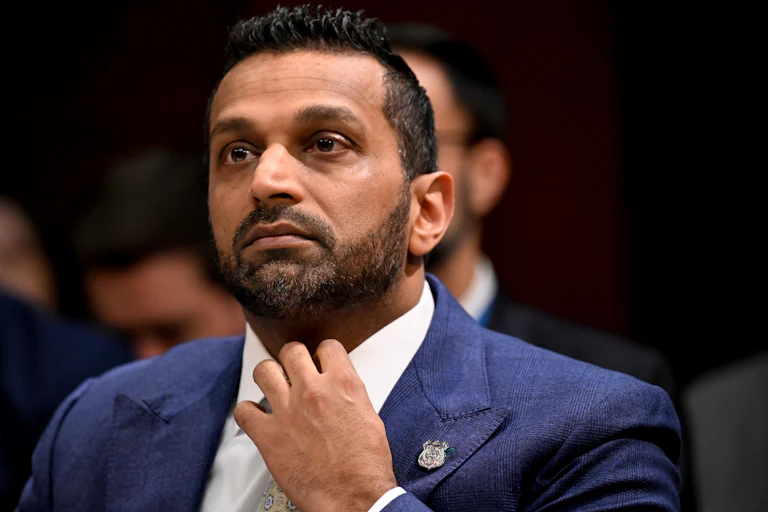
Kash Patel adjusts his tie
Daniel Heuer/Bloomberg/Getty Images
FBI Director Kash Patel testifies during a House Intelligence Committee hearing, on March 19.

FBI Director Kash Patel doesn’t want to take responsibility for his decision to fire an entire team of Iran experts days before the Trump administration attacked the country.

On Thursday, Patel was called to testify about national security before the House Select Committee on Intelligence, and Democratic Representative Steve Cohen confronted Patel and asked him when he knew about the administration’s plans to attack Iran.

Initially, Patel said that he’d answer that question in a classified setting, but when Cohen pressed him further, he admitted he knew more than a month before. Cohen then got to the heart of the problem.

“With that knowledge, why did you fire at least a dozen agents in Counterintelligence Unit 12 that specializes in Iran counterintelligence, which makes us much less secure and safe with this war going on from Iranian attacks potentially against our country?” the Tennessee congressman asked.

“I don’t work on timelines when these terminations occur,” Patel replied, saying the firings were the result of unethical or inappropriate behavior. Cohen pressed Patel on whether the people fired were Iran experts, to which Patel said he didn’t believe so.

“They worked in counterintelligence, did they not?” Cohen replied, his voice rising. Patel replied, “I’m taking you at your word sir, I’m not familiar with—”

“You’re the director, I’m not,” Cohen interrupted. “You should know the answer. You fired the people. Where did they work?”

Patel said that the employees were fired for ethical violations, to which Cohen asked if those ethical violations concerned classified documents found in Donald Trump’s bathroom at Mar-a-Lago. Patel said he wouldn’t comment on pending litigation.

It’s hard to believe Patel was intimately familiar with the employees’ ethics violations but had no information about what their jobs even were. Throughout his tenure at the FBI, Patel has done little but promote himself, party on the taxpayer’s dime, and give Trump whatever he wants, including revenge for the bureau’s criminal investigations into the president. Evidently, protecting the American public from threats is a lesser priority.

Japanese P.M. Visibly Uncomfortable as Trump Makes Pearl Harbor Joke

President Trump made the joke in an official White House meeting.

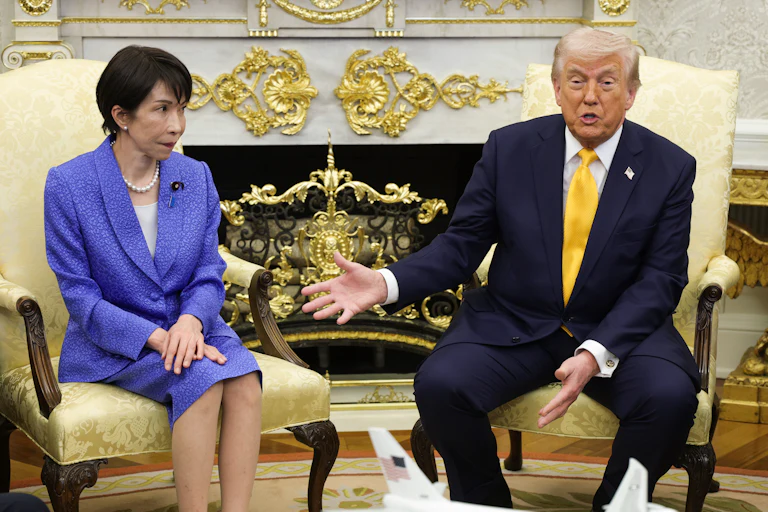
Japanese Prime Minister Sanae Takaichi looks on as Donald Trump speaks and points to her.
Alex Wong/Getty Images
Japanese Prime Minister Sanae Takaichi listens as Trump speaks during a bilateral meeting in the Oval Office of the White House, on March 19.

On Thursday, President Trump was asked why he didn’t warn Japan before he decided to attack Iran last month. His response, in front of Japanese Prime Minister Sanae Takaichi: “Who knows better about surprise than Japan?” 

“Japan and U.S. are very good friends. But … why didn’t you tell U.S. allies in Europe and Asia like Japan about the war before attacking Iran?” a Japanese reporter asked Trump during his meeting with Takaichi. “We are very confused.” 

“Well one thing, we didn’t wanna signal too much, you know? When we go in, we went in very hard, and we didn’t tell anybody about it because we wanted surprise,” Trump replied. “Who knows better about surprise than Japan? Why didn’t you tell me about Pearl Harbor? OK?” Trump said in jest.

The dark joke got some laughs and one sigh. Takaichi looked visibly tense, and struggled to keep the smile she had previously maintained on her face. 

Trump was of course referring to Japan’s 1941 surprise attack on the U.S. Pearl Harbor naval base in Oahu, Hawaii, which killed 2,403 U.S. servicemen and civilians and led to the U.S. entry into World War II. This attack—and U.S. propaganda about it—resulted in a flourishing of anti-Japanese racism at home, including “jap hunts” and the brutal forced internment of about 120,000 Japanese people on the West Coast of the U.S.  

The U.S. knows something about surprise too. It ended the war by dropping two atomic bombs on the Japanese cities of Hiroshima and Nagasaki, killing more than 200,000 civilians in one of the most abominable crimes of war in human history. But things might not have been so funny anymore had Takaichi mentioned that.