Breaking News
Breaking News
from Washington and beyond

Even Republicans Flip Out After Classified Pentagon Briefing on Iran

The Pentagon isn’t properly briefing members of Congress on its plans in the Iran war.

Representative Mike Rogers in a congressional hearing.
Ting Shen/Bloomberg/Getty Images
Representative Mike Rogers, a Republican from Alabama and chairman of the House Armed Services Committee, speaks during a hearing on March 29, 2023.

Prominent Republicans are bristling at the Trump administration’s opaque Iran war plans, particularly after a closed-door briefing of the House and Senate Armed Services Committees on Wednesday.

Alabama Representative Mike Rogers, the Republican chair of the House committee, told reporters after the briefing that the Pentagon wasn’t providing sufficient information about its aims in the Middle East.

“We want to know more about what’s going on, what the options are, and why they’re being considered,” Rogers said. “We’re just not getting enough on those questions.”

Rogers added that the Pentagon did not answer general questions about the additional 3,000 troops and over 2,000 Marines that the administration is sending to Iran. There are already roughly 50,000 U.S. troops in the area, despite Trump telling reporters last week that he’s “not putting troops anywhere.”

“We just wanted them to tell us what’s the plan, and we didn’t get any answers,” Rogers said. “I understand they can’t give us—they shouldn’t give us—specific operational details. But generally, we should be able to get more texture than we’re receiving from them.… This is a consistent pattern of tagging the base and saying, ‘We came over and briefed you.’ But they’re not telling us things, substantive things.”

Politico’s Connor O’Brien asked the chair of the Senate Armed Services Committee, Republican Roger Wicker, what he thought of Rogers’s remarks.

“Let me put it this way, I can see why he might have said that,” Wicker replied.

But the always-vocal Nancy Mace was the most furious Republican after the briefing. Mace wrote a number of posts on X criticizing both the war and the government’s unclear objectives.

“Just walked out of a House Armed Services briefing on Iran,” read one post. “Let me repeat: I will not support troops on the ground in Iran, even more so after this briefing.”

Another of Mace’s posts elaborated: “The justifications presented to the American public for the war in Iran were not the same military objectives we were briefed on today in the House Armed Services Committee. This gap is deeply troubling. The longer this war continues, the faster it will lose the support of Congress and the American people.”

The comments are a welcome turn against an illegal, unpopular war. But let’s not forget that all three lawmakers were supportive of Trump’s decision to strike Iran in February.

“History will record this night,” Mace wrote after the first U.S. missiles fell. “America and Israel did not flinch and did not negotiate with darkness.”

White House Declares Mission Accomplished on Regime Change in Iran

Meanwhile, the clerical leadership and Revolutionary Guard Corps still hold power.

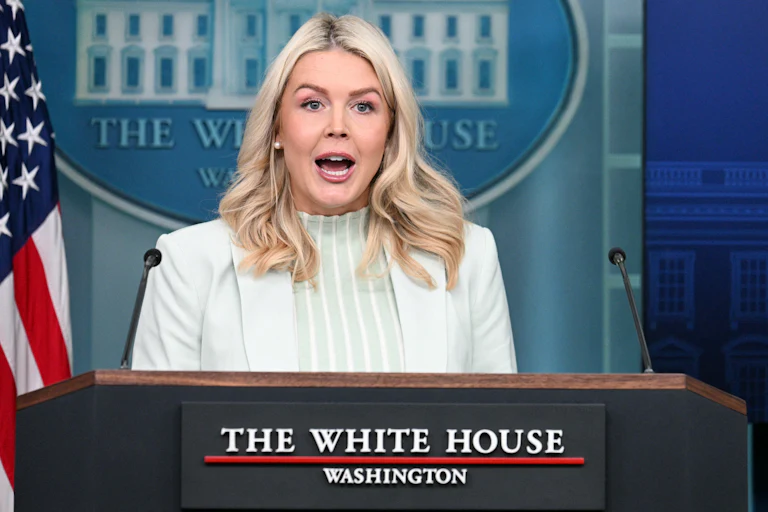
Karoline Leavitt stands behind a podium speaking vehemently
Jim Watson/AFP/Getty Images
White House press secretary Karoline Leavitt speaks during a press briefing in the White House on March 25.

The next time White House press secretary Karoline Leavitt wants to double down on one of Donald Trump’s dubious claims, she should really consult a dictionary first.

During a press briefing Wednesday, Leavitt was asked about Trump’s comments the day before when he claimed that regime change had been achieved in Iran.

“I mean, has it not?” Leavitt replied, smirking. “Their entire leadership has been killed. And nobody has really seen, or legitimately heard from this alleged new leader. So, wouldn’t you say there has been a change in the regime?”

“There has been a change in the leadership,” the reporter replied.

“There’s been a change in the regime leadership, which is what the president said. So, thank you for confirming he was right,” Leavitt said.

Former national security adviser John Bolton—and everyone else with a high school education—disagrees with that assessment.

“The faces may change, but the ideology remains the same,” Bolton told CNN’s Anderson Cooper on Tuesday. “The regime will change when the ayatollahs and the Revolutionary Guard are gone, and we’re not at that point yet, quite obviously. But it’s another way for him to say that we have won the objective and therefore are victorious and can leave.”

The Iranian Revolutionary Guard Corps has only consolidated power after the U.S. and Israel launched a series of brutal airstrikes that killed members of the Iranian regime, The Washington Post reported last week.

After Ayatollah Ali Khamenei was killed earlier this month, his son Mojtaba Khamenei, a hard-line cleric, was tapped to replace him. Trump has claimed that Khamenei is not an acceptable replacement but admitted he would be open to working with another religious leader. His own remarks revealed what was already clear: that his administration has no plan for a postwar Iran.

Trump Gushes Over ICE Agents’ “Much Larger, and Harder” Muscles

The president seems to have a fantastical impression of his immigration agents.

Two ICE agents wearing camoflage flak jackets stand in an airport terminal.
Michael M. Santiago/Getty Images
ICE agents patrol LaGuardia Airport, on March 24, in New York City.

President Trump claimed on Wednesday that “the public is loving ICE.” In reality, Immigration and Customs Enforcement’s approval ratings are actually the lowest they’ve ever been.

“I am so proud of our ICE Patriots! They were unfairly maligned by the Lunatic Democrats for years, and now, at the Airports, in addition to what they are supposed to be doing, they are helping people with bags, even picking up and cleaning areas. They are so proud to be there!” Trump wrote on Truth Social. “The Public is loving ICE, so the Democrats, unwittingly, did us a favor—They are Great American Patriots, they just happen to have much larger, and harder, muscles than most—which is what they’re supposed to have.”

The public is not loving ICE. Recent polling from YouGov shows that a record-high 50 percent of Americans either somewhat or strongly support abolishing the agency entirely.

Opposition to abolishing ICE is now at its lowest levels ever, dropping from 45 to 39 percent since January. The majority of Americans still think of masked men banging down doors and killing Renee Good and Alex Pretti in the street when they think of ICE.

It’s also hard to ignore this strange comment on “larger” and “harder” muscles, something that is clearly more fantasy for Trump than reality.

“Great. Ok @realDonaldTrump, I’m game. Let’s make the November election a referendum on this issue, and ONLY this issue—If you love ICE and love what ICE is doing, vote Republican,” wrote “Never Trump” Republican and former Representative Joe Walsh on X. “If you don’t love ICE and don’t love what ICE is doing, vote Democrat. Simple. I like our odds …”

Meta and Google Found Liable in Landmark Social Media Addiction Trial

This is the first ruling of its kind—holding the tech companies responsible for deliberately creating addictive apps.

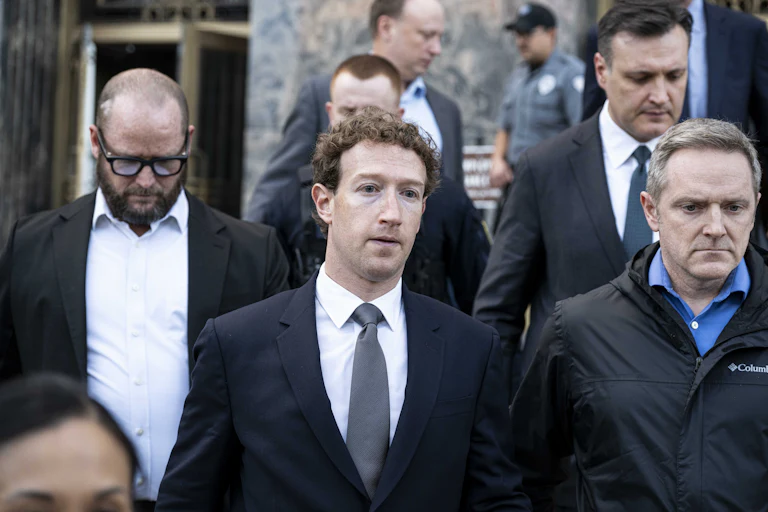
Meta CEO Mark Zuckerberg looks worried as he leaves court alongside other men.
Jon Putman/Anadolu/Getty Images
Meta CEO Mark Zuckerberg leaves the federal courthouse in downtown Los Angeles after defending the company in a landmark social media–addiction trial, on February 19.

In a landmark ruling that could affect thousands of future cases, Google and Meta were found liable Wednesday for inducing depression and anxiety in a woman who obsessively used social media as a child. It was the first jury trial in which tech companies were sued over the addictive nature of their social media apps. Google and Meta own the apps YouTube and Instagram, respectively.

The California jury ruled that the companies should award the woman a total of $3 million in damages, with Meta paying 70 percent of the fee.

The plaintiff, a 20-year-old woman identified as Kaley, said she began using YouTube at age 6 and Instagram at age 11. Her lawyers contended that the social media apps were intentionally addicting, and that both companies knew they were creating mental health issues in children. They presented an internal memo from Meta that detailed how 11-year-olds were four times more likely to use Instagram than rival apps. This contradicts Instagram’s own terms, which require users to be at least 13.

Lawyers for Google and Meta argued that their apps were being unfairly blamed for broader mental health problems in adolescents. Both companies are expected to appeal the decision.

The owners of Snapchat and TikTok, two more popular social media apps, reached pretrial settlements with the plaintiff back in January.

The ruling will likely impact roughly 2,000 ongoing lawsuits against social media companies. The suits, filed by parents and school districts around the country, similarly allege that the tech behemoths should be punished for getting children addicted to their services.

This story has been updated.

Trump Makes Shocking Carve-Out in Cruel Cuba Fuel Blockade

Public institutions continue to be blocked from receiving oil and gas.

Two men on the left stand behind dozens of plastic bottles waiting to be filled with water in a street in Havana, Cuba.
AMIL LAGE/AFP/Getty Images
People queue to fill their water containers in Havana during a national blackout on March 22 caused by the U.S. oil blockade.

President Donald Trump has been facilitating shipments of oil to private businesses in Cuba while cutting off government-run institutions for months.

Since capturing Venezuelan President Nicolás Maduro in January, the United States has barred Cuba from receiving any Venezuelan oil and threatened any countries that export oil to the island country. But since early February, the U.S. has exported 30,000 barrels of oil to Cuba’s small but important private sector, Reuters reported Wednesday.

This means that while private businesses, like foreign-owned hotels, will receive a boon amid the ongoing blockade, state-run entities will suffer. Speaking to NBC News’s Meet the Press Sunday, Cuba’s Deputy Foreign Minister Carlos Fernández de Cossío called Trump’s fuel policy an “energy asphyxiation,” and claimed it had already caused mass disruptions to Cuba’s health care system.

Secretary of State Marco Rubio said this is all part of the plan. The policy was “entirely designed to put the private sector and individual private Cubans—not affiliated with the government, not affiliated with the military—in a privileged position.”

In February, the U.S. Bureau of Industry and Security released guidance that authorized the export of gas to eligible Cuban businesses, specifying that the fuel was not available for resale. Fuel soon began to trickle into private companies that were initially crippled by the U.S. blockade, three Cuban businesspeople told Reuters.

Cuba has historically required 100,000 barrels of oil per day to fuel cars, planes, and power plants. Cuban President Miguel Diaz-Canel announced last week the country had not received any ​fuel in three months. The Trump administration is reportedly pressing Diaz-Canel to step down as part of the president’s so-called “friendly takeover” of the island. Cuba has already outlined some changes it plans to make to open up the island’s economy to the U.S.

In 2026, 61 ships carrying goods imported by private companies arrived in Cuba, including fuel. While overall arrivals are down, there has been an increase in shipments originating from a key energy corridor on America’s Gulf Coast, according to vessel tracking data from LSEG Data & Analytics analyzed by Reuters.