Breaking News
Breaking News
from Washington and beyond

Trump’s Revenge Cases Derail Key DOJ Office

The U.S. attorney’s office in Miami has significantly scaled back its focus on white-collar crime and narcotics cases.

Acting Attorney General Todd Blanche speaks at a podium while Donald Trump stands next to him
Mandel NGAN/AFP/Getty Images
Acting Attorney General Todd Blanche with Donald Trump

The Miami U.S. attorney’s office is in turmoil.

The legal office has steered resources away from criminal cases in order to aid Donald Trump’s personal revenge tour, Bloomberg reported Tuesday.

The decision to explicitly aid Trump’s agenda has triggered a mass exodus of staff, hamstringing the department’s ability to prosecute white-collar crime and narcotics trafficking cases, according to more than a dozen sources that spoke with the outlet.

Several dozen attorneys have already left the Southern District of Florida since Trump returned to office, either by quitting, retiring, or being fired by the current administration. One unit focused on prosecuting economic crimes lost roughly half of its staff, reported Bloomberg.

The Justice Department has issued different figures. So far, the DOJ has recorded just 26 departures since Jason Reding Quiñones took over as U.S. attorney in the Southern District of Florida in August 2025.

Two months after he was confirmed by Congress, Reding Quiñones filed more than two dozen subpoenas to U.S. officials that took part in the 2016 Russian election interference inquiry, which has been internally redefined among Trump loyalists as the “grand conspiracy.” The unsubstantiated theory turns Trump’s legal challenges on their head, positing that the real-life charges—and Trump’s fleeting comeuppance—were a part of a groundless scheme by Democrats and “deep-state” operatives to destroy Trump and his political movement.

The district has become the epicenter of Trump’s political retribution since Reding Quiñones took over, but it’s far from the only office to massively reorient its resources under pressure by Trump’s White House. The Department of Homeland Security has had to move away from other missions in order to abet Trump’s deportation plans; the Department of Defense shifted billions of dollars to fund Trump’s border mission; and more than 6,000 FBI agents were diverted to handling “immigration-related matters,” effectively redefining the agency’s work.

The Justice Department has also dropped thousands of criminal cases in an attempt to funnel its efforts—almost singularly—toward convicting immigration cases. Altogether, the chief law enforcement agency closed some 23,000 criminal cases in the first six months of Trump’s term, including investigations into terrorism, white-collar crimes, and drugs, while prosecuting 32,000 new immigration cases.

The shift in priorities is an indication that “making America safe again” is not necessarily as much of a goal for the current administration as Trump has promised. At the president’s direction, federal authorities have arrested thousands of noncriminal immigrants across the country, despite repeated pledges that the deportation purge is focused on the “worst of the worst”—such as “murderers, pedophiles, rapists, gang members, and terrorists.”
Plantiff in Case That Destroyed Voting Rights Act Exposed as Jan. 6er

Phillip Callais, who helped the Supreme Court demolish the historic civil rights law, had fallen deep in the MAGA rabbit hole.

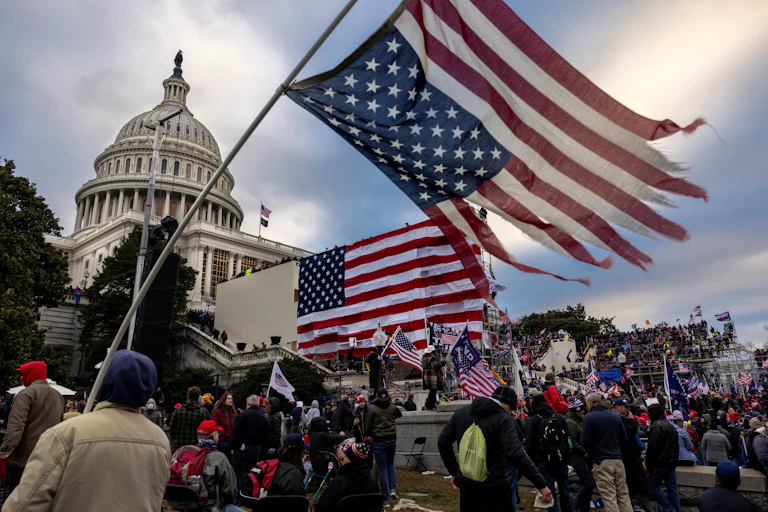
Protesters outside the Capitol on January 6, 2021, with a shredded and upside down U.S. flag in the foreground.
Brent Stirton/Getty Images
Protesters outside the Capitol on January 6, 2021

The Supreme Court’s gutting of the Voting Rights Act last week came about thanks to a conspiracy theorist who participated in the Capitol insurrection on January 6, 2021. 

Democracy Docket reports that Phillip “Bert” Callais, the lead plaintiff in Louisiana v. Callais, has long claimed U.S. elections are rigged on social media. Callais posted photos and video from the scene at the infamous “Stop the Steal” protest prior to the 2021 Capitol riot, and his Facebook page is full of MAGA and right-wing content, including attacks on vaccines and anything to the left of President Trump. 

It’s a sharp contrast to the original legal complaint that ultimately reached the Supreme Court. Callais is described there as a “non–African American voter” from Brusly, Louisiana, whose congressional district changed after his state redrew its districts. Callais also said that he was a member of a local board of supervisors in 2024.  

In reality, Callais seems to be a partisan activist steeped in the right’s conspiracy theories regarding elections. On X, he commented on an Elon Musk post in December 2025, writing, “This is f#€king insane, non citizens voting in our country.” In February of this year, he expressed doubt in election security, and in January, he called the voting system “manipulated,” touting hand-counted paper ballots as a solution. 

Callais also dismissed concerns about how eliminating mail-in voting would hurt disabled or elderly voters, posting in February, “Find someone to haul you to the polls. Don’t let your disability put the rest of the country at risk.” 

On Sunday, only days after the Supreme Court’s ruling, election denier Seth Keshel, featured in The New York Times for his voter fraud claims, posted a photo to X of him shaking hands with Callais. 

X screenshot Seth Keshel
@RealSKeshel
Sunday afternoon in Baton Rouge, and got to meet veteran and hero Bert Callais, also known as the plaintiff in Louisiana v. Callais.

All of this seems to reveal a plot by conservatives to change how Americans vote in order to satisfy debunked conspiracy theories. With the right plaintiff, Republican politicians and wealthy donors can push through a tailored legal case to undo laws that protect elections from partisan interference. Callais seems to have been ready and willing. 

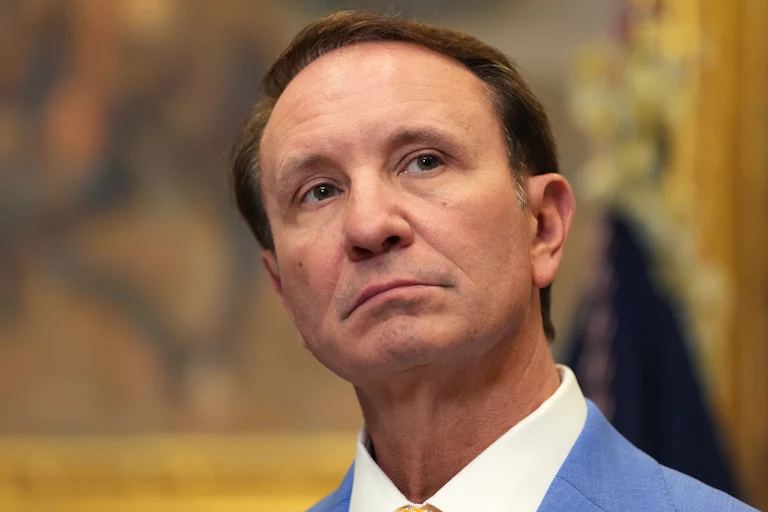
Louisiana Governor Tossed Thousands of Votes In Order to Help Trump

Louisiana Governor Jeff Landry wasted no time trying to overturn votes.

Louisiana Governor Jeff Landry
Win McNamee/Getty Images

Louisiana’s secretary of state has already received tens of thousands of absentee ballots for the state’s primary elections, but now won’t count them because of Republican Governor Jeff Landry’s desperate move to please Donald Trump.

The Supreme Court voted 6-3 last week to throw out Louisiana’s congressional map and get rid of its only Democratic (and majority-Black) district. Landry immediately suspended the primary elections for Louisiana’s U.S. House seats in order to implement a new map that could give Republicans an advantage.

By the time the governor pushed the date of the race from May 16 to July 15, more than 42,000 absentee votes had already been received, the Louisiana Illuminator reported Monday.

Landry’s blatant attempt to overturn thousands of votes comes at the bidding of Trump, who has pressured red states to redraw their congressional maps.

Several Democratic candidates and civil rights advocates have urged voters to continue voting in these races, as Landry’s move is subject to an array of legal challenges. Other races in the party primaries on May 16 are going forward, including those for the two Senate contests.

How Trump Plans to Profit Off Renaming of Palm Beach Airport

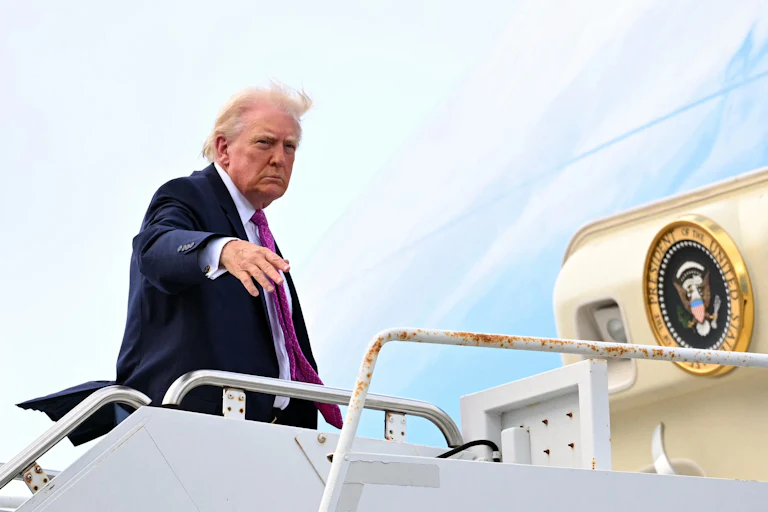
President Donald Trump has made a deal with Palm Beach Airport that will make him even richer.

President Donald Trump boards Air Force One.
Mandel NGAN/AFP/Getty Images

President Trump has trademarked the name “Donald J. Trump International Airport”—and could soon generate millions of dollars for his family.

Palm Beach County commissioners will vote on Tuesday on whether to use taxpayer dollars to rename Florida’s Palm Beach International Airport the “President Donald J. Trump International Airport.” If they approve the name change, a trademark deal between the county and DTTM Operations LLC—a company run by Donald Trump Jr.—will force the airport to run all airport-branded merchandise by the Trump family for approval.

Trump would become the first and only president with an airport named after him who has trademarked his own name in this manner.

While Trump’s companies have claimed that the trademark is only for legal protections, and that Trump won’t directly profit, the agreement signed by Trump and reviewed by the Miami Herald would leave loopholes for the president’s companies to sell “President Donald J. Trump Airport” branded merchandise off-site, and even gives the president control over biographical information included at the airport.

The agreement also allows Trump to create the list of “approved retailers” from which airport stores have to buy Trump-branded items. If the county or any retail businesses want to sell DJT Airport merch, they have to buy those products “exclusively and directly from such entities designated by Licensor.” The licensor is DTTM—of which Trump Jr. is the president.

“Normally a license agreement says that the goods have to be of a certain quality. It doesn’t say that you have to purchase them from a retailer that we’re approving them from,” trademark lawyer Josh Gerben told the Herald. “It’s not just a nonpartisan individual that’s going to be able to write marketing materials or talk about Donald Trump. It’s going to be him and his organizations getting to control the messaging here.”

Doubts about the ethics of the deal were raised months ago, with Palm Beach lawmakers stating over email that the airport renaming would confer “a commercial benefit upon the president and his companies.” Even still, the deal may very well be approved on Tuesday, giving perhaps the most blatantly corrupt president yet another free pass.

GOP Finds Way to Give ICE Even More Money—With Way Less Accountability

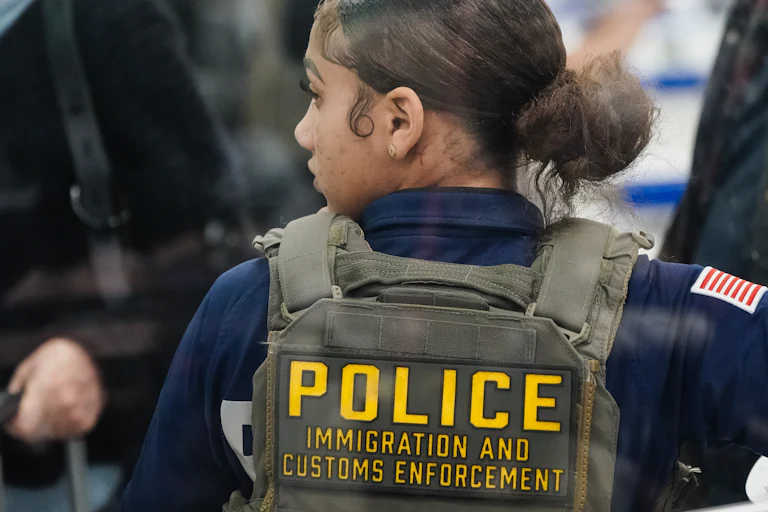
Senate Republicans are putting forward a new reconciliation package for immigration enforcement.

An ICE agent stands with her back to the camera and looks to the side
Elijah Nouvelage/Bloomberg/Getty Images

Senate Republicans are looking to funnel nearly $70 billion with absolutely no strings attached to Donald Trump’s lawless immigration enforcement campaign.

Senate Judiciary Committee Chairman Chuck Grassley unveiled the legislative text Monday night for the Republicans’ reconciliation package, directing $38.2 billion to Immigrations and Customs Enforcement. The bill also allocates $26 billion for offices under Customs and Border Protection, including $3.5 billion for border security technology and screening, according to Punchbowl News.

Meanwhile, another bill from the Homeland Security and Government Affairs Committee would provide an additional $32.5 billion, bringing the total package for immigration enforcement to roughly $69.2 billion, with ICE set to receive approximately $38.2 billion, according to Migrant Insider.

Bobby Kogan, senior director of federal budget policy for the Center for American Progress, warned on X Monday night that these funds had “enormous flexibility, with far less accountability or oversight than typical annual appropriations for DHS funding has.”

Senate Republicans have framed this massive expenditure as giving ICE and CBP enough funds to be shutdown-proof until the end of Trump’s term. But in reality, ICE already had twice as much funding as it needed to run from the president’s One Big Beautiful Bill, passed in July. Now ICE has roughly four or five times the amount of funding it needs to run until 2029, while CBP only has the funds to make it to 2027, according to Kogan.

There do not appear to be any offsetting cuts to pay for this bill.

Since Trump launched his sweeping immigration crackdown, American voters have borne witness to federal immigration agents’ use of threats and intimidation, excessive force, warrantless searches or arrests, racial profiling, and wrongful detentions. ICE has detained hundreds of children, and families of mixed legal status are being regularly torn apart by the administration’s relentless immigration crackdown. Federal immigration agents were also responsible for the deaths of two U.S. citizens in Minnesota.

Rather than reform these federal agencies, Senate Republicans are choosing to write them a blank check using taxpayer dollars.