Breaking News
Breaking News
from Washington and beyond

Feds Forced to Drop Case Against “Broadview Six” Anti-ICE Protesters

Federal prosecutors have dismissed all charges against the protesters after apparent misconduct.

Kat Abughazaleh drinks water while sitting on the ground with others who were tear gassed.
Joshua Lott/The Washington Post/Getty Images
Demonstrators including Kat Abughazaleh are tear-gassed while protesting outside an ICE facility in Broadview, Illinois, on September 19, 2025.

The charges against the remaining “Broadview Six” protesters were dropped Thursday, in a win for anyone who has protested ICE activity under the Trump administration.

The six protesters were hit with felony conspiracy charges carrying a maximum sentence of six years in prison after they surrounded an ICE agent’s car in the Chicago suburb of Broadview in September, in an attempt to slow it down. It was alleged the protesters “pushed and scratched and otherwise damaged,” the vehicle, according to the Chicago Sun-Times. But like many charges brought by the feds against anti-ICE protesters, they failed to hold up in court.

The government first dropped charges against two of the protesters, Catherine Sharp and Joselyn Walsh. Then it threw out the conspiracy charges against the other four—Brian Straw, Michael Rabbitt, Andre Martin, and former congressional candidate Kat Abughazaleh—and instead tried to convict them of one misdemeanor count each for impeding a federal agent.

In the end, the administration couldn’t even do that. Chicago’s top federal prosecutor, U.S. Attorney Andrew Boutros, dropped the charges with prejudice in front of U.S. District Judge April Perry, meaning the case cannot be refiled in the future.

Boutros remained petty to the end. He called the protesters’ actions “unacceptable in a civilized society,” adding: “It is for the grace of God that that agent moved at two miles per hour.”

Perry was unimpressed. “You are significantly undercutting your mea culpa here by standing behind the charges and continuing to vilify these particular defendants,” she told Boutros.

Boutros had already annoyed the judge once before, when his assistants took transcripts of themselves explaining the conspiracy laws to the grand jury pool, then apparently redacted some of the transcripts when Perry asked for them. She discussed this with them in a private hearing. Boutros later insisted to Perry that “no one acted with the intent to mislead your honor.”

ICE came to Chicago in Operation Midway Blitz, a deportation campaign beginning in September 2025, a few months before Operation Metro Surge took over Minneapolis. The campaign resulted in protests, arrests, and the fatal shooting of one resident, Silverio Villegas-Gonzalez.

Republican Rep. Wants to Use Trump Slush Fund to Steal From Americans

Representative Andrew Clyde also wants a piece of the pie.

Representative Andrew Clyde speaks into microphones outside the U.S. Capitol
Stefani Reynolds/Bloomberg/Getty Images
Representative Andrew Clyde

Even members of Congress are taking the opportunity to cash in on Donald Trump’s slush fund.

The DOJ created a $1.8 billion honey pot earlier this week, offering “anti-weaponization” payouts to virtually any right-winger who felt targeted by the previous presidential administration—at cost to U.S. taxpayers.

The money is apparently worth more to lawmakers than the negative impacts it will have on their constituents. Republican Representative Andrew Clyde came out in favor of the executive branch’s creation, suggesting to Politico Thursday that he wouldn’t rule out the possibility of taking money from the account himself.

The Georgia Republican argued that he had been previously targeted by the IRS and had to forfeit assets to the tune of $1 million. Clyde won most of the money back after he took the IRS to court, but he told Politico that he still has considerable legal fees from the endeavor.

There are others far beyond Capitol Hill who are interested in milking the fund, such as the financially ruined CEO of MyPillow, Mike Lindell, who lost most of his net worth for spreading unfounded conspiracies about the 2020 presidential election.

Hundreds of pardoned January 6ers are also in the queue, including former Proud Boys leader Enrique Tarrio, a sex offender who bear-sprayed cops, and a convicted child molester who told his victims he would give them money from a Trump payout in exchange for their silence.

Trump leveraged the promise of payouts to his success on the campaign trail. In January—months before the slush fund became a reality—Democrats attempted to stave off such payments, introducing the “No Rewards for January 6 Rioters Act.” But the bill never went anywhere, and has made no progress since.

The slush fund was the result of an unprecedented deal that Trump made with himself. Rather than settle his $10 billion lawsuit against his own administration, Trump opted to drop the case entirely earlier this week and, in turn, extracted a pledge from the DOJ to financially assist his allies.

The arrangement came with a curious addendum from acting Attorney General Todd Blanche, immunizing Trump from further federal prosecution. The government of the United States, Blanche wrote Tuesday, is “forever barred and precluded” from pursuing “any and all claims” against Trump, his family, or his business.

Legal experts are questioning whether the scheme is unconstitutional. If the arrangement is allowed to stand, Trump will have effectively thwarted the powers of both the legislative and judicial branches, and soiled the constitutionally defined separation of power.

Trump Tells Republicans to Defend His Slush Fund by Lying

The Department of Justice has given Republicans a list of talking points not grounded in reality.

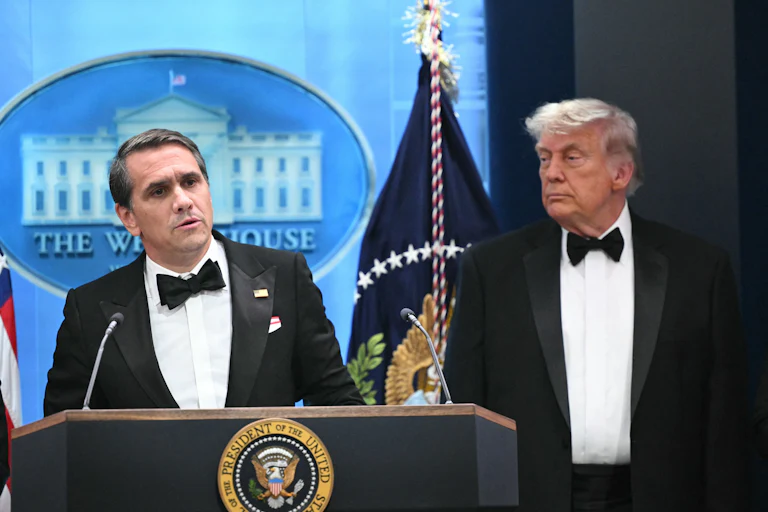
Acting Attorney General Todd Blanche speaks at a podium while Donald Trump stands next to him
Mandel NGAN/AFP/Getty Images
Acting Attorney General Todd Blanche and President Donald Trump

Ahead of a meeting with acting Attorney General Todd Blanche, the White House sent a document to GOP senators on Thursday explaining why President Donald Trump’s $1.8 billion slush fund is actually a great idea.

The document says the fund is about “seeking accountability” for millions of Americans “who were victims of lawfare and weaponization.” It falsely claims the president cannot profit from it, lets senators know they can get a piece of the action themselves (wink, wink), and even attempts to paint the fund as a bipartisan win. “Democrats can submit claims, too,” the document states happily.

Unsurprisingly for the most corrupt presidential administration in history, the document greatly contradicts the legal agreement that actually established the fund. Journalist Adam Klasfeld found nine different instances where the document differs from the agreement.

For example, the document claims the fund can be audited by a third party, while omitting the fact that Blanche gets to choose the auditor and can veto the audit at will. The document also claims there is no “partisan restriction” to the fund, despite the legal settlement defining the “weaponization” in question as being committed exclusively by Democrats.

Even Republican senators realize this fund is incredibly corrupt. Just a few hours after receiving the White House document, the GOP canceled its plans to vote on a budget bill that would fund the Department of Homeland Security though the end of Trump’s second term, largely due to fears Democrats would force Republicans to go on the record about whether or not they support the fund.

The fund was announced on Monday as a result of a massive legal settlement between Trump and the IRS. It is expected to be doled out to Trump allies—including January 6 rioters and members of Trumpian super PACs—who claim they were unfairly targeted by past administrations. Of course, no one except Blanche will actually know who is awarded the bounties, and how much they’re getting.

The fund has come under intense public scrutiny since it was created. One legal watchdog called it “one of the single most corrupt acts in American history,” Democrats have bashed it as clear fraud, and a few Republican legislators have similarly gone on record to say it unfairly benefits the president.

Republicans Flee Work Early to Avoid Voting on Trump’s Slush Fund

Republicans in the Senate went home earlier than scheduled, abandoning a key budget vote so they wouldn’t also have to vote on the slush fund.

Senate Majority Leader John Thune speaks at a podium while House Speaker Mike Johnson listens
Kayla Bartkowski/Getty Images
Senate Majority Leader John Thune and House Speaker Mike Johnson

Republican senators oppose President Trump’s “Anti-Weaponization Fund” so much that they’re going home early.

Senate Majority Leader John Thune announced to his colleagues Thursday afternoon that the Senate will recess until June without a vote on their planned reconciliation bill to fund controversial parts of the government, such as Immigration and Customs Enforcement. The House is expected to dismiss early, as well, as a scheduled meeting between Speaker Mike Johnson and Trump on Thursday was instead canceled.

The original plan was to vote this week on the legislation, which would have provided about $70 billion to fund immigration enforcement through 2029. But Democrats promised to introduce a series of amendments to the bill forcing Republicans to vote on the slush fund, as well. To avoid those votes, Republicans have chosen to skip town.

A meeting earlier Thursday between acting Attorney General Todd Blanche and Senate Republicans on the fund went very poorly, with at least 25 Republican senators speaking out against it.

Republicans are also divided over funding for Trump’s ballroom, which is now unlikely to make it into the final version of the bill, whenever that comes. Trump had set a June 1 deadline to sign the bill into law, but that can’t happen if both the Senate and the House are out of session.

Most Americans can’t decide to skip working the next day and start their vacations early just because they have tough decisions at work. But for Republicans in Congress, it’s easier to just keep kicking the can down the road rather than try to fix their terrible policies.

Trump Says He’s Known His Son “a Long Time”

Donald Trump mulled skipping his son’s wedding in the weirdest way possible.

Donald Trump gestures and speaks while sitting at his desk in the Oval Office
Kent NISHIMURA/AFP/Getty Images

Donald Trump just illustrated exactly how close he is with his children.

The president told reporters at the White House Thursday that he will likely miss his son Don Jr.’s wedding this weekend, citing national security concerns related to the war with Iran. But his explanation suddenly veered into the absurd when he referred to his 48-year-old offspring as someone he’s “known for a long time.”

“He’d like me to go,” Trump said. “It’s gonna be just a small, little, private affair. I’m gonna try and make it, I’m in the midst—I said, ‘You know, this is not good timing for me. I have a thing called Iran and other things.’”

Trump then went on to blame the “fake news” for his impending decision, claiming that he would be raked over the coals by the press whether or not he attended. “That’s one I can’t win on,” Trump said.

But Trump has found plenty of time for other nonwork activities. Since returning to office, he has hit the links at least 106 times, spending more than a fifth of his term—about 21.95 percent—golfing, putting him on pace to exceed the 307 days he spent golfing over the course of his first term. That begs the question: Does his son’s wedding rank lower in his priorities than teeing up?

“He’s uh—he’s been a very, a person I’ve known for a long time,” Trump concluded on the topic of his first child. “Hopefully they’re gonna have a great marriage.”

Don Jr. and Bettina Anderson, a Palm Beach socialite, are expected to wed over Memorial Day weekend at a private ceremony in the Bahamas. The couple had, at one point earlier in the planning process, reportedly considered getting married at the White House—though those plans were scrapped due to the optics of a “lavish” wedding during wartime.

“They’re very aware that a lavish wedding at the White House while people are dying wouldn’t be well-received,” an insider told Page Six.

It will be Don Jr.’s second marriage, after his 13-year union to Vanessa Trump ended in 2018. The two share five children together and are said to be friendly toward one another (Vanessa’s health also clouds the happy couple’s weekend: She announced on Wednesday that she was diagnosed with breast cancer).

The eldest Trump child was previously engaged to former Trump adviser Kimberly Guilfoyle, though their four-year engagement was called off after Don Jr. was photographed getting cozy with Anderson. Guilfoyle is now the U.S. ambassador to Greece.