Key Swing States Say DOJ’s “Election Monitors” Are Acting Out
The Department of Justice sent hundreds of election monitors across the country. Multiple states are already reporting the agents are acting beyond the scope of their role.

For the first time in U.S. history, the White House is monitoring elections across the entire country—and they’ve already crossed the line.
The Justice Department announced Tuesday that it had placed roughly 1,000 election monitors and observers in all 50 states. They will be assessing polling places for compliance with federal election statutes.
The declaration also specified more than 100 jurisdictions that the agency intends to monitor. Most of the inclusions are either Democratic strongholds or hotly contested districts in the midterm elections.
“Election integrity has been one of the top priorities for this Administration and this Division,” Assistant Attorney General for Civil Rights Harmeet K. Dhillon said in a statement. “I am very proud we are deploying the largest monitoring effort in DOJ history, and pursuing transparency for elections in an assertive and nondiscriminatory manner.”
Previous administrations have similarly tapped monitors to oversee election cycles, but never before at this level. In 2024, the DOJ monitored 86 jurisdictions across 27 states. It was the largest such effort by the DOJ since at least 2004. But some election officials have already flagged the 2026 rollout as a potential intimidation tactic that could scare voters away from actually participating at the ballot box.
Within hours of the DOJ announcement, New Mexico’s secretary of state told PBS NewsHour that some of the agency’s monitors had been asking “some unusual questions and doing things that are not allowed by law such as questioning voters” in Bernalillo County.
A spokesperson for the Justice Department subsequently told NewsHour that their “team had a productive call with the New Mexico Secretary of State just a few minutes ago,” and that they “believe the issue is resolved and will not affect our ongoing monitoring for the rest of the day.”
Similar complaints also emerged out of Michigan. There were at least two instances in Dearborn and Flint in which the DOJ’s election monitors overstepped their authority, a spokesperson for the Michigan Attorney General’s Office told the Detroit Free Press. The monitors reportedly asked election workers for copies of their training materials and the training they personally received.
DOJ spokesperson Kiersten Pels told VoteBeat that the monitors “asked their typical questions about election official training.”
“These are standard questions on the forms we provided our monitors. They are the same questions asked by monitors in the past, including during the previous administration,” Pels said.
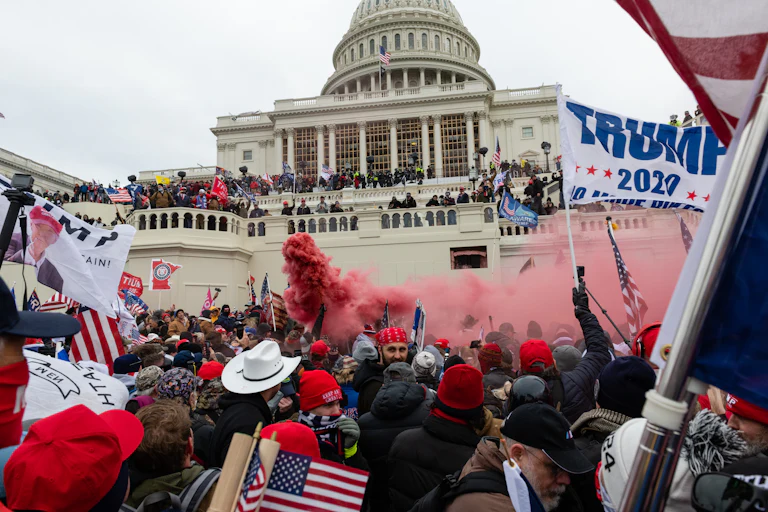
Since 2020, Donald Trump and his allies have relentlessly opined about alleged voter fraud, attempting to not only rewrite prior election results but also unravel the tools of future elections, such as mail-in voting. But his rhetoric has also had the auxiliary effect of damaging public trust in American democracy, disenfranchising voters—and their faith in their individual power—as a result.
Dhillon herself has been tied to prominent election deniers and conspiracy theorists, including the president, 2022 Arizona gubernatorial candidate Kari Lake, and former Trump fixer Rudy Giuliani.
Earlier this year, Dhillon oversaw a series of lawsuits against dozens of state election officials as the administration attempted to gain access to local voter rolls containing sensitive information, such as Social Security numbers, as part of a nationwide investigation to uncover noncitizens who might vote in the November election.
One arm of that legal effort was torn to shreds by a judge last week, who argued that “never before in American history has the federal government, on the eve of an election, sought to coerce a state and local government to abandon their own Constitutional elections procedures and bend to the will of the Executive Branch.”
This story has been updated.