Breaking News
Breaking News
from Washington and beyond

Nearly Every Republican Tulsi Gabbard Endorsed Lost the Election

Since leaving the Democratic Party, Gabbard endorsed 13 Republican candidates. Ten lost.

Anna Moneymaker/Getty Images

On October 11, Tulsi Gabbard proudly announced her departure from the Democratic Party. Calling on “fellow common sense independent-minded Democrats” to join her, Gabbard wasted no time on her new path, endorsing 13 Republicans before the midterm elections.

Many of the races were high-stakes. Among Gabbard’s endorsements were election denialists and conspiracy theorists.

Ten out of the 13 candidates she endorsed went on to lose their election.

Here is a full list of her failed endorsements:

House

  • John Gibbs, Michigan’s 3rd district
  • Tom Barrett, Michigan’s 7th district
  • Joe Kent, Washington’s 3rd district

Senate

  • Blake Masters, Arizona
  • Adam Laxalt, Nevada
  • Don Bolduc, New Hampshire

Governor

  • Kari Lake, Arizona
  • Darren Bailey, Illinois
  • Tudor Dixon, Michigan
  • Lee Zeldin, New York

Only three candidates she endorsed won the election: J.D. Vance for Ohio senator, Mike Lee for Utah senator, and Kristi Noem for South Dakota governor.

Gabbard’s shift to the right is not surprising. Beyond appearing at CPAC this year, she has found a home in right-wing media for some time. There, she has focused less on bringing conservatives closer to her and more on bringing herself closer to them—criticizing the impeachment inquiry into former President Donald Trump as “partisan,” complaining about “open borders,” and even filling in for Tucker Carlson on his show.

Though Gabbard’s endorsements have largely failed, her efforts are paying dividends for her own self-interest. On Monday, MAGA Republican Matt Gaetz floated Gabbard as a potential speaker of the House candidate. That same day, Gabbard officially signed a deal with Fox News to join the network as a paid contributor. And in the evening, Gabbard once again hosted Carlson’s program.

If Gabbard expected to coast into the GOP on a red wave, one bolstered by her “free-thinking” endorsements, she might be disappointed with the results. She’s not alone, of course. Donald Trump has an even longer list of failed endorsements. Now both seek to fail upward—Gabbard, as she becomes a mainstay of the right-wing media sphere, and Trump, who is expected to soon announce his third consecutive bid for the presidency.
Katie Hobbs Wins Arizona Governor Race, Beats MAGA Republican Kari Lake

Democrat Katie Hobbs prevented Kari Lake, an election denier, from taking the governor’s seat.

Christian Petersen/Getty Images

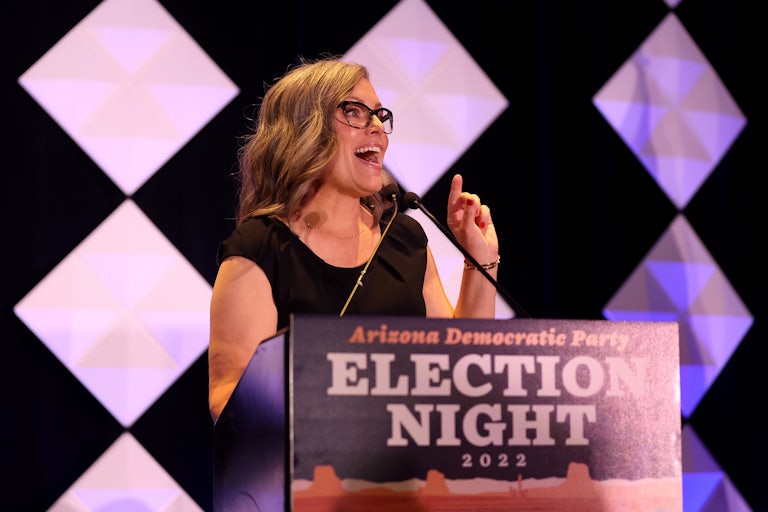
Democrat Katie Hobbs was elected Arizona governor Monday in a tight race against mega MAGA Republican Kari Lake, according to a projection from NBC News.

Hobbs maintained a razor-thin lead over Lake, winning with 50.4 percent to 49.6 percent, with 97 percent reporting.

Although gubernatorial races do not normally garner much national attention, the Arizona race has been a nail-biter from start to finish. Arizona has become a crucial swing state after surprisingly going for Joe Biden in the 2020 presidential election. Then-Governor Doug Ducey certified the vote results, but Arizona has been plagued with election falsehoods since.

During early voting, the state reported multiple cases of voter intimidation as armed self-appointed poll watchers turned up at ballot boxes. On Election Day, some of the state’s ballot tabulators malfunctioned, leading many Republicans to misleadingly cry foul.

Lake is one such election denier. Backed by Donald Trump, she embraced conspiracy theories throughout her campaign, such as his insistence the 2020 election was stolen, and would not commit to accepting the results if she lost her own election.

On Election Day, as reports of tabulator issues came out, she claimed Democrats were trying to steal the election and told her supporters not to change polling stations because doing so would make their ballots “likely not count”—a claim reporters immediately debunked.

Counting Arizona ballots stretched for almost a week, before the race was finally called for Hobbs.

Hobbs, a former social worker, struck a much softer-spoken figure on the campaign trail compared to Lake. The Democrat and Arizona secretary of state rose to national prominence when she helped certify the 2020 election results for Biden.

Her first foray into politics was volunteering for one of Kyrsten Sinema’s state races. The senator was notably absent from stumping for Hobbs, but former President Barack Obama hit the campaign trail for her.

Hobbs has outperformed expectations and managed to keep a lead over Lake, even if that margin had narrowed by Monday.

Gallego Says Sinema Did Nothing to Help Arizona Democrats, “Only Cares About Herself”

The Arizona congressman—and potential Sinema challenger—took the senator to task for her lackluster support for Democrats.

Kyrsten Sinema
Anna Moneymaker/Getty Images

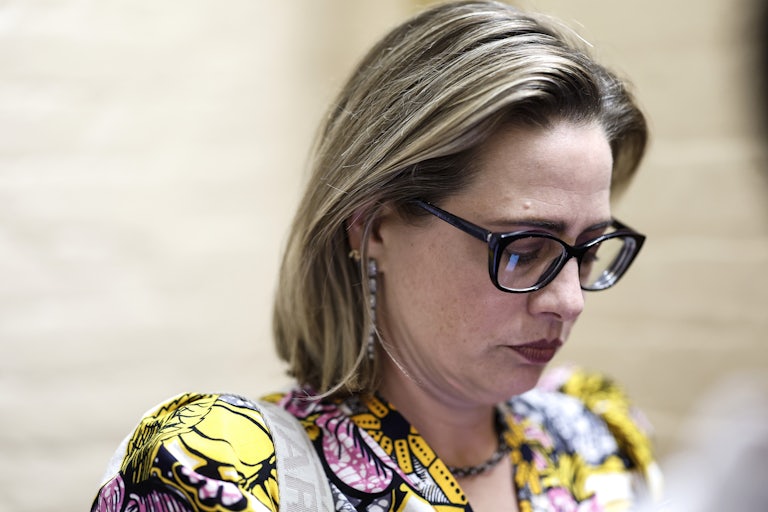
Arizona Representative Ruben Gallego is going after Senator Kyrsten Sinema for being “nowhere to be found” leading up to the midterm elections.

“You did not see [Sinema] at one public event for anybody,” Gallego said Sunday on MSNBC. “And when we have these races that are really in the mix right now, she could have been a very good surrogate to help out a lot of our candidates. And she did nothing, because she only cares about herself.”

On November 9, the day after the election, Sinema tweeted: “Every vote counted, every voice heard. That’s how our democracy works. It may take some time for the results to be finalized, so in the meantime, let’s stay patient. Democracy is always worth the wait.”

Gallego responded, writing, “Thanks for all your help this year. 🙃”

This is not the first time Gallego has gone after Sinema. In January, he tweeted that Sinema and Manchin “care more about arcane Senate rules than protecting your vote,” referring to the pair’s opposition to eliminating the filibuster.

In April, Gallego predicted Sinema would not spend much time stumping for Arizona Democrats. “She doesn’t care about the Democratic movement. She doesn’t care about working-class people,” he said. “She’s not going to be out there with Mark [Kelly]. She’s not going to be out there with our gubernatorial nominee. It’s not her nature.”

Then in July, after the Supreme Court overturned Roe v. Wade, Gallego tweeted at Sinema, asking her to have a town hall and explain her opposition to forgoing the filibuster in order to codify the right to abortion. Later that month, Gallego’s campaign fundraised on Facebook, teasing a potential primary challenge against Sinema in 2024.

“Many people are asking Ruben if he will run against Senator Kyrsten Sinema,” the post read. “We know many of you hope he does and he appreciates that fact. That’s one of the reasons he is asking you to contribute to his campaign today. Because if he is going to run against her, he’ll need to win his re-election campaign this November and build a strong grassroots movement.”

“Anything he doesn’t spend in 2022, he can use in 2024 … whatever he decides,” the post finished.

In September, less than two months before Election Day, Gallego alleged that Sinema “would prefer the Dems lose control of the Senate and House.” This, in response to Sinema predicting that, since government control periodically switches, it’s “likely to change again in just a few weeks.”

Five days before the election, former President Barack Obama visited Phoenix to rally support for the state’s Democrats. Sinema was notably absent—not even to show support for Katie Hobbs, whose first foray in politics was volunteering for one of Sinema’s state legislative races.

If not for the effort of Gallego and other Democratic groups, Sinema’s passivity was almost self-fulfilling. Nearly one week after Election Day, two Arizona House races—split by just hundreds of votes—and the extremely consequential gubernatorial race featuring Kari Lake are all yet to be called.

Democrats Won Nevada (And the Senate) Thanks to Latino Voters

Nevada's Latino voters showed up for Catherine Cortez Masto, and they saved the Democrats.

Brett Forrest/SOPA Images/LightRocket via Getty Images
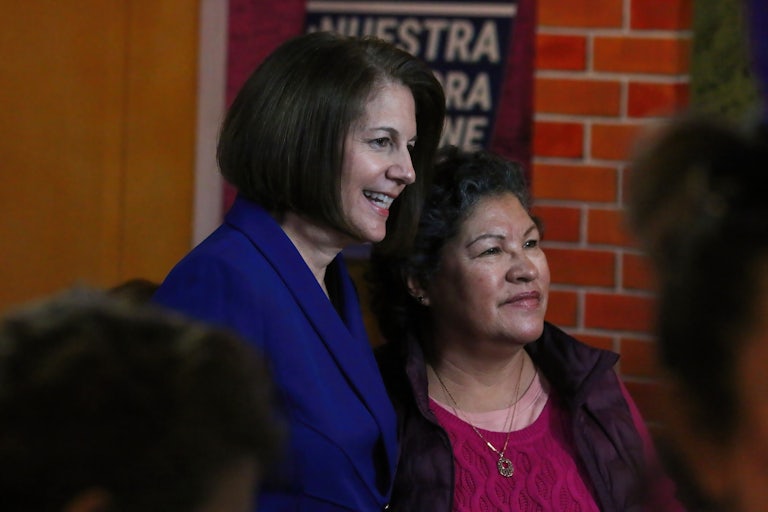
Senator Cortez Masto poses with a Latino supporter in Las Vegas after giving a victory speech.

Catherine Cortez Masto owed her Senate victory in large part to Nevada’s Latino voters.

Cortez Masto was reelected as Nevada senator over the weekend, winning a tight race against MAGA Republican Adam Laxalt and securing Democratic control of the Senate. Ahead of the vote, analysts had warned she would need to win about two-thirds of the state’s Latino voters to clinch the seat.

She pulled it off: 62 percent of Latino voters said they had voted for the incumbent senator, according to an NBC exit poll.

In the leadup to the midterm elections, analysts widely predicted that Latino voters would swing Republican, disillusioned by Democrats taking their support for granted and failing to address their top issues.

But network exit polls and the AP found that about 60 percent of Hispanic and Latino voters went Democratic.

Latino votes for Democrats are not a given: the community’s support for the party is lower than the previous midterm cycle, when nearly 70 percent of Hispanic and Latino voters went Democratic.

And while Latinos were expected to make up 20 percent of Nevada voters last week, an NBC poll found they made up only 12 percent. The real issue was not whether Latino voters would go Republican; it was whether they would turn up at all.

Cortez Masto, the first Latina senator, worked hard to ensure they would. During her campaign, she did major outreach to the Latino community, particularly women and small business owners. She focused on issues important to them, such as child care and affordable housing, and ran ads in both English and Spanish.

She acknowledged the influence of Latino support in her victory speech: “I will never, ever give up fighting for our immigrant families. That means a pathway to citizenship for Dreamers, our TPS holders, our essential workers, and our farm workers,” she said. “These Nevadans deserve to feel safe here, in their home, and I will work with anyone, anyone to ensure they are treated with dignity.”

It turns out voters will back you if you show you’re listening to them.

Supreme Court Says January 6 Committee Can Get Kelli Ward’s Phone Records

Things aren’t looking good for Team Trump.

Caitlin O’Hara/Bloomberg/Getty Images

The U.S. Supreme Court on Monday denied a motion by Arizona Republican Party Chair Kelli Ward to block the House January 6 committee from accessing her phone records.

Justice Elena Kagan on October 26 had temporarily blocked a subpoena from the committee investigating the January 6 riot from accessing Ward’s phone and text records. Ward is accused of working with former President Donald Trump to organize a group of fake presidential electors who would help prevent the transfer of power to Joe Biden.

Although Kagan’s ruling initially looked like a win for Team Trump, she denied the motion a few weeks later.

Justices Samuel Alito and Clarence Thomas—whose wife, Ginni Thomas, is also being investigated for allegedly trying to overturn the 2020 election results—said they would have granted Ward’s request.

The January 6 committee is slowly closing in on Trump’s inner circle. South Carolina Senator Lindsey Graham and Trump’s former chief of staff Mark Meadows have been ordered to testify about their efforts to interfere with election results.

Former Trump adviser Stephen Bannon was sentenced to four months in prison for refusing to testify before the committee, and Trump himself has sued to block a subpoena for his testimony.

It is unclear what the committee will do if Trump fails to comply.