Breaking News
Breaking News
from Washington and beyond

George Santos Says Sinema Told Him to “Hang In There.” Sinema Says She Never Even Spoke to Him.

Santos claims that Senator Kyrsten Sinema offered him words of encouragement during the State of the Union. Her office says it’s a lie.

Win McNamee/Getty Images

Representative George Santos claimed that, despite his less-than-friendly interaction with Senator Mitt Romney during the State of the Union speech, Senator Kyrsten Sinema told Santos “something to the effects of ‘Hang in there, buddy,’” offering a “very kindhearted” hand of support.

Sinema’s office denies this ever happening. “I know this is *shocking* but he is lying,” Sinema spokeswoman Hannah Hurley said in an email to The Washington Post on Friday. “Kyrsten did not speak to him.”

Santos made the claim in an interview on Newsmax Thursday night, one in which he also failed to satisfy the far-right network about his previous claims of having had a brain tumor. He also claimed to have obtained his “legitimate” campaign money from his organizational work of “capital introduction relationship management of high net-worth individuals,” which he supposedly, at the age of 13, had already done “for years.”

Santos explained to Newsmax his attention-drawing interaction with Romney on Tuesday night was “not meant for television.” While the pair have slightly different accounts of what exactly was said, it is clear that Romney expressed his disapproval of Santos.

Meanwhile, Santos claimed that Sinema went out of her way to tell him to “hang in there” against the gathering storm brewed by his own lies.

While pretty much everything Santos says at this point should be taken with a pound of salt, Sinema is not one to necessarily automatically believe either. Her whole career trajectory in many ways is one based on a certain dishonesty—she began as an unabashed Green Party member all to become an independent who has watered down Democratic legislation and met more often with officials and executives than her own constituents.

But Sinema and Romney have been … close for a while:

And the pair also sat together during the State of the Union. Judging by Sinema and Romney’s affinity for each other and the scale of Santos’s lying track record, one would be inclined to believe he might be lying once again too. But what, if anything, was exactly said between Sinema and Santos is not certain; such is the challenge when a pathological and unhesitating liar meets his match with a more practiced, less egregious one.
There Was No Option but to Subpoena Mike Pence

The special counsel investigating Donald Trump’s role in January 6 has subpoenaed the former vice president, a key witness in what exactly went down that day.

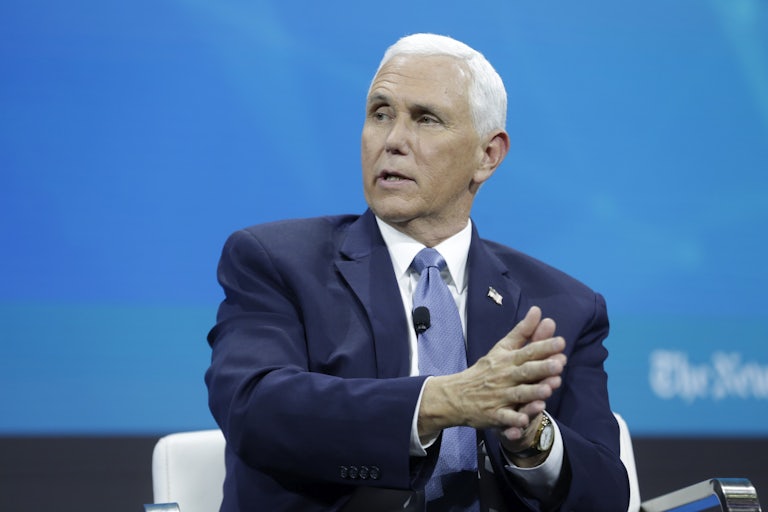
Mike Pence speaking
Thos Robinson/Getty Images for The New York Times

No investigation into the January 6 riot could be complete without interviewing Mike Pence, and now it may finally happen: The special counsel investigating Donald Trump’s role in the insurrection has subpoenaed the former vice president.

It is not clear when Jack Smith issued the summons, which was first reported Thursday, but it should come as no surprise that he did: Pence is a key witness to both the events of January 6 and Trump’s state leading up to them.

Smith was appointed in November to investigate Trump’s role in the January 6 attack, as well as his handling of classified documents at his Mar-a-Lago estate, and the investigation has been slowly drawing in on the former president.

This latest subpoena is one of the clearest moves yet to investigate Trump’s inner circle.

But it’s unclear how much Pence will cooperate. You’d think, considering that the rioters wanted to hang him and his former boss didn’t exactly have his back, he’d be willing to talk about what happened.

But the Department of Justice has been trying to get Pence to testify for months. Pence has previously said that, despite January 6 being “the most difficult day of my public life,” the House of Representatives investigative committee had “no right” to his testimony.

Pence could argue he is protected by executive privilege. Trump has repeatedly claimed that executive privilege protects him against testifying in the January 6 investigation, and Pence could do the same.

That argument, though, doesn’t hold as much water considering Pence has released a tell-all memoir in which he includes many details he would be asked to testify on.

Pence’s refusal to testify in January 6 investigations is spineless and infuriating, but it makes sense: He is reportedly considering running for president in 2024. In interviews and his book, he has sought to distance himself from Trump, a bid to appeal to moderates and independents.

But if he were to testify, he’d have to denounce Trump, alienating his former boss’s most loyal supporters in the process.

Florida Repeatedly Contacted the College Board About the A.P. African American Studies Course

A new letter reveals the truth about why the College Board changed its A.P. African American studies course—and the role Ron DeSantis’s government played.

Octavio Jones/Getty Images

A newly uncovered letter shows that Florida government officials had repeated, ongoing contact with the College Board while it was first developing the Advanced Placement African American studies course. The revelation contradicts the board’s previous claim that Florida officials had no influence over its decision to water down the class’s curriculum.

In the letter, first obtained by The Daily Caller, Florida Department of Education officials write to thank the senior director of College Board’s Florida Partnership for “the regular, two-way verbal and written dialogue on this important topic,” spanning “since January 2022.” The letter explained in detail when state officials expressed objections to the proposed curriculum.

Last week, the College Board released final guidelines for the class, having removed substantial facets of the curriculum that Florida’s Department of Education objected to, including concepts surrounding intersectionality, mass incarceration, the Black Lives Matter movement, and more. The College Board stated that “core revisions” to the proposed A.P. African American Studies class “were substantially complete” by December 22, “weeks before Florida’s objections were shared.” (Florida announced it would ban the course from public schools in late January.)

The new letter shows that, in fact, Florida had shared its objections for nearly a year before the cited December date. This calls into question whether Florida government officials influenced the final resultant curriculum—and if so, how much.

The Florida officials wrote that they “were grateful to see” the final curriculum had removed 19 topics, many of which they had previously objected to, deeming them “discriminatory and historically fictional,” referring to topics like intersectionality, mass incarceration, and the Black Lives Matter movement.

While the class has already been barred from Florida schools this year, Florida officials expressed in the letter that they’re “looking forward” to reviewing the College Board’s submission of the supposedly coincidentally watered-down course for the following school year.

Florida’s banning of the class, and apparent influence on the College Board to water it down for the rest of the nation, is part of an ongoing assault on education in the state.

One Florida school district serving over 50,000 students recently banned 23 books, including The Kite Runner and the entire Court of Roses and Thorns book series—going even beyond a state law that mandates books in public schools to be subject to review by a “specialist.”

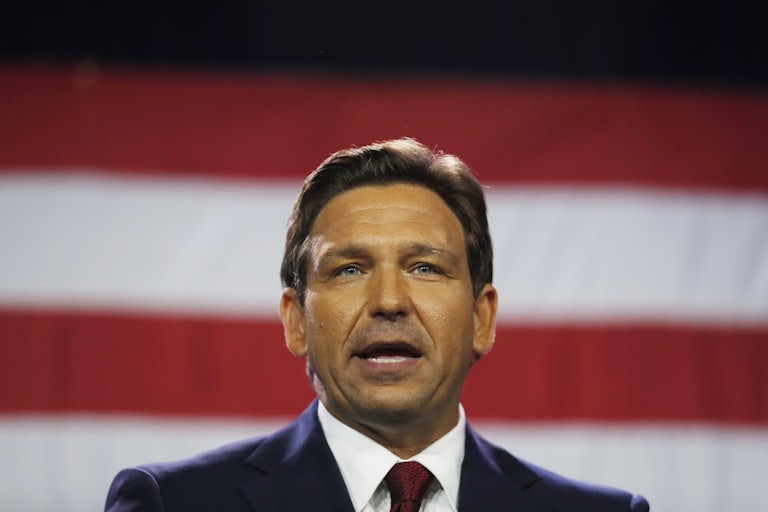
Last week, the president of the New College of Florida was forced out by a board of trustees stacked with hand-picked appointees of Governor Ron DeSantis; she was replaced with another DeSantis ally.

DeSantis has also pushed through the “Don’t Say Gay” bill, which prevents classroom discussion of sexual orientation and gender identity through third grade; lobbied for the Stop Woke Act, which restricts teaching on race in colleges; and announced plans to mandate Western civilization courses and defund diversity, equity, and inclusion programs on state college campuses.

Make no mistake: Even just in imposing his will on teachers and students, DeSantis has proven over and over again to be a fascist. Regardless of however many hogwash columns or cable news commentators insist that DeSantis represents some sort of icon of intrigue or political savviness, or even an alternative to Trump, know that he is as rotten as they come—and should be nowhere near any lever of power in a just society.

Republicans Have Long Wanted to Cut Medicare and Social Security. Don’t Fall for the Fake Outrage Now.

You’d never suspect it from their reactions to Biden’s State of the Union. But here’s the proof.

Rick Scott, Mike Lee, and Bill Cassidy sit next to each other
ANDREW CABALLERO-REYNOLDS/AFP/Getty Images
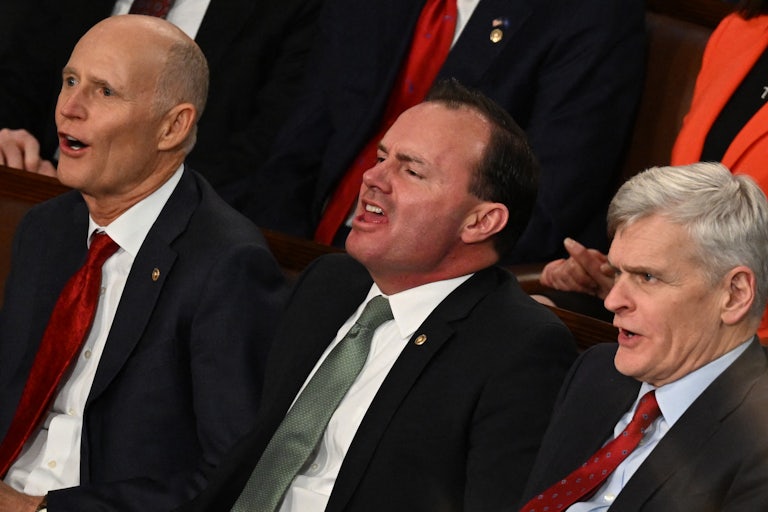
Senators Rick Scott, Mike Lee, and Bill Cassidy yell as President Joe Biden delivers the State of the Union address on February 7.

You’d never suspect Republicans have been trying to slash Social Security and Medicare for years, based on their reactions to Joe Biden’s State of the Union address.

The president scored a big win Tuesday night when he appeared to get Republicans to agree not to cut funding for Medicare or Social Security during his speech.

Republicans were outraged when Biden said some of them were proposing to “sunset” the federal entitlements programs—and have since doubled down, claiming they intend to do no such thing. But not only have GOP lawmakers suggested slashing the funding multiple times in the past year, the party has been out to end the programs since they began.

Republicans have held a “visceral and abiding dislike” for the welfare programs since the Social Security Act was implemented in 1935, according to the historian Lewis L. Gould. Since the party took control of the House of Representatives in January, they have been weighing options to slash Social Security and Medicare, ostensibly in order to curb federal spending. GOP lawmakers are threatening to hold the debt ceiling hostage until the federal budget is reduced, and Social Security and Medicare are on the chopping block.

Mike Lee looked appalled that Biden said his party would cut Social Security funding, despite saying quite clearly on camera during his first Senate campaign in 2010, “It will be my objective to phase out Social Security, to pull it up from the roots and get rid of it.”

Rick Scott has previously proposed sunsetting the programs every five years. The morning after the State of the Union, he tried to refute Biden’s accusation—by doubling down on his plan to cut Social Security and Medicare. In August, Ron Johnson went even further, proposing removing Social Security and Medicare as federal entitlement programs and instead making them discretionary spending programs that Congress approves on a yearly basis.

The list goes on: Lindsey Graham proposed changing the income cap and eligibility age for the programs in June. Michael Waltz said in January the entitlements program needs to be considered when it comes to cutting the federal budget. And just last week, Kevin Hern said he “wouldn’t think it’d be off the table” in regard to slashing Social Security and Medicare.

Even Donald Trump tried to cut the programs every year he was in office. For the 2021 federal budget alone, he proposed slashing about half a trillion dollars from Social Security and Medicare. Again, these are just a handful of examples in a larger Republican agenda to cut the social safety programs.

So it’s no wonder Biden looked so gleeful as half of Congress shouted at him Tuesday night.

Florida Won’t Require High School Athletes to Share Their Menstrual History, but May Force Them to Reveal Their Sex Assigned at Birth

The information could be used to out transgender students.

Girls’ soccer teams on the field. One is about to kick a soccer ball.
Jonathan Newton/The Washington Post/Getty Images

The Florida High School Athletics Association decided Thursday not to require student athletes to give their schools detailed information about their periods—a proposed policy that sparked widespread outcry—but will ask for their sex assigned at birth.

The FHSAA board of directors was due to meet at the end of the month for a final vote on the committee recommendation, but held an emergency meeting Thursday after heated pushback from parents, health care providers, and Florida legislators.

Ahead of the vote, the board read public comments that had been submitted. Almost all of the 150 comments submitted to the board opposed asking for students’ menstrual history.

“This is a huge invasion of privacy, not necessary, and absolutely creepy,” one commenter said. Others pointed out the double standard of not requiring boys to submit personal medical details. “It is clear that your agenda is a political one, and it has no place in our schools,” said another commenter.

The board voted 14–2 to remove all menstrual history questions, but students would still be required to submit their entire medical history form to their schools.

However, the form was changed to ask the students’ “sex assigned at birth” instead of just their sex. If the board votes at the end of the month to adopt this new form, the information could be used to out transgender students. Florida Governor Ron DeSantis has banned trans girls from playing girls’ sports.

The FHSAA announced in October that it was digitizing its annual physical form for student athletes. The new form included optional but detailed questions about students’ menstruation cycles. Previously, only one page of the paper form—on which a pediatrician would sign off on a student being allowed to play—would be submitted to a school.

Despite widespread public outcry over the potential repercussions of digitizing that data, an FHSAA panel decided in January not only to stand by the change, but also recommended the menstrual history questions be made mandatory.

Many parents and doctors were worried that schools would use the menstrual data to monitor students for late or missed periods, a possible sign of pregnancy, or to out trans students by watching for girls who don’t get periods or boys who do.

The FHSAA board of directors announced Tuesday they would hold the emergency meeting, just hours after 30 Florida lawmakers called on them not to approve the requirement that students provide their menstrual history. The letter writers, all Democratic members of the state House, called the menstrual history questions “highly invasive,” in violation of Florida’s constitutional right to privacy, and asked what the scientific justification for the questions was.

Since the fall of Roe v. Wade, people have been hypervigilant about third parties tracking menstrual data. Period tracker apps and the platform that hosts Florida’s new digital athletics form are not owned by medical institutions and therefore are not subject to health privacy laws. If subpoenaed for someone’s data, particularly in a state where abortion has been made illegal, the companies would be required to hand it over.

Republicans have been cracking down on the rights of women, girls, and gender minorities at the state and federal level. In the past few weeks alone, there has been a huge uptick in state-level health care legislation aimed at limiting access to gender-affirming care and abortion, even in states where residents have voted to protect those rights. In Texas, anti-abortion groups have filed a lawsuit that could force the FDA to revoke approval of mifepristone, a medicine used to terminate pregnancies, which would pull the drug from the market.