Breaking News
Breaking News
from Washington and beyond

Feeling Bold, GOP Now Pushes for D.C. Cops to Use Neck Restraints and Hide Body Cams

Republicans are pretty high on the whole “overturn democratically approved D.C. reforms” thing.

Andrew Clyde and Kevin McCarthy talk while seated.
Tom Williams/CQ-Roll Call, Inc/Getty Images
Representative Andrew Clyde (right) talks to Kevin McCarthy during the speaker of the House drama in January 2023.

Not even a full day after the Senate overwhelmingly voted to overturn Washington, D.C.’s criminal code updates, Republicans are now pushing for D.C. officers to be able to put people in chokeholds and more easily hide their body camera footage.

Republican Representatives Andrew Clyde and Andrew Garbarino introduced a House resolution Thursday targeting criminal justice and policing reforms made in the aftermath of a string of police killings, including the deaths of George Floyd and Breonna Taylor.

The duo is specifically targeting D.C.’s Comprehensive Policing and Justice Reform Emergency Amendment Act of 2022, Axios reports. The D.C. legislation, which passed the City Council last year but is now being reviewed by Congress, enacts an array of reforms, such as outlawing the use of neck restraints, like that used by Minneapolis Police Officer Derek Chauvin to kill Floyd in May 2020. The bill also calls to make body camera footage of officer-caused deaths or serious uses of officer force more accessible to the public.

The D.C. legislation also seeks to expand membership and inclusion on governing bodies like the Police Complaints Board and Use of Force Review Board. It would also ban employment of new officers if they were previously determined by agencies to have committed serious misconduct or to have been forced out of previous roles for “disciplinary reasons.”

Some of the policies, like banning police neck restraints, had been enacted through temporary legislation since the summer of 2020. But all these were to be codified by the  broader reform package that Republicans are now vying to overturn. Axios reports that the resolution to overturn such baseline reforms already has 15 co-sponsors.

While this new GOP effort in favor of chokeholds and against democratically approved reforms may seem particularly brazen, it’s clearly about momentum. Just yesterday, a successful right-wing-driven campaign against D.C. updating its 100-year-old criminal codes led to 81 senators voting to overrule the criminal code updates.

The updated criminal codes were even more modest than the police reforms now being challenged; they mainly dusted off archaic standards and effectively made it easier for courts to prosecute crimes. But overturning these mild policies clearly emboldened Republicans to go a step further. 

Texas Wants to Appoint a Special Prosecutor to Pursue People Who Get Abortions

Because not enough people are getting punished, apparently

Demonstrators carry pro-choice signs.
MARK FELIX/AFP/Getty Images
Abortion rights demonstrators march outside the Harris County Courthouse in Houston, in October.

A Republican lawmaker in Texas has introduced a bill to appoint a state special prosecutor to handle abortion law violations, among other issues, The Washington Post’s Caroline Kitchener reported Thursday.

The bill, introduced in the state House of Representatives Wednesday, would let the state Supreme Court appoint a special prosecutor to handle violations of Texas election laws, human trafficking cases, and violations of the state’s abortion laws.

Since Roe v. Wade was overturned, Texas has banned abortion after six weeks, before many people even know they are pregnant. There are no exceptions for rape or incest, and only a few to save the life of the pregnant person. Individuals are also allowed to sue anyone who provides abortion care or helps someone get an abortion, in what’s known as the state’s vigilante law.

But apparently not satisfied with that, Texas Republicans have begun to introduce bill after bill to curb access to abortion, despite the fact that six out of 10 Texas voters say they support abortion in all or most cases.

One lawmaker introduced a bill in February that would compel internet providers in Texas to block websites that sell or provide information on how to obtain abortion pills. Just last week, another official introduced a bill that would ban credit card companies from processing transactions for abortion pills. Both measures are aimed at cutting off a crucial resource in maintaining access to safe abortion.

Texas is not the only state to ignore what constituents actually want when it comes to abortion laws. Georgia Republicans have introduced a bill that would classify abortion as homicide, despite almost two-thirds of Georgia voters already objecting to current abortion restrictions. A Kentucky lawmaker also introduced a bill classifying abortion as homicide, even though the state voted to protect abortion access during the midterm elections.

The most egregious example is Kansas, where residents voted in August to keep abortion protections in the state constitution. Lawmakers responded by introducing legislation that would let individual cities and counties ban the procedure, a blatant attempt to override the will of the people.

Writer Jessica Valenti pointed out that the latest Texas legislation could be how anti-abortion lawmakers make sure their agenda gets carried out. She noted that many district attorneys are refusing to pursue cases that criminalize abortion, so a special prosecutor for abortion law violations would make sure people are punished for getting the procedure.

One such attorney to take a principled stand against abortion prosecutions was Andrew Warren, a state attorney in Florida who had signed a joint statement with other elected prosecutors the day Roe was overturned, stating “our firm belief that prosecutors have a responsibility to refrain from using limited criminal legal system resources to criminalize personal medical decisions,” such as abortion or transgender health care.

Florida Governor Ron DeSantis fired Warren for signing the statement.

Biden Introduces Plan to Shrink the Deficit While Funding Childcare, Medicare, and Prekindergarten

The proposal: Tax the rich and eliminate subsidies for the fossil fuel industry

Kent Nishimura/Los Angeles Times/Getty Images
President Joe Biden takes questions from reporters after announcing his budget for fiscal year 2023.

President Joe Biden unveiled a $6.8 trillion budget on Thursday that would expand support for poor and middle-class Americans—and tax the rich to help pay for it.

“Folks, let me tell you what I value with the budget I’m releasing today,” he said at an event in Philadelphia. “I value everyone having an even shot. Not just labor, but small-business owners, farmers, so many of the people [who] hold the country together who have been basically invisible for a long time.”

The proposed budget includes hundreds of billions of dollars each for childcare assistance, health coverage assistance, home care for the elderly and disabled, paid leave for workers, free community college and prekindergarten, and homeowners’ and renters’ assistance. The plan is a blueprint of Biden’s priorities as he prepares—presumably—to run for reelection.

Biden said his plan would reduce the federal deficit by $3 trillion over the next 10 years, primarily by increasing taxes on wealthy Americans and corporations. He would also increase payroll and income taxes on single filers who make more than $400,000 a year and raise the corporate tax rate from 21 to 28 percent (in 2017, Donald Trump reduced it from 35 percent).

Biden already previewed another part of the plan earlier this week: extending Medicare into the 2050s, a direct challenge to Republicans who want to slash funding for the program. His budget would let Medicare negotiate prices for a wider range of prescription drugs, an expansion of part of the Inflation Reduction Act. The money saved by negotiating drug prices would then be reinvested in the Medicare trust fund.

The budget would also quadruple a newly implemented tax on corporate stock buybacks and eliminate tax incentives for the oil and gas industry, forcing companies to invest their funds back into the economy, instead of keeping money within their own organizations.

With Republicans in control of the House of Representatives, this budget doesn’t stand a chance of becoming reality. The GOP has made clear they are willing to hold the debt ceiling hostage in order to cut costs in the federal budget—though they have not said exactly how they propose to cut costs. Some Republicans have hinted at cutting Medicare and Social Security, then denied this intent following backlash.

Senator Rick Scott, who came under particular fire from Biden for a proposal to sunset Medicare every five years, immediately criticized the president’s budget.

Biden’s “budget should be a wake-up call for the American people,” the Florida Republican tweeted. “He isn’t concerned about reducing the debt or lowering inflation. He’s focused on throwing money at his woke agenda.”

Democrats, including Biden, have said they refuse to compromise on the debt ceiling, setting up a protracted battle. But if the debate drags out too long, the United States could be in economic peril. The government hit the debt ceiling in January and could default on its debt by the summer if the cap isn’t raised, according to Treasury Secretary Janet Yellen.

More on GOP Obstruction of Good Things

Norfolk Southern CEO Says He’s Committed to Safety—While Another Train Derails

In the first hearing on the East Palestine train derailment, Bernie Sanders grilled the executive, who mostly avoided specific promises.

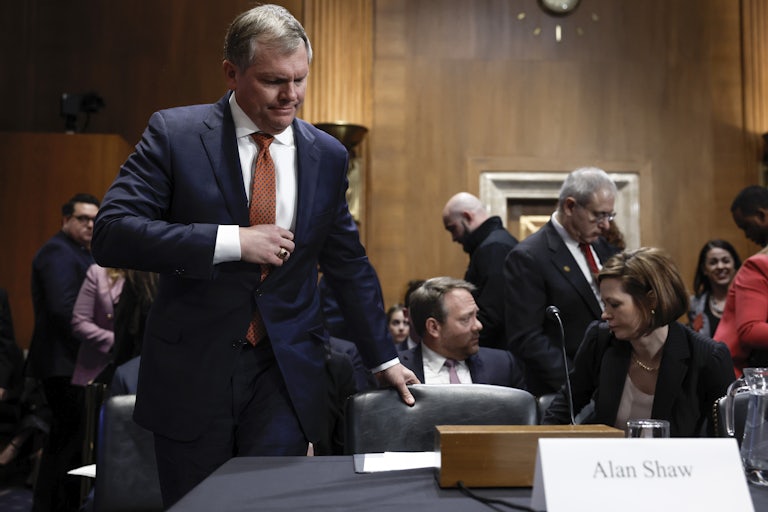
Alan Shaw pulls out his chair to sit down.
Anna Moneymaker/Getty Images
Alan Shaw, president and CEO of Norfolk Southern Corporation, arrives to testify before the Senate Environment and Public Works Committee on March 9.

Norfolk Southern CEO Alan Shaw told senators Thursday morning that his company is doing “what’s best” for the community of East Palestine in the wake of a disastrous train derailment. Shortly before he began speaking about the company’s renewed commitments to rail safety, another Norfolk Southern train derailed in Alabama.

The morning’s proceedings were the Senate Environment and Public Works Committee’s first hearing on the derailment of a Norfolk Southern train last month that has left people sick, animals dying, and residents wondering if it’s still safe to remain in the place they’ve lived in for generations.

Committee members spent much of their time grilling Shaw on questions ranging from how much support the company will pledge to the community to what it will do to lead the industry away from the kinds of practices that have resulted in disasters like those in East Palestine. Over and over, Shaw promised company support to those affected; over and over, he also demurred on the nitty-gritty questions about exactly how far companies will go to make railroads safer for both workers and the public.

The hearing began with opening remarks from Senators Sherrod Brown, Bob Casey Jr., and J.D. Vance. Casey challenged Shaw to support his bipartisan rail safety bill, which, among other things, calls for stronger safety standards for all trains carrying hazardous materials, expands those standards to trains not deemed “high-hazard,” and calls for a minimum of two-person crews on freight trains.

Brown echoed this suggestion and criticized Norfolk Southern’s adoption of the industry-wide, Wall Street–blessed, precision-scheduled railroading, or PSR, practices.

Precision-scheduled railroading is essentially a series of cost-saving measures, in the name of which rail companies have cut jobs and consolidated dispatch centers, making trains less safe, as fewer workers have less time to manage bigger trains.

Vance was a bit more idiosyncratic with his remarks. On one hand, the senator who likes to position himself as the sage of working-class America denounced some of his Republican colleagues “who seem to think that any public safety enhancements for the rail industry [are] somehow a violation of the free market.” Vance suggested the industry’s exclusive subsidies are already intervening in the free market. “Do we do the bidding of a massive industry that is embedded with big government, or do we do the bidding of the people who elected us to the Senate into the Congress in the first place?” Vance challenged.

On the other hand, Vance still maintained that it wasn’t simply deregulation bought by corporate greed that has led to these disasters. Vance claimed there was a slow response to the crisis in Ohio “because a certain segment of our leadership feels like the people of East Palestine are a little out of style. They have their own politics. They’re a little too rural, maybe a little too white.”

Shaw responded favorably to the idea of reforms but did not explicitly say he supports the entire bipartisan rail safety bill. Throughout the hearing, Shaw repeatedly claimed that Norfolk Southern has a “culture of safety”—one he commits to making better, by working with others to learn from the East Palestine derailment.

For her part, Senator Debbie Stabenow pointed out that at least 20 derailed Norfolk Southern trains had chemical releases; she questioned how Norfolk Southern would be “learning” from this instance if they hadn’t seemed to learn from the previous 20. “I don’t want number 21 in Michigan, or anywhere else for that matter,” she said.

On broader industry trends, Senator Sheldon Whitehouse described how much money the industry has pumped into lobbying for weaker regulation. Whitehouse focused specifically on the industry fighting against the implementation of updated electronic brakes, as opposed to the Civil War–era brakes generally used on freight trains now.

Senator Bernie Sanders asked Shaw point-blank whether the CEO would commit to leading an industry-wide charge to stop the practice of profit-chasing, job-cutting PSR. Shaw insisted the company was on a “hiring spree,” but Sanders pressed, countering that the company was just recouping from previous layoffs. Shaw declined to answer directly, instead saying that he “charted a new course in the industry,” by moving “away from a near-term focus solely on profits” and taking a “longer-term view,” with regard to its workers.

Sanders then brought up paid sick leave, which is still not guaranteed to all rail workers (though companies including Norfolk Southern have begun giving some workers paid sick days, ostensibly to stave off further regulation).

“Senator, I share your focus on our employees. I will commit to continuing to discuss with them important quality of life issues with our local craft colleagues,” Shaw said.

“With all due respect, you sound like a politician,” Sanders responded. “Paid sick days is not a radical concept in the year 2023. I am not hearing you make that commitment to guarantee that to all of your workers. Will you make that commitment, sir?”

Shaw repeated that he would speak to employees about “quality of life issues that are important to them.”

More on Norfolk Southern's Chemical Spill

Iowa and Arkansas Hop on the Extremist GOP Bandwagon to Criminalize Gender-Affirming Care for Trans Kids

Republican legislators claim they’re protecting children. Meanwhile, they’re also passing bills to loosen child labor laws.

Arkansas Governor Sarah Huckabee Sanders
Al Drago/Bloomberg/Getty Images
Arkansas Governor Sarah Huckabee Sanders

Iowa and Arkansas are the latest red states to pass bills cracking down on gender-affirming care for minors. Both bills are expected to become law.

The Iowa House of Representatives passed a bill Wednesday that would prohibit doctors from giving puberty blockers, hormone therapy, or gender-affirming surgeries to people under age 18. Five Republican lawmakers broke ranks to vote against the bill with Democrats. The measure had passed the Senate along party lines the night before. It now moves to Republican Governor Kim Reynolds, who is expected to sign it into law.

In Arkansas, the House passed a medical malpractice bill that would make it easier for people to sue doctors who give gender-affirming care to minors. Republican Governor Sarah Huckabee Sanders has said she supports the measure.

The bills are part of a much larger wave of state-level legislation targeting LGBTQ people, particularly transgender people. Also in Iowa this week, the Senate passed a bill that would prohibit transgender kids from using the school bathroom that does not match their sex at birth; and the state House passed a bill Wednesday that bans teaching kids about gender identity or sexual orientation until sixth grade.

The most common argument from lawmakers who support such bills is that they are looking out for the best interests of children. “Children should not be pushed to receive experimental medical treatments that can leave them permanently sterile and physically marred for life,” Iowa Senator Jeff Edler said when debating the gender-affirming care bill, citing false information.

“The governor has said that she supports bills that protect our kids and will support legislation like this that does just that,” a spokeswoman for Sanders told the Associated Press. “Only in the far-left’s woke vision of America is it not appropriate to protect children.”

Both states have also introduced legislation easing child labor protection laws. On Tuesday, Sanders signed a law rolling back her state’s only oversight mechanism for child labor. In Iowa, Republicans unveiled a bill in February that would allow teenagers to work in previously prohibited jobs, such as in slaughterhouses or meatpacking plants, or operating heavy machinery.

While that proposed law could endanger teenagers, gender-affirming care can be lifesaving for LGBTQ minors. A study published in January in the New England Journal of Medicine found that trans and nonbinary teens who receive gender-affirming care have significantly less depression and anxiety than before treatment.

The Human Rights Campaign and ACLU urged the states’ governors not to sign the bills. Iowa’s “heartless legislation puts craven politics ahead of the health and safety of young people, and should strike fear in the hearts of parents” throughout the state, said Cathryn Oakley, the HRC’s state legislative director.

The ACLU also slammed the Arkansas state legislature. “By choosing to ignore the voices of those who are most directly impacted by this legislation, Arkansas politicians are sending a clear message that they value political posturing over the health and wellbeing of their constituents,” the group said.