Breaking News
Breaking News
from Washington and beyond

Ron DeSantis Wants to Make It a Felony to Have an Undocumented Person in Your Home or Car

A new Florida bill criminalizes not just undocumented Floridians but anyone who associates with them.

Ron DeSantis
Scott Olson/Getty Images

Around 772,000 Florida workers, students, and community members are undocumented. And Governor Ron DeSantis wants to make it a felony for anyone to have them in their home or even give them a ride.

Senate Bill 1718, part of Desantis’s broad repressive legislative agenda this year, targets not just undocumented people but also anyone associated with them. The bill, which is likely to pass the Republican-controlled state legislature, criminalizes anyone who transports an undocumented person “into or within this state.” In other words, anyone—co-worker, friend, neighbor, classmate—giving a simple ride to someone they know or care about who is undocumented would be guilty of a third-degree felony.

The bill also criminalizes anyone who “conceals, harbors, or shields” (or “attempts” to do so) an undocumented person in “any place within this state.” Nearly 4 percent of Floridians are undocumented. The bill text, reading like an edict issued in Margaret Peterson Haddix’s Shadow Children series, foments fear about these hundreds of thousands of people. It isn’t hard to imagine law enforcement agencies conflating a house party or simple afternoon cup of tea with a secret migrant-harboring operation.

Under the framework, any person with a prior conviction who commits the “crime” of hosting an undocumented person would be liable to an even higher second-degree felony.

The bill imposes thousands of dollars of fines on private employers who give work to undocumented people; employers are not allowed to continue employing someone if they find out they are undocumented. And any undocumented person who works without appropriate identification papers would be liable to a third-degree felony. The bill also prohibits undocumented people from being admitted to the Florida bar, overturning standing law that currently allows it.

If the bill is passed into law, Florida would also refuse to recognize any out-of-state licenses issued to undocumented people. Authorities would be directed to take DNA samples from undocumented people who are booked into jails or detention facilities per orders from the Immigration and Customs Enforcement.

Finally, the bill orders Medicaid-accepting hospitals to ask patients to indicate their citizenship status. Ostensibly meant as a cost-tracker for undocumented patient care, the bill reads that the question must be accompanied with an assurance that the patient’s response will not affect care or result in a report to immigration authorities. However, given the extremity of the rest of the bill, even with regard to criminalizing people who host undocumented people in “any place,” the assurance does not welcome complete trust.

“Governor Ron DeSantis and his Republican colleagues continue to show that they are more focused on attacking and vilifying immigrants and Latinos to advance their political agenda than solving the real problems hurting Floridians,” said Congressional Hispanic Caucus Chair Nanette Barragán and Vice Chair of Policy Darren Soto, who represents Florida’s 9th district, in a statement.

Republicans hold supermajorities in both the Senate and House, and, of course, the governorship; the repressive bill that further criminalizes undocumented people—and the co-workers and classmates, neighbors, and friends with whom they’ve developed relationships—is set to pass.

“This should be the model for all 50 states going forward,” boasted state Senator Blaise Ingoglia, the sponsor of the draconian bill.

After Largest Bank Failure Since 2008, Nancy Mace Says Now Is Not the Time for Politics

The South Carolina representative seems to want to “thoughts-and-prayers” bank regulation.

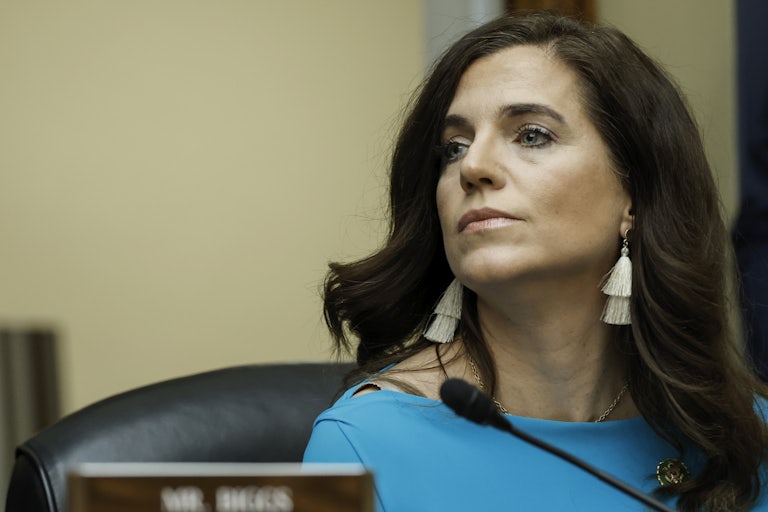
Nancy Mace
Anna Moneymaker/Getty Images
Representative Nancy Mace

As federal and state regulators rush to contain the fallout from the collapse of Silicon Valley Bank and Signature Bank, Representative Nancy Mace wants to make sure that we don’t politicize the situation.

The South Carolina Republican called out Elizabeth Warren on Monday night for discussing the inherently political issue of bank regulation. Warren, a.k.a. the person who would know best, slammed Congress and the Federal Reserve in a New York Times op-ed for failing to step in and prevent the banks’ failures.

Idk, probably shouldn’t politicize such a serious issue. Also your statements are irresponsible, false and poorly timed,” Mace tweeted.

Republicans have already been fast to blame literally anything but deregulation of the financial industry for the SVB and Signature breakdowns, particularly (mind-blowingly) diversity. But Mace is the first to say that rather than place blame anywhere at all, we should just thoughts-and-prayers away the problem.

Naturally, the internet had some thoughts.

Mace has developed a reputation for pandering to the left while voting staunchly with the right. She condemned Donald Trump’s role in January 6 but didn’t vote to impeach him. She says her party is becoming too anti-choice but continues to vote for anti-abortion measures.

But it’s not entirely clear what she hopes to achieve with her tweet. It’s not as if there’s a “little guy” to stick up for here. If anything, Mace is the one making “irresponsible, false and poorly timed” quips.

The New Inflation Report Has Some Signs of Hope

Here’s what you need to know about the Bureau of Labor Statistics’ new consumer price index report.

Shoppers are seen in a supermarket.
ELIJAH NOUVELAGE/AFP/Getty Images

Inflation is slowly but steadily going down, the consumer price index showed, according to a report released Tuesday by the Bureau of Labor Statistics.

The CPI measures the monthly change in prices that U.S. consumers pay for certain goods. It’s a key government indicator of inflation.

Here are three things to know about the inflation report and what it might mean going forward.

1. It has some of the lowest increases in more than a year.

Prices rose 6 percent in February compared to a year earlier. This is a decent slowdown from January, which saw prices go up 6.4 percent compared to the year before. This is the eighth consecutive month that the inflation rate has dropped and the smallest yearlong increase since September 2021.

Obviously, 6 percent is still high, especially considering the Federal Reserve’s target of 2 percent inflation. But the pace of inflation is slowing, decreasing to a 0.4 percent increase in February compared to 0.5 percent in January.

Removing the price increases for food and energy, which are always volatile even before the Covid-19 pandemic and the war in Ukraine tied up supply chains, prices rose 5.5 percent compared to last February. This is the smallest yearlong increase since December 2021.

Mark Zandi, the chief economist at economic research group Moody’s Analytics, said inflation was “headed in the right direction.”

Inflation is painfully high, but steadily receding. It is on track to be closer to 3% by year’s end, and the Fed’s inflation target by next summer,” he said on Twitter.

2. But inflation in key areas remains high.

Energy prices have been steadily decreasing over the past few months, which has contributed to the slowing inflation. Prices for fuel, gas, and electricity fell 0.6 percent from January.

But prices for food and shelter increased. Shelter, in particular, was the biggest contributor to prices hikes in February, with housing costs going up 0.8 percent. Part of that is due to the Fed’s aggressive campaign of raising interest rates, which has driven up mortgages even as home prices go down. People who own property are having to pay more, while people who can’t afford to buy are having to stay in the rental market. While rent costs have started to ease up, they’re still high due to high demand.

Costs for groceries went up 0.4 percent in February, and the price of eating out went up 0.3 percent.

3. What does this mean looking forward?

The Fed begins its policy-setting meeting Tuesday and was widely expected to hike interest rates by 0.25 percent for the second time.

The new CPI report is unlikely to affect that decision, but the Fed could be influenced by the recent closures of Silicon Valley Bank and Signature Bank. Regulators in California and New York, respectively, swooped in to shut down both banks after panicked customers began to withdraw their funds en masse.

Goldman Sachs chief economist Jan Hatzius predicted Sunday that the SVB and Signature failures would prompt the Fed to hold off on raising interest rates for now.

But Ian Shepherdson, chief economist at the consulting firm Pantheon Macroeconomics, thinks the Fed will stay the course.

“Assuming markets stay calm and no more banks fail, we think the Fed will hike” by 0.25 percent, he wrote in an analysis Tuesday.

“To be clear, we think further hikes are now unnecessary; the lagged effect of the increases over the past year are enough to push inflation back to target, but Fed officials have been unwilling so far to accept this argument.”

The U.S. central bank is scrambling to achieve a so-called soft landing, or a decrease in inflation without tipping the economy into a recession. The labor market has remained strong overall, causing concerns that the economy has not slowed sufficiently to avoid a downturn.

Dean Baker, senior economist at the Center for Economic Policy and Research, put the likelihood of a 0.25 percent hike at “50-50.”

“I think we have a very good shot [at a soft landing] as long as the Fed doesn’t get carried away,” he told The New Republic.

This post has been updated.

Biden to Issue Executive Order Increasing Background Checks on Gun Sales

Biden is expected to sign the order while visiting Monterey Park, California, where a deadly mass shooting took place earlier this year.

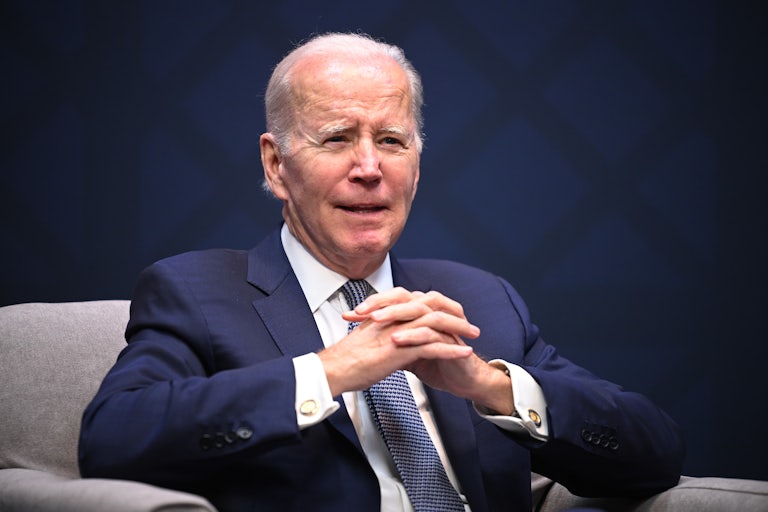
Joe Biden
Leon Neal/Getty Images

On Tuesday, President Biden is visiting Monterey Park, California—where 11 people were shot dead and another nine were injured amid a Lunar New Year Festival. At the site of the deadliest mass shooting in the history of Los Angeles County, Biden will sign an executive order seeking to increase the level of background checks conducted before gun sales.

The order will also direct his Cabinet to develop a plan for how the government can better support communities suffering from gun violence. The Cabinet is ordered to raise public awareness surrounding “red flag” laws, which allow people to ask a court to determine whether someone is dangerous and merits having their guns temporarily confiscated.

Another plank of the plan calls for Attorney General Merrick Garland to elevate focus on rules for federally licensed gun dealers, ensuring the dealers are compliant with background check requirements. Biden also directs Garland to develop and implement a program to stop dealers whose licenses have been revoked or surrendered from continuing to sell guns.

Biden’s order also calls for enhanced reporting of ballistics data on a federal, state, and local law enforcement level; currently, local and state law enforcement agencies are not required to report such data. The mandate’s aim is to strengthen a federal clearinghouse that helps law enforcement agencies match shell casings to guns.

Biden is also asking the Federal Trade Commission to issue a public report that analyzes how manufacturers market guns to minors.

The order is not so much an expansion of new regulation as a move to more properly carry out standing rules. It follows the Bipartisan Safer Communities Act, which passed last year after two shootings in May: one at a school in Uvalde, Texas, that left 19 children and two adults dead; the other a racist mass shooting in Buffalo, New York, that left 10 people dead.

The bill—though called “bipartisan,” it only had the support of 15 Republican senators and 14 Republican House members—focused more on mental health and school safety programs. The gun regulation aspect of the bill focused mainly on expanding background checks for gun purchasers under the age of 21 and attempting to close the so-called “boyfriend loophole,” disqualifying anyone found guilty of a domestic violence charge in a romantic relationship from purchasing firearms, regardless of marital status.

Biden’s direction is a welcome one. But until there’s a more meaningful crackdown on guns themselves, and until Republicans are not allowed to keep posturing as standing behind “commonsense” gun reforms while mostly not voting for even the most basic policies, people will keep dying.

Republicans Who Pushed for Financial Deregulation Blame Silicon Valley Bank Collapse on “Woke Agenda”

A list of Republicans blaming the bank failure on wokeness, contrasted with their own record.

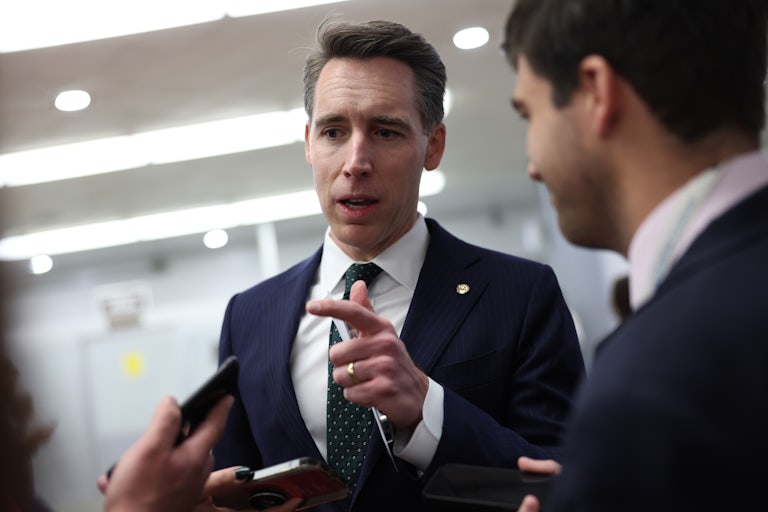
Senator Josh Hawley speaking
Kevin Dietsch/Getty Images
Senator Josh Hawley

In the aftermath of the collapse of bloated tech lender Silicon Valley Bank, conservatives have flailed around, lazily throwing any culprit at the wall except the-word-that-must-not-be-said: deregulation.

Republican members of Congress are blaming “wokeness,” critical race theory, and diversity, equity, and inclusion—ignoring their own history of pushing for a deregulated financial industry.

Missouri Senator Josh Hawley on Monday complained that SVB was “too woke to fail,” opining that “these SVB guys spend all their time funding woke garbage (‘climate change solutions’) rather than actual banking and now want a handout from taxpayers to save them.” SVB, of course, lends money to any number of start-ups, plausibly including ones aiming to address climate change (and like any capital-driven financial institution, that’s definitely not its main focus). And Hawley—while posturing as a pro-worker, hardscrabble leader—has actually sought to weaken consumer protection and bank regulation.

After the 2008 financial crisis, the Obama-era Dodd-Frank reforms helped establish the Consumer Finance Protection Bureau. Spearheaded by Senator Elizabeth Warren, the agency’s main task was to watchdog banks, lenders, securities firms, debt collectors, and so on to try to protect consumers. The CFPB has conducted oversight including fining Wells Fargo $100 million for transferring funds from authorized customer accounts to covertly opened unauthorized accounts in order to accrue fees and other secret charges. All that’s to say, to any regular person, the CFPB would be an organization worth strengthening, not weakening.

Not to Hawley, however. In 2017, the then–Missouri attorney general signed onto an amicus brief attacking the CFPB for “out-of-control regulations”; Hawley’s brief was tied to a lawsuit filed by PHH Corporation, a massive mortgage lender that was fighting a $109 million CFPB fine for overcharging loans to consumers and for an alleged “kickback scheme.” PHH allegedly referred customers to mortgage insurers it partnered with, and in exchange for the referral, the mortgage insurers purchased “reinsurance” from the PHH’s subsidiary companies.

With Hawley’s help, the company won, on the grounds that other agencies refused to go after PHH for the fraudulent scheme in the past; the court moreover ruled that the White House could remove the director of the CFPB at will. Hawley could’ve chosen to argue that regulation of the financial industry should be stronger, not weaker; he chose the latter.

Meanwhile, an array of Hawley’s fellow Republicans peddle the charade while having their own hands dirty. Florida Governor Ron DeSantis and Representatives Virginia Foxx, James Comer, and Andy Biggs have all come out with “woke” statements blazing, as they deride Biden’s plan to support depositors without burdening any taxpayers.

In 2018, all four Republicans voted to roll back Dodd-Frank rules that would have subjected Silicon Valley Bank to stronger regulations and stress tests to determine its stability and security.

Representative Ronny Jackson has also come out in full self-parodizing form:

While relatively newer to Congress, Jackson has had plenty of time to focus on the financial sector. One bill he has signed onto would prevent the Treasury Department from requiring a financial institution to report transfers in and out of accounts. Three more he’s signed onto would block a Securities and Exchange rule for companies to disclose their greenhouse gas emissions, in order to better tackle climate-related catastrophes.

Jackson, like the rest of his party, seems so deeply preoccupied with not letting shady corporate interests off the hook.