Breaking News
Breaking News
from Washington and beyond

What Is Silicon Valley Bank, and Why Is It Collapsing?

The nation’s sixteenth-largest bank—and a favorite of tech startups—is having The Worst Week Ever.

Silicon Valley Bank
Smith Collection/Gado/Getty Images

Silicon Valley Bank, a major lender for tech startups, was shut down Friday by California regulators.

SVB was struggling to raise enough funds to offset a nearly $2 billion loss on bond sales. Customers worried that the bank would collapse entirely and rushed to withdraw their funds, further destabilizing it.

The California Department of Financial Protection and Innovation swooped in and closed the bank Friday morning, putting the Federal Deposit Insurance Corporation, or FDIC, in charge of SVB’s assets.

The FDIC announced that SVB’s branches will reopen Monday, and insured customers will be able to access their deposits then.

Here is a look at what happened to Silicon Valley Bank.

1. What is Silicon Valley Bank?

Silicon Valley Bank is the sixteenth-largest bank in the United States. It primarily operates in Northern California and thus is relatively unknown outside of Silicon Valley.

However, the bank partnered with nearly half of all venture-backed technology and life sciences companies in the U.S. Silicon Valley Bank lent to higher-risk startups that have taken a hit from the Federal Reserve’s high interest rates as well as decreasing venture capital investment.

2. What went wrong?

Silicon Valley Bank announced Wednesday evening that it needed to raise more than $2 billion. It outlined a plan to do so that included selling $1.25 billion in common stock, which are shares that give holders voting rights, and $500 million in convertible preferred shares, which do not give the holder voting rights.

SVB also said that investment firm General Atlantic had agreed to a deal to sell $500 million in common stock.

But SVB’s customers were apparently not appeased by the plan, and the bank’s stock value has plummeted at least 60 percent since then.

3. What caused the collapse?

The Fed has hiked interest rates aggressively over the past year to try to bring down record-high inflation. The higher rates caused venture capital investments to shrink, while the bank’s clients used up cash much faster than before due to price increases. As a result, SVB’s startup customers had far less money to deposit.

To make up for its cash losses, SVB sold $21 billion in securities—but at a $1.8 billion loss, prompting the plan to sell off shares and stabilize itself with the new funds.

Instead, investors panicked and began withdrawing their money from the bank. This created a vicious feedback loop, where the bank appeared increasingly unstable and unsustainable, prompting more customers to take out their money.

4. What was the bank trying to do?

SVB was in talks to sell itself, right up until regulators took over, after its attempts to raise more cash failed. Several large financial institutions were reportedly considering purchasing the bank.

But because so much money was flowing out as customers withdrew their funds, it was difficult to assess SVB’s value anymore, making it less appealing to any potential buyers.

5. Why is this important?

Investors are worried that SVB’s troubles are a bellwether of what is to come for the rest of Silicon Valley, and the financial sector at large. The day before SVB announced its fundraising plan, cryptocurrency lender Silvergate Capital Corp said it would be shutting down, rattling the market. Shares in other banks fell Thursday as concerns over SVB grew.

The high interest rates mean that other banks that attempt to sell off bonds to make fast cash will be forced to do so at a loss, like SVB, according to Bloomberg. If customers get nervous, banks will have to compete harder to keep them, for instance by offering higher interest rates on savings. Doing that will chip away at what the banks are able to earn for themselves.

Things will be particularly difficult for small and midsize banks, Bloomberg noted. Those institutions don’t have as many funding flows, meaning they would have to sell more stock and take more hits.
Trump Will Probably Be Forced to Listen to the Revolting Access Hollywood Tape in Court

A judge has ruled that the offensive recording can be used as evidence in E. Jean Carroll’s defamation trial against him.

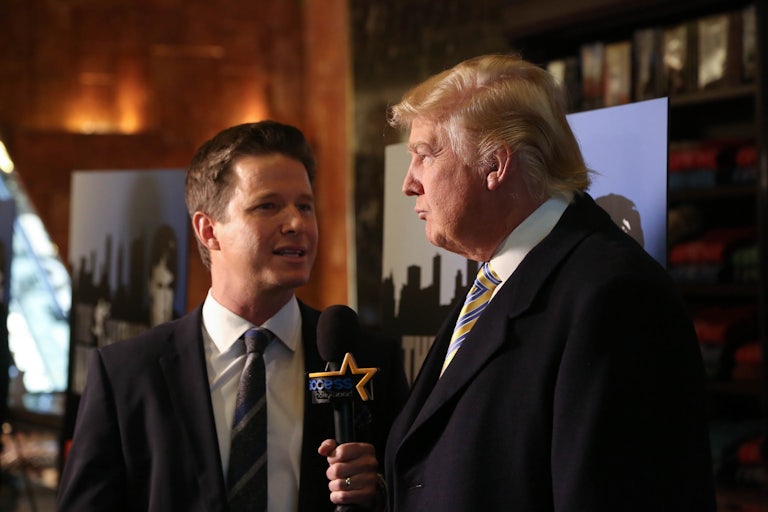
Billy Bush of “Access Hollywood” interviews Trump
Rob Kim/Getty Images
Billy Bush of “Access Hollywood” interviews Trump in 2015.

A federal judge ruled Friday that the infamous Access Hollywood tape in which Donald Trump bragged about groping women without their consent can be used as evidence in the defamation trial brought by a woman accusing him of rape.

Writer E. Jean Carroll is suing Trump for defamation and sexual assault. Trump has rejected the rape allegation and repeatedly argued that the 2005 recording of him was just “locker-room talk,” and thus irrelevant to the case.

But Judge Lewis Kaplan determined otherwise. “In this case, a jury reasonably could find, even from the Access Hollywood tape alone, that Mr. Trump admitted in the Access Hollywood tape that he in fact has had contact with women’s genitalia in the past without their consent, or that he had attempted to do so,” he wrote in his decision.

Kaplan also ruled that testimony from two other women who accuse Trump of sexually assaulting them can be introduced as evidence in the trial. Most of the evidence that Mr. Trump seeks to keep from the trial jury is to the effect that Mr. Trump allegedly has abused or attempted to abuse women other than Ms. Carroll in ways that are comparable to what he allegedly did to Ms. Carroll,” he wrote in his decision. “In other words, Ms. Carroll offers evidence to show that Mr. Trump has a propensity for such behavior.”

Carroll accused Trump in her 2019 memoir of raping her in the Manhattan Bergdorf Goodman department store in the mid-1990s. She has sued him twice for defamation: first in 2019, when he said she made up the rape allegation to promote her book, and again in November for posts he made about her on social media. She isn’t alone: At least 26 women have accused Trump of sexual harassment or assault since the 1970s, all of which he has denied.

The Access Hollywood tape, from a 2005 taping of the show, caught Trump on a hot mic saying, “When you’re a star, they let you do it. You can do anything. Grab ’em by the pussy.” It became public in 2016, just days before his second debate against Democratic presidential nominee Hillary Clinton.

Now, it seems, Trump will soon have to hear the tape replayed to him in court. Kaplan has set the trial date for April 25.

Is This How Trump Ends Up in Jail?

His hush payments to Stormy Daniels and subsequent cover-up are hardly his biggest crimes, but the Manhattan D.A.’s invitation for Trump to testify suggests he may be indicted for them.

Anna Moneymaker/Getty Images

Finally, after decades, the law might be catching up with Donald Trump. The invitation to him to testify next week from Manhattan District Attorney Alvin Bragg signals, according to many reports, that Bragg’s investigation into the Stormy Daniels matter is winding down and that an indictment of Trump may be imminent. The indictment would be for breaking election and business record laws by allegedly paying $130,000 in hush money to Daniels and subsequently covering it up.

Not his biggest crime, by a long shot. I’d rank it about fifth at best (fomenting an insurrection, accepting foreign help during a campaign, ordering a state official to “find” 11,780 votes, all the tax stuff over many decades, for starters). But even so, a felony.

Trump denies it, of course. He claims he had no interest in Stormy Daniels (whom he refers to as “Horseface”). It’s all a “Witch-Hunt,” like all the other hoaxes. His statement mentioned George Soros, the “Radical Left media,” Hunter Biden, and violent crime (although not the violent crimes allegedly committed by him, as in against his first wife and E. Jean Carroll).

The law grinds slowly. Politics, however, like Niagara Falls, never stops. So what are the politics of this? It likely has a marginally positive impact for Trump in a GOP presidential primary. It gives him another target, something else to whine about. I doubt his opponents will really be able to attack him over it; they’ll just sound like they’re defending the corrupt, Soros-backed, radical-left deep state.

One little-examined question, however, is whether an indicted Trump draws an anti-Trump Republican primary vote to the polls. For example, there are about 5.3 million registered Republicans in Florida. In the 2016 primary (the most recent competitive one), about 2.3 million people voted. That’s not bad, for a primary. Still, it means 57 percent of Republicans didn’t vote, and we can reasonably assume, because all the political science says so, that the primary voters were more extreme ideologically than nonvoters. So if half a million or so less-MAGA-oriented Republicans come out in a primary to vote against Trump, he loses. He maybe loses in that state to Ron DeSantis anyway, but the basic formula repeats elsewhere.

Anyway. Just reading his crazy statement is a chilling reminder of what life was like when we had to pay attention to that maniac every day. He’s just the most poisonous person ever. What a joyous day it would be if he were actually hauled off to a jail cell.

Feeling Bold, GOP Now Pushes for D.C. Cops to Use Neck Restraints and Hide Body Cams

Republicans are pretty high on the whole “overturn democratically approved D.C. reforms” thing.

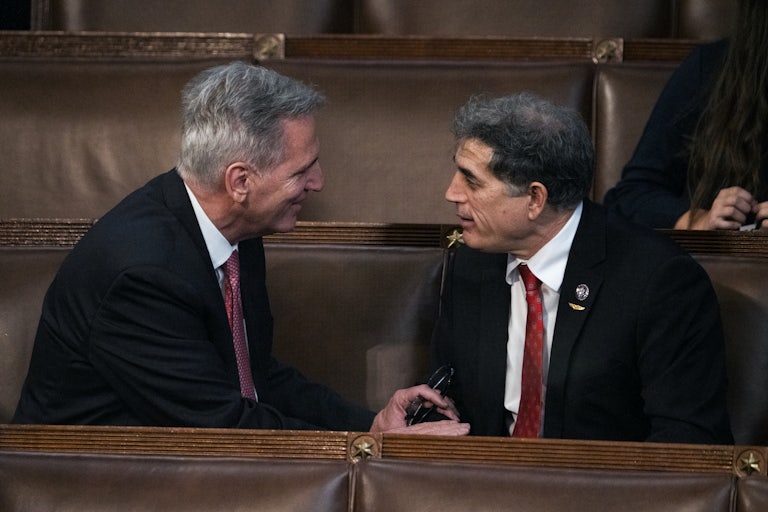
Andrew Clyde and Kevin McCarthy talk while seated.
Tom Williams/CQ-Roll Call, Inc/Getty Images
Representative Andrew Clyde (right) talks to Kevin McCarthy during the speaker of the House drama in January 2023.

Not even a full day after the Senate overwhelmingly voted to overturn Washington, D.C.’s criminal code updates, Republicans are now pushing for D.C. officers to be able to put people in chokeholds and more easily hide their body camera footage.

Republican Representatives Andrew Clyde and Andrew Garbarino introduced a House resolution Thursday targeting criminal justice and policing reforms made in the aftermath of a string of police killings, including the deaths of George Floyd and Breonna Taylor.

The duo is specifically targeting D.C.’s Comprehensive Policing and Justice Reform Emergency Amendment Act of 2022, Axios reports. The D.C. legislation, which passed the City Council last year but is now being reviewed by Congress, enacts an array of reforms, such as outlawing the use of neck restraints, like that used by Minneapolis Police Officer Derek Chauvin to kill Floyd in May 2020. The bill also calls to make body camera footage of officer-caused deaths or serious uses of officer force more accessible to the public.

The D.C. legislation also seeks to expand membership and inclusion on governing bodies like the Police Complaints Board and Use of Force Review Board. It would also ban employment of new officers if they were previously determined by agencies to have committed serious misconduct or to have been forced out of previous roles for “disciplinary reasons.”

Some of the policies, like banning police neck restraints, had been enacted through temporary legislation since the summer of 2020. But all these were to be codified by the  broader reform package that Republicans are now vying to overturn. Axios reports that the resolution to overturn such baseline reforms already has 15 co-sponsors.

While this new GOP effort in favor of chokeholds and against democratically approved reforms may seem particularly brazen, it’s clearly about momentum. Just yesterday, a successful right-wing-driven campaign against D.C. updating its 100-year-old criminal codes led to 81 senators voting to overrule the criminal code updates.

The updated criminal codes were even more modest than the police reforms now being challenged; they mainly dusted off archaic standards and effectively made it easier for courts to prosecute crimes. But overturning these mild policies clearly emboldened Republicans to go a step further. 

Texas Wants to Appoint a Special Prosecutor to Pursue People Who Get Abortions

Because not enough people are getting punished, apparently

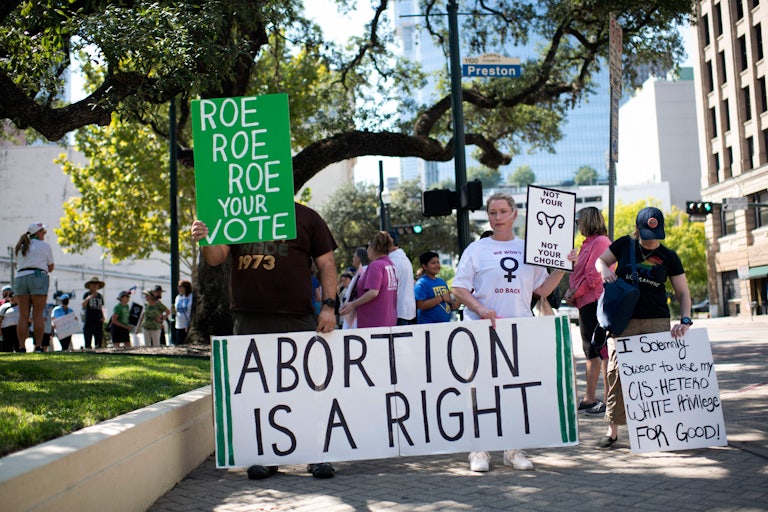
Demonstrators carry pro-choice signs.
MARK FELIX/AFP/Getty Images
Abortion rights demonstrators march outside the Harris County Courthouse in Houston, in October.

A Republican lawmaker in Texas has introduced a bill to appoint a state special prosecutor to handle abortion law violations, among other issues, The Washington Post’s Caroline Kitchener reported Thursday.

The bill, introduced in the state House of Representatives Wednesday, would let the state Supreme Court appoint a special prosecutor to handle violations of Texas election laws, human trafficking cases, and violations of the state’s abortion laws.

Since Roe v. Wade was overturned, Texas has banned abortion after six weeks, before many people even know they are pregnant. There are no exceptions for rape or incest, and only a few to save the life of the pregnant person. Individuals are also allowed to sue anyone who provides abortion care or helps someone get an abortion, in what’s known as the state’s vigilante law.

But apparently not satisfied with that, Texas Republicans have begun to introduce bill after bill to curb access to abortion, despite the fact that six out of 10 Texas voters say they support abortion in all or most cases.

One lawmaker introduced a bill in February that would compel internet providers in Texas to block websites that sell or provide information on how to obtain abortion pills. Just last week, another official introduced a bill that would ban credit card companies from processing transactions for abortion pills. Both measures are aimed at cutting off a crucial resource in maintaining access to safe abortion.

Texas is not the only state to ignore what constituents actually want when it comes to abortion laws. Georgia Republicans have introduced a bill that would classify abortion as homicide, despite almost two-thirds of Georgia voters already objecting to current abortion restrictions. A Kentucky lawmaker also introduced a bill classifying abortion as homicide, even though the state voted to protect abortion access during the midterm elections.

The most egregious example is Kansas, where residents voted in August to keep abortion protections in the state constitution. Lawmakers responded by introducing legislation that would let individual cities and counties ban the procedure, a blatant attempt to override the will of the people.

Writer Jessica Valenti pointed out that the latest Texas legislation could be how anti-abortion lawmakers make sure their agenda gets carried out. She noted that many district attorneys are refusing to pursue cases that criminalize abortion, so a special prosecutor for abortion law violations would make sure people are punished for getting the procedure.

One such attorney to take a principled stand against abortion prosecutions was Andrew Warren, a state attorney in Florida who had signed a joint statement with other elected prosecutors the day Roe was overturned, stating “our firm belief that prosecutors have a responsibility to refrain from using limited criminal legal system resources to criminalize personal medical decisions,” such as abortion or transgender health care.

Florida Governor Ron DeSantis fired Warren for signing the statement.