Breaking News
Breaking News
from Washington and beyond

GOP Rep. Andy Ogles Seems to Have Kept $25,000 From a GoFundMe for a Child Burial Garden

The freshman Republican raised the money using a photo of his stillborn child.

Representative Andy Ogles close-up
Francis Chung/POLITICO/AP Images
Representative Andy Ogles

Tennessee Representative Andy Ogles appears to have kept money raised through a charitable GoFundMe event, making him the second freshman Republican member of Congress in hot water over dubious fundraising efforts.

An investigation by NewsChannel5 found that Ogles set up a GoFundMe in 2014 after his son was stillborn. Ogles said he wanted to build a garden where families could bury their stillborn children and sit on benches by the gravestones. The GoFundMe raised almost $25,000, but the garden was never built.

GoFundMe confirmed that Ogles received the money. He declined to answer any of NewsChannel5’s questions about what happened to the funds:

“Congressman, this doesn’t have to be a story if you just offer some evidence it went for a good cause,” we told him, as he got into a truck and slammed the door.

Ogles had told The Tennessean in 2015 that “burials are heavily regulated,” preventing them from buying all the plots necessary to start the garden. He promised that none of the money had been spent.

The funeral director of Williamson Memorial Funeral Home was quoted in the same story saying she planned to meet with the Ogles family to help organize their plans. But eight years later, she told NewsChannel5, the family never followed up with her.

One donor, speaking anonymously, said he asked Ogles what happened to the money and, when he didn’t get a clear answer, asked for a refund. This donor got his money back, but others said they were not given the same option.

Ogles is already under fire for appearing to lie about his background. Another NewsChannel5 investigation revealed that although the lawmaker says he studied “policy and economics,” his college transcript shows that Ogles majored in liberal studies and actually failed the one economics class he took.

The Tennessee Republican isn’t the first member of Congress seemingly making up parts of their background. One of George Santos’s many falsehoods is that in May 2016, the New York representative allegedly raised $3,000 for a homeless and disabled veteran’s service dog—only to take the money and run.

Santos also appears to have lied that his mother survived 9/11 (she was not even in the country), that his grandparents fled the Holocaust, and that four of his employees were killed in the Pulse nightclub shooting, among many, many other examples.

Florida Representative Anna Paulina Luna has also claimed Jewish heritage, but not only does she appear to have no ties to Judaism, her grandfather may have served in the Nazi army.


Instead of Fixing an Already Broken Industry, Government Approves Another Rail Merger

The merger of Canadian Pacific and Kansas City Southern comes as East Palestine, Ohio, is still recovering from a disastrous train derailment.

Whitney Curtis/Bloomberg/Getty Images
A Kansas City Southern railway locomotive passes through Kansas City, Missouri.

After a Norfolk Southern derailment crippled East Palestine, Ohio, and after Congress had its first hearing taking the company to task for industry corruption, federal regulators on Wednesday approved the first major U.S. corporate railroad merger in more than two decades: Canadian Pacific’s $31 billion acquisition of Kansas City Southern.

The merger combines the two smallest of the largest railroad companies in the country; the combined duo will now reduce the number of Class I freight railroads from seven down to six. Moreover, the merger of the two will create the only railroad that links Canada, Mexico, and the United States.

Previously, Canadian National railroad had attempted to buy Kansas City Southern for $33.6 billion, but the plan fell through after the Surface Transportation Board rejected part of the merger plan.

While workers and regulators aim to get a hold on a runaway industry driven by a practice known as precision scheduled railroading, or PSR, that has cut jobs and made trains bigger and bigger—thus making the whole industry less safe—it’s worth noting the relevance of this consolidation.

In 2011, billionaire investor Bill Ackman was undergoing a proxy battle with the railroad’s board of directors. He won and installed Hunter Harrison—a railway executive who pioneered PSR at the smaller Illinois Central Railroad—as president and CEO of Canadian Pacific. Once there, he continued his PSR regime, further spurring the industry to be more profit-driven and less safety-oriented.

Now one of the test subjects of PSR becomes another emblem of consolidation, which opponents worry will lead to further job losses and fewer consumer choices in an already consolidated industry.

While proponents say the merger will allow for more shipments and a stronger linkage between the three nations in North America, there’s surely reason for scrutiny. Existing debilitating conditions for workers and a status quo of over 1,000 derailments a year does not offer trust in the industry. A Surface Transportation Board analysis also found that the merger would increase the deployment of longer trains and more tank cars carrying hazardous materials, and even increase the already high risk of train derailments.

There’s also the matter of worker negotiations. Last year, the Biden administration imposed a rail contract on workers that left them with no paid sick leave. On the same day that the U.S. Senate rejected an amendment to add paid sick leave days to the negotiations, Canada announced it would offer 10 days of paid sick leave to workers in the federally regulated private sector—which includes Canadian Pacific. Still, some of their workers are in the United States; now, Canadian Pacific must align with Kansas City Southern on worker benefit and wage packages, negotiating with their respective workforces together.

That the companies will need to navigate aligning how they treat their workers points to the broader issue. While regulators approve such a consequential merger, we have yet to address the current problems that plague the industry and that will only be compounded by the merger: unequal and insufficient worker wages and protections, a too-high risk of derailments, weak classifications of how much regulation should be on trains carrying hazardous materials, and weak safety standards for all trains. It has been barely a month since the East Palestine derailment—and the government appears readier to approve more consolidation than it is to address what led to such a disaster at all.

Who Is Matthew Kacsmaryk, the Judge Who Could Pull Abortion Pills From the Market?

The Trump-appointed judge is set to issue a decision on mifepristone, one of two drugs used in medication abortion. Here’s what his track record reveals.

Protesters hold signs that read "Abortion is Health Care," "Defend Medication Abortion, Bigger than Roe," and "Not Your Uterus Not Your Decision."
MOISES AVILA/AFP/Getty Images
Abortion rights advocates gather in front of the J. Marvin Jones Federal Building and Courthouse in Amarillo, Texas, on March 15. The Texas court is considering a national ban on mifepristone, a widely used abortion pill.

Texas-based Judge Matthew Kacsmaryk is poised to change the entire market for abortion pills.

Kacsmaryk, who was nominated by former President Donald Trump in 2019, is a known conservative and has a track record of viewing abortion unfavorably. He is currently hearing arguments over whether the Food and Drug Administration improperly approved mifepristone for widespread use more than 20 years ago. Reports from the Wednesday hearing thus far indicate that Kacsmaryk entertained disproven claims that the abortion medication is unsafe.

A coalition of anti-abortion groups and individuals filed the lawsuit in November specifically in Amarillo, Texas. Amarillo is a federal district with a single judge, meaning the plaintiffs could essentially guarantee that Kacsmaryk would hear their case, a practice known as “forum shopping.”

It seems unethical, but it’s a common practice on both sides of the political divide. During the 2017 Senate hearing for his current job, Kacsmaryk promised to be fair and said he didn’t believe judges should impose their religious beliefs on their rulings. But his actions both during and before his judicial career have abortion rights advocates bracing for one of the biggest blows since Roe v. Wade was overturned.

Kacsmaryk and his siblings were raised deeply Christian and taught from an early age that abortion was wrong. Over the years, he has published multiple essays arguing against the procedure, including in college, when he described abortion as “the federally sanctioned eradication of innocent human life.”

Kacsmaryk worked for several law firms in the early 2000s and at different divisions of the U.S. Attorney’s Office for the Northern District of Texas from 2008 to 2013.

In 2014, he became the deputy general counsel at First Liberty Institute, a conservative legal group that has challenged anti-discrimination laws and birth control coverage. During his time there, Kacsmaryk represented the Christian owners of a bakery in Oregon who refused to make a wedding cake for a same-sex couple.

In commentary and legal briefs, he said same-sex marriage would send the U.S. “on a road to potential tyranny,” and the demand for “so-called marriage equality” was a “complete abuse of rule of law principles.”

Two months before Trump nominated him to the bench, Kacsmaryk met with administration budget officials at the White House to argue that businesses should be allowed to refuse to cover their employees’ contraception based on religious or moral beliefs.

Kacsmaryk also served as a trustee of Christian Homes and Family Services starting in 2014. The group works to dissuade people from getting abortions and instead carry the pregnancy to term and then give the child up for adoption to a Christian family.

Although Kacsmaryk left the organization’s board when he joined the bench in 2019, he and his wife are still donors.

Since assuming his current position, Kacsmaryk has ruled in several high-profile cases, including striking down Biden administration protections for transgender people and forcing thousands of asylum-seekers to return to Mexico while their cases are processed.

Most recently, in December, Kacsmaryk ruled that health clinics that provide birth control to minors violate Texas law and federal constitutional rights, shutting down a crucial channel for reproductive health care in the state.

If he rules that mifepristone was improperly approved, the case will likely be appealed. It could go all the way to the Supreme Court, but the nine justices have already made clear what they think about abortion rights. And it isn’t looking good.

San Francisco Board Open to Paying Black Residents $5 Million in Reparations

The city’s board of supervisors moved forward a draft plan with suggestions on how to compensate Black residents for centuries of slavery and systemic racism.

Shamann Walton seated with a mic before him
Santiago Mejia/San Francisco Chronicle/Getty Images
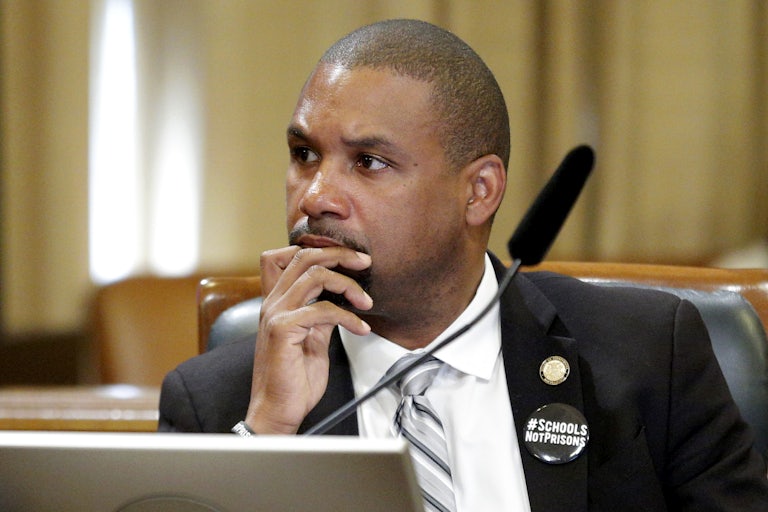
Supervisor Shamann Walton

The San Francisco Board of Supervisors unanimously accepted a draft plan with suggestions on how to pay millions in reparations to the city’s Black residents, in an effort to atone for centuries of slavery and systemic racism.

The case for reparations has been made many times in recent years, particularly after the murder of George Floyd in 2020. California was the first state to establish a task force to determine how to compensate for the legacy of slavery and racist policies made after the practice of enslaving people was abolished, both of which have crippled Black people’s economic mobility.

San Francisco is the first major city to propose a reparations plan, and its draft, put forward in December, is “unmatched nationwide in its specificity and breadth,” as described by the Associated Press. Under the plan, suggestions include giving every eligible Black adult a lump payment of $5 million. Personal debt and tax burdens could be eliminated, annual incomes of at least $97,000 for 250 years could be guaranteed, and families in San Francisco could get a home for just $1. More than 100 recommendations are included in the draft proposal, though no specific plan has been formally accepted yet.

“Those of my constituents who lost their minds about this proposal, it’s not something we’re doing or we would do for other people,” San Francisco Supervisor Rafael Mandelman said during the five-hour hearing Tuesday night. “It’s something we would do for our future, for everybody’s collective future.”

The plan does not say how much the proposed payments would cost the city, nor is it clear how many San Franciscans would be eligible. Critics argue that it’s unreasonable to pay reparations in a city or state that never enslaved Black people. But advocates of the plan note that the majority of data and historical evidence shows that after slavery ended in 1865, policies and practices across the nation helped curb the rights of Black Americans.

The African American Reparations Advisory Committee, which proposed the plan, has until June to put forward a final report on reparations. Until then, the board of supervisors can approve, change, or reject any or all of the plan’s points.

The California state reparations committee is due to give a final report in July.

Other cities are toying with reparations too. The Chicago suburb of Evanston became the first city to pay for reparations, offering eligible residents funding for home repairs, down payments, and interest or late penalties for property. Experts say Evanston’s approach is a good start but has a ways to go in terms of achieving actual justice.

Leaders in Asheville, North Carolina, have also promised reparations through funding housing, business, and career programs for Black city residents. The City Council in Boston approved a reparations study task force in December.

Texas Representative Sheila Jackson Lee introduced a bill in 2021 to develop a reparations study task force. President Joe Biden has expressed support for studying reparations, but he has yet to back Lee’s bill, and the issue has yet to be seriously discussed at the federal level.

Oklahoma Republicans Stop Bill That Would’ve Banned Hitting Disabled Kids at School

Republican lawmakers read Bible verses and talked about the need for physical discipline, before voting against the bill.

Oklahoma State Capitol building
Getty Images
Oklahoma State Capitol building

A just society would not allow teachers to hit disabled kids at school. Sounds reasonable enough, right? Well, Oklahoma Republicans disagree.

On Tuesday, the Oklahoma House, in which Republicans have a supermajority, voted against House Bill 1028, which would have outlawed school district personnel from “using corporal punishment on any student identified with a disability in accordance with the Individuals with Disabilities Education Act.”

After lawmakers read Bible verses and talked about the need for physical discipline, the measure failed to proceed by a vote of 45–43 (though a narrow majority, the bill needed 51 votes to pass).

Current Oklahoma law only prohibits “deliberate infliction of physical pain” to discipline students with “the most significant cognitive disabilities.” Even then, schools can obtain permission from parents or guardians to supersede the ban.

“The rod and reproof give wisdom. But a child left to himself bringeth his mother to shame,” said Republican Representative Jim Olsen. “So that would seem to endorse the use of corporal punishment. So, how would you reconcile this bill with scripture’s counsel on this matter?” he asked Representative John Talley, a proponent for the bill.

Olsen then asked, “On what basis would we automatically conclude a special needs child should not get corporal punishment?” as if there’s some dangerous risk in allowing children not to be hit by their teachers.

Olsen proceeded to nonblushingly cite a constituent call he apparently received from someone who said their “special needs” child “did not respond to positive motivation but that she responded very well to corporal punishment.”

According to his biography, Olsen himself serves as a Sunday school teacher.

Another Republican representative, Randy Randleman, actually wanted to get into the minutiae of the bill to make sure parents could still freely hit their kids.

“A child could have dyslexia, and then you couldn’t spank him, correct?” he said. “I would never spank an emotional problem, I would never spank a neurological problem,” he continued, in curious syntactical manner. “But if a parent has the choice, and they know that it can stop a misbehavior for behavioral problem, is this bill stopping that?”

Again, the bill’s bare-minimum ambition was just to outlaw school staff (not even all people) from being able to hit disabled children (not even all children).

“‘You can’t touch me.’ I hear that over and over. I don’t want to hear that in school,” Randleman said.

Randleman (supposedly a certified teacher, counselor, principal, psychometrist, school psychologist, and superintendent) has “a passion for children—his children, your children, Oklahoma’s children,” according to his biography.

“We need to help teachers understand how to discipline difficult children while keeping consistency in all classrooms,” he says in his bio.