Breaking News
Breaking News
from Washington and beyond

Texas GOP Bill Would Ban Students From China and 3 Other Countries From All Public Universities

Texas Republicans are fanning the flames of xenophobia and racism.

Brandon Bell/Getty Images
Texas State Capitol

Texas Republican lawmakers are under fire for a bill that would ban students from China and three other countries from all public colleges and universities in the state, with many calling the measure racist and xenophobic.

The bill, introduced last week, would prohibit higher education institutions from admitting international students from China, Iran, North Korea, and Russia, or any students who are undocumented. It also changes existing law to restrict the definition of a Texas resident. People who received a high school diploma or equivalent in Texas and lived in the state for three years prior to receiving that degree or for the year prior to enrolling in higher education no longer count.

The measure has “little chance of advancing” in the current legislative session, according to the San Antonio Express News, but it has still raised fears as it comes just two months after other Texas Republicans introduced a bill banning citizens from the same countries from purchasing land in the state.

That bill garnered months of backlash. Governor Greg Abbott endorsed the measure, even as local Asian American groups slammed it as racist.

Lawmakers amended the bill earlier this month to clarify that dual citizens and green card holders would still be allowed to buy property. But their attempt to cool the controversy was rightfully called out.

It’s still a fundamentally racist bill as it unfairly targets H1B visa holders, students, and refugees from exercising their full property rights,” the Texas-based Asian American group Rise AAPI said.

Both of these bills are painfully reminiscent of the Chinese Exclusion Act, which was enacted in 1882 and restricted Chinese immigration to and rights in the United States until 1943. That measure was a direct result of “yellow peril,” or racist fearmongering about Asian people. The heightened political tensions around race helped set the stage for much broader political scapegoating, when people of color were specifically blamed for issues in American society.

More recently, citizens of Iran and North Korea were targeted for years under former President Donald Trump’s travel ban. (Levels of immigration from North Korea to the United States are, of course, quite low.)

The Texas bills are also coming at a time of increased racial scapegoating. The nonprofit Stop AAPI Hate released a report in October that found Asian Americans are blamed for issues with the economy, public health, and national security.

Trump helped foment a lot of resentment towards China and Asian Americans through his rhetoric around Covid-19, calling it “Kung Flu” and the “China virus.” He and other Republicans blame China for deliberately spreading the coronavirus around the world. Their words helped spur a massive increase in anti-Asian hate in the past few years.

Lawmakers on both sides of the aisle accuse TikTok of spying on American users for the Chinese government, and the Biden administration has threatened to ban the app nationwide if it is not sold to a non-Chinese entity. But at the end of the day, it doesn’t really matter who owns TikTok: Bad actors get hold of private data all the time. China’s just a handy scapegoat.

And in February, Texas Representative Lance Gooden said he felt his Californian colleague Judy Chu needed “to be called out” and that her security clearance should be revoked.

“I question her either loyalty or competence,” he said.

Democrats rushed to Chu’s defense, with Minority Leader Hakeem Jeffries calling Gooden’s comments “dangers, unconscionable, and xenophobic.” But Chu herself summed it up best.

I very much doubt that [Gooden] would be spreading these lies were I not of Chinese American descent,” she said on MSNBC.

ICC Issues Arrest Warrant for Putin Over War Crimes in Ukraine

The ICC has issued arrest warrants for the Russian leader as well as his children’s rights commissioner.

Contributor/Getty Images
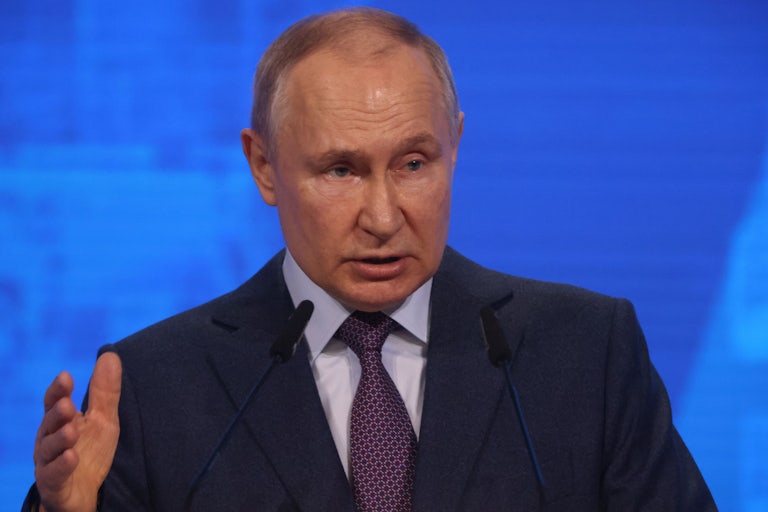
Russian President Vladimir Putin

On Friday, the International Criminal Court issued an arrest warrant against Vladimir Putin, accusing the Russian president of war crimes in abducting children from Ukraine and deporting them to Russia.

Russia’s government has denied accusations that it has committed such atrocities during its one-year invasion and occupation of Ukraine that has left, according to the U.N., at least 9,000 civilians dead and over 15,000 wounded.

The ICC also issued a warrant for Maria Alekseyevna Lvova-Belova, Putin’s commissioner for children’s rights, on similar allegations.

Enforcement, however, is another thing. The ICC has no police force to carry out such warrants, and defers to the international community to do so.

“The ICC is doing its part of work as a court of law,” said court president Pitor Hofmanski. “The judges issued arrest warrants. The execution depends on international cooperation.”

Meanwhile, Russia is not taking the court’s threat seriously. “The decisions of the International Criminal Court have no meaning for our country, including from a legal point of view,” said Russian Foreign Ministry spokeswoman Maria Zakhraova on Telegram.

Ukraine also technically does not adhere to the ICC. But since 2015,* it has granted the court ongoing jurisdiction over crimes occurring in the region. There are 123 state party members of the statute overseeing the ICC; the United States is the only North American country not part of the cooperative.

The warrant comes before Chinese President Xi Jinping’s scheduled visit to Moscow next week. Xi’s visit will mark his first visit to Russia since the invasion began, and the first foreign trip he makes since securing his third term as president last week.

While Xi ostensibly plans to visit as a neutral arbiter between Russia and Ukraine, his visit marks a deepening tie between China and Russia. Xi has reportedly spoken to Putin numerous times since Russia began its invasion, but has not even shared a single phone call with Ukrainian President Volodymyr Zelensky. China is also not among the states who adhere to the ICC.

* This post originally misstated the length of ICC jurisdiction in Ukraine.

Chicago Mayoral Candidate Brandon Johnson Gains Steam With Key Democratic Endorsements

Support for Johnson seems to be growing ahead of the April runoff.

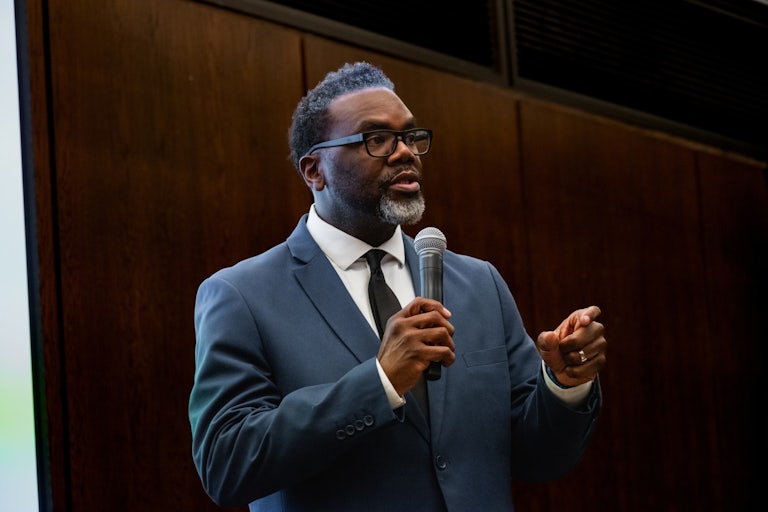
Chicago mayoral candidate Brandon Johonson speaks holding a mic
Tyger Ligon/Shutterstock
Chicago mayoral candidate Brandon Johnson

Chicago mayoral candidate Brandon Johnson is surging. Polls are tightening. A broad coalition of labor, women’s rights, and LGBTQ advocacy groups are throwing their support behind Johnson. And this week, he has earned endorsements from Senators Bernie Sanders and Elizabeth Warren, Representative and Democratic kingmaker Jim Clyburn, and Representative and former opponent Chuy Garcia.

The endorsements come alongside reports indicating growing support for Johnson’s candidacy ahead of the April runoff. A poll conducted this week showed Johnson leading his opponent, pseudo-conservative Paul Vallas, 46–44. The first two polls conducted after the general election last month showed Vallas leading Johnson by 9 and 11 points, respectively. Johnson’s steady rise mirrors his path during the general election, as his performances on the debate stage and on the campaign trail gradually earned him more support.

Johnson’s performance is all the more notable in Chicago, where crime has pervaded as a main issue throughout the entire race. Question after question in debates—whether about transportation, education, housing, and so on—has been framed through the lens of crime. But Johnson has not taken the bait, insisting on reimagining public safety. “This so-called toughness that politicians or insiders have just been recycling over the past 40 years has failed us—in the most dramatic of ways,” Johnson told TNR in January.

Johnson has remained consistent even as national Democrats have taken the bait on right-wing crime narratives. Earlier this month, 33 Senate Democrats and 31 House Democrats, led by Biden himself, voted with Republicans to overturn modest criminal justice reforms in Washington, D.C. Johnson, however, has stuck to his vision to invest in a more holistic approach to public safety: affordable housing, mental health services, year-round youth opportunities, and more. And the message has resonated enough with local groups, from unions to advocacy organizations, to build a wide enough coalition that earned trust from both Sanders and Clyburn.

Vallas, meanwhile, has come under fire for being further right than he lets on. The Chicago Tribune found Vallas’s Twitter account had liked several tweets that “used racist language, supported controversial police tactics like ‘stop-and-frisk’ or insulted the mayor in personal terms.” The Chicago Sun-Times reported Vallas once described himself as “more of a Republican.” And he has also come under scrutiny for his close relationship with the Fraternal Order of Police, as well as his previous role as a school superintendent in Louisiana, during which time he helped flip virtually all schools in New Orleans into charter schools, some of which reportedly discriminate against disabled students.

It is just some two weeks away from the runoff election. If Johnson continues his climb and Vallas can’t find a way to break free from all that plagues his campaign, Chicago voters may yet show America their hunger for a new vision of politics.

Donald Trump Gets His YouTube Page Back, Two Years After Being Suspended for Inciting Violence

2024 is going to be wild.

Scott Olson/Getty Images

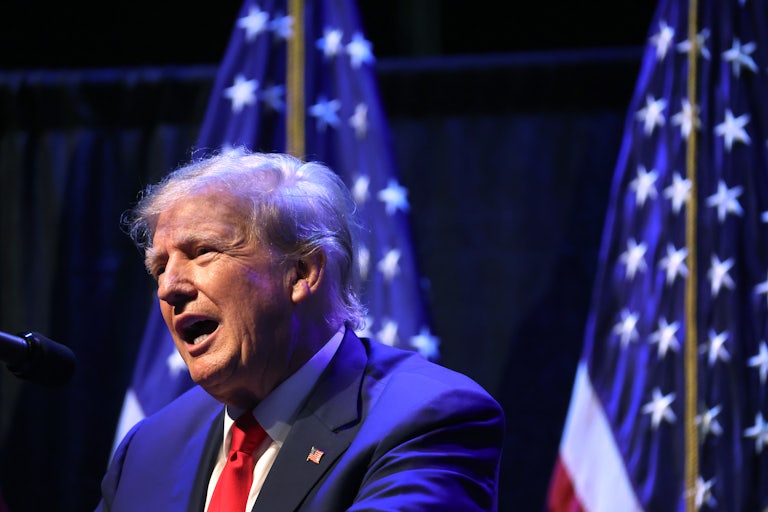
YouTube restored former President Donald Trump’s channel on Friday, two years after he used it to help incite the January 6 insurrection.

Trump was suspended from the platform a few days after the riot for posting content that incited violence. YouTube removed some of the videos on Trump’s channel and restricted comments, although the company said it would lift the suspension when it felt “the risk of violence has decreased.” The last video on his YouTube page is a 46-minute speech from December 2020, during which he complained about the “rigged” election.

But as of Friday, Trump’s channel “is no longer restricted and the ability to upload new content is restored,” YouTube’s vice president of public policy Leslie Miller told Axios.

“We carefully evaluated the continued risk of real-world violence, balancing that with the importance of preserving the opportunity for voters to hear equally from major national candidates in the run up to an election.”

Miller said the channel will be subject to all of YouTube’s policies on content moderation. But many social media platforms give leeway to posts they deem “newsworthy,” meaning considered to provide more to public interest than to cause harm.

With the suspension lifted, Trump can now post videos and buy ads ahead of the 2024 election.

Trump has been granted access once more to all major social media platforms, although he has yet to make his grand reentry to Facebook, Instagram, or Twitter, instead favoring his own Truth Social.

Trump has millions of followers on his mainstream social media accounts, including 2.6 million on YouTube—and that’s less than a tenth of the followers he has on Facebook or Instagram. On Twitter, he has even more.

Experts were already worried that letting him back onto mainstream social networks would increase the flow of disinformation ahead of the 2024 election. OnYouTube, he’ll have greater ability to purchase targeted ads.

Don’t forget, he was suspended from all of these platforms in the first place for sharing false information about the 2020 election and January 6. And prior to his suspensions, he had already gotten reprimanded for sharing misinformation about Covid-19 and election fraud. In fact, misinformation on Twitter dropped 73 percent after Trump was suspended from the platform.

This post has been updated.

Florida Republicans Are Too Afraid to Say Whether They Back DeSantis or Trump

“Do you think I want to talk about that? You think I’m crazy?”

CHENEY ORR/AFP/Getty Images; Anna Moneymaker/Getty Images

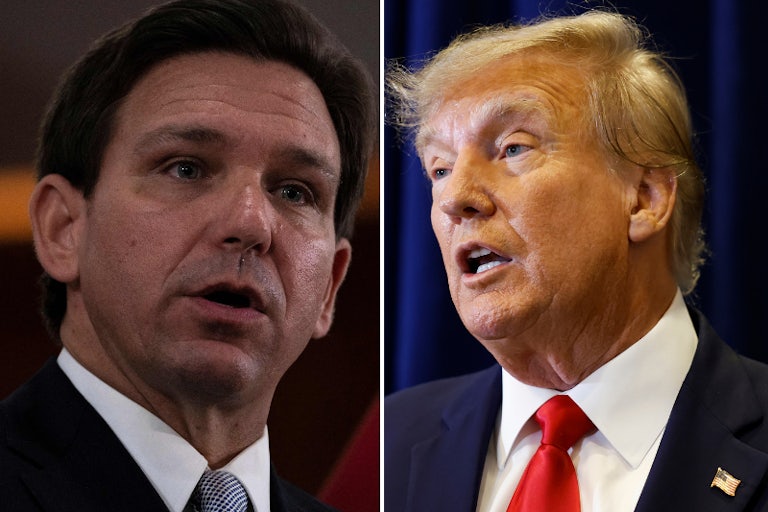
The congressional Florida contingent is sure that the next president will be from their home state, but very few are willing to say outright whether they back Donald Trump or Ron DeSantis.

Politico asked all 22 Floridians on the Hill whether they preferred the former president or the current governor. Most preferred to keep their cards close to their chest.

“Oh, wow. You are really trying to get me into a situation here,” joked Representative Neal Dunn. Dunn said he had made up his mind but wouldn’t share his endorsement because he didn’t want to put a target on his back.

Another Florida Republican, speaking anonymously, said, “Do you think I want to talk about that? You think I’m crazy?”

So far, only Trump has announced that he’s running for president, although DeSantis is expected to announce a run. The latter recently visited Iowa and commented on Fox News about the war in Ukraine—attempts to showcase his appeal in another state and his foreign policy chops, which governors typically don’t worry about.

Both men have demonstrated an ability to hold grudges and to take them out through their politics. Trump in particular is known for turning on a dime against anyone he perceives as an opponent. That includes DeSantis: Trump had backed the governor during his reelection campaign in 2018.

But now that the governor is nipping at his heels, Trump has slammed him as disloyal and nicknamed him “Meatball Ron” and “Ron DeSanctimonious.” Trump’s influence in the Republican Party is declining, but he’s still powerful. The Florida contingent knows better than to alienate him just yet.

DeSantis is less brash than Trump but no less dangerous. The governor has been quietly but steadily cutting back human rights in his state, particularly for women, the LGBTQ community, and people of color. He could easily exact revenge on members of Congress who turn on him, such as by restricting resources for their district.

Only two representatives were open about who they support. Both Matt Gaetz and Anna Paulina Luna backed Trump. Gaetz pointed out that DeSantis has been somewhat closed off and hasn’t tried to build relationships with federal lawmakers.

Senator Rick Scott said he typically doesn’t endorse anyone during the primary, but he similarly noted that he has a more open relationship with Trump.

Overall, the lawmakers were clear on one thing: “The next president will be from Florida.” It doesn’t seem like they really care who the nominee is, so long as it’s someone who will help them complete their political agenda.