Breaking News
Breaking News
from Washington and beyond

Kyrsten Sinema Is Proud That She Has No Beliefs

In a rare interview, the Arizona senator gets tangled up in a web of her own ideological contradictions.

Bill Clark/Getty Images
Arizona Senator Kyrsten Sinema

“No.” This is what Arizona Senator Kyrsten Sinema said when asked if there’s an ideological through line in the votes she has taken in the Senate.

Sinema takes pride in her transformation from young idealist to defender of the status quo as an example of maturity. Alas, what the Arizona senator views as some unique, independent approach to politics is simply what hegemonic forces in America have encouraged for decades: You can dream of a better world when you’re young, but you better wise up when you get old enough to become a cog in the machine that prevents such a fantasy from happening in the first place. (Note: This tradition of relinquishing idealism is now being upended by millennials and Gen-Z.)

Sinema seldom engages with the press; in fact, she famously seldom gives more than a minute’s attention to anyone unless they have lots of money, lots of power, or both. Consequently, hedge funders and private equity titans all seem to have her on speed dial whereas her own constituents have to stalk her in public to earn a moment of her time. But the Arizona senator bucks this trend in a recent interview with The Atlantic, in efforts to show that her approach to politics “works.” Sinema comes across as both staunch in ignoring the advice of others and too willing to skate around her own self-purported principles.

Sinema has faced criticism for appearing to have abandoned previous ideals, serving now instead as a foot soldier for plutocratic elites. But she’s pointedly proud of her ideological shift, and refers to her youthful political activities—protesting against the Iraq War, marching in sweltering heat in support of undocumented immigrants, spearheading a historic and successful effort to defeat an Arizona gay marriage ban—as “a spectacular failure.” Abandoning those youthful ideals, she says, is a sign of “age and maturity,” in which “new information” led the “lifelong learner” to adopt a different approach to politics.

“You can make a poster and stand out on the street, but at the end of the day all you have is a sunburn,” Sinema told The Atlantic. “You didn’t move the needle. You didn’t make a difference … I set about real quick saying, ‘This doesn’t work.’”

Sinema’s supposed concern with moving “the needle” connects to her view of herself as “practical,” as someone who moves efficiently to solve problems and broker deals, like the 2021 infrastructure package and 2022 gun safety bill following the Uvalde, Texas, school shooting. Naturally, there are some factors that complicate her self-evaluation.

For one, both bills were severely watered down (in no small part from Sinema’s own hand) and fall short of what is necessary to genuinely solve the problems they sought to address. The guiding principle to compromise in order to achieve something doesn’t carry as much weight when the compromise imperils the original legislative goals from being achieved. It certainly seems significantly at odds with Sinema’s self-aggrandizing claim that she is “a long-term thinker in a short-term town”—there’s hardly anything more short-term-minded than continually lobbying for half-measures that ensure the underlying problem will fester, continually demanding the attention of lawmakers and adversely affecting ordinary Americans.

Moreover, the “problems” Sinema is trying to solve do not just exist in the ether. Her own approach to politics in a narrowly divided Senate is one source of the problems stopping the government from enacting meaningful change. The Arizona senator has been staunch in her opposition to eliminating the filibuster, for instance, which requires 60 votes for most bills to pass in the Senate. Eliminating this barrier would allow a simple majority of the Senate to enact legislation. Sinema famously has an illogical and ahistorical position on the filibuster that doesn’t track with the Founders’ ideals.

Sinema’s insistence on maintaining this status quo is grounded in her belief that it prevents parties from imposing their agenda with narrow majorities—as if conservatives have not benefited from structural advantages like the Electoral College that have allowed the right wing to impose its agenda with not just narrow but often unearned or illusory majorities, or through the courts (banning abortion and attacking labor and calling corporations “citizens” are not popular policies in the slightest, but all have been imposed by conservatives all the same).

“When people are in power, they think they’ll never lose power,” Sinema said two years after a Republican-fomented attempt to overthrow the results of an election in which the party she fled from won a mandate to pass policies she has played a central role in preventing from happening.

Much ink has been spilled questioning Sinema’s motives. Is she just a capital-serving villain? Is she playing some long game? Is she just now a moderate who believes in the system that she rightfully saw as broken a few decades ago? Or does she actually have no ideology?

For the sake of argument, what if we imagine she truly believes in her approach? There often can be nefariousness drawn from the actions of the most powerful in our society—either intentional, or at least in their outcome. And can we recall that the most powerful are human beings too: shrouded by their personal experiences and biased by what they believe or come to believe is correct (think of how Elon Musk’s attitudes have only become more and more reactionary as he structurally surrounds himself more and more with sympathetic employees and blue check reply guys).

What some may see as subservience to power interests and shady, consistent avoidance of engaging with the public may be imagined by others as unorthodox tactfulness. But the impacts are the same nonetheless: The possibilities of politics are being hijacked by a lawmaker whose imagination has been lost. If Sinema truly is a “lifelong learner,” may we ask her, genuinely, to consider how she may now be stricken from the very maladies of establishment thinking to which she presumes herself to be immune.


First Republic Becomes the Latest Bank to Fool Around and Find Out

The firm becomes the latest financial institution to get in on 2023’s hot new trend of risky decisions leading to total failure.

Patrick T. Fallon/Getty Images
A First Republic Bank branch in Beverly Hills, California

Regulators took over First Republic Bank on Monday, marking the third bank collapse since the start of this year.

First Republic was viewed as the next weak link in the U.S. banking sector, following the collapse of Silicon Valley and Signature Banks in March. A last-ditch effort to save First Republic by injecting it with cash failed.

Following a weekend auction, the Federal Deposit Insurance Corporation announced Monday that JPMorgan Chase would take over First Republic’s assets and deposits, effective immediately. JPMorgan and the FDIC will split the losses and loans.

Much like Silicon Valley Bank, First Republic was a specialized lender. It focused on wealthy customers, at one point counting Mark Zuckerberg among its clientele, and offered fixed low rates on long-term loans for mortgages or businesses.

But the low rates that enticed people to stash their cash with First Republic were the proximate cause of the bank’s downfall. The Federal Reserve has hiked interest rates aggressively over the past year to try to bring down record-high inflation. Returns on First Republic’s loans stayed low, about 3 percent, while the bank had to pay at a 5 percent rate to get new funds from the Fed and Federal Home Loan Bank.

Silicon Valley Bank’s breakdown brought further scrutiny on banks that didn’t insure their deposits, a risky move that was enabled by former President Donald Trump’s rollback of Dodd-Frank regulations in 2018. The Obama-era rules were implemented to make sure that nothing like the 2008 Great Recession happened again. We are now in the midst of the second-biggest bank failure in U.S. history.

The collapse of Silicon Valley Bank and Signature Bank sparked no small amount of fear among investors, and First Republic customers soon began to withdraw their funds, looking elsewhere for stability and better returns on interest rates. First Republic revealed at the end of April that clients had withdrawn more than $100 billion since the start of March.

A group of 11 larger banks agreed to deposit $30 billion in First Republic in an attempt to stabilize it, but the effort fell short. And now First Republic is just another warning story about the dangers of having inadequate bank regulations.

Nebraska Lawmaker Has Filibustered for Nine Weeks—and She’s Not Done

Machaela Cavanaugh says she’ll do whatever it takes to stop the anti-trans bill in her state.

Machaela Cavanaugh
Courtesy of the Nebraska Legislature

Machaela Cavanaugh has filibustered the Nebraska state legislature for nine weeks straight, all to make sure a bill banning gender-affirming care for minors never makes it to a final vote.

Cavanaugh made waves when she first began her filibuster in February for saying she would “burn the session to the ground over this bill.”

“If this legislature collectively decides that legislating hate against children is our priority, then I am going to make it painful, painful for everyone,” she said. “I have nothing, nothing but time, and I am going to use all of it.”

Cavanaugh has made good on her word: There are three weeks left in the legislature’s 90-day session, and the chamber just passed its first bill last week, as she and other Democratic senators have blocked measure after measure.

She spoke with The New Republic about why she decided to block the anti-trans bill, what the effect has been, and the importance of good footwear.

1. Why is it important to block this bill?

Seeing legislation, any legislation that targets a vulnerable population is upsetting to me, and seeing people in positions of power push forward things that are really perpetuated out of a place of fear and hate is really upsetting.

I’m a mom of three kids, I am a very ferocious mama bear for all children. A lot of my legislation in my first four years was focused on maternal health and child welfare, and I’ve done a significant amount of work specifically around child welfare in Nebraska. So I’m very passionate about protecting our kids, all of our kids. All of our kids.

This and the abortion bill that was just blocked is government overreach in health care, and getting in between a patient and a provider and making their health care decisions based on the personal views of elected officials. And that’s not how health care should work.

2. What was unusual about this bill?

One of the great things about Nebraska is that we’re unicameral, and we’re nonpartisan. We pride ourselves on taking a moderate approach to policymaking and taking time and working diligently on specific policy issues over several years to get things right.

That’s one of the things that’s really unusual about this specific bill, is that this came from a freshman senator. It’s a brand new policy idea. It’s obviously from a national group, it’s terribly written. It’s just not Nebraska, in every sense of it, not just that it is legislating hate. Not just that it is attacking a minority population, but also just the approach. It’s trying to be rushed through and rammed through. And that’s just not how we do things.

3. Have there been repercussions for you?

Certainly there’s a price for me to pay. None of my legislation will be debated on the floor. I won’t pass any legislation this year. Anything that I cared about accomplishing legislatively will not happen, but nothing that I would want to accomplish would be more important than stopping hateful legislation against trans children.

Also, a few weeks ago, I talked about the 10 steps of genocide and correlated that to legislation such as the bill attacking gender-affirming care. And one of my colleagues made a motion to censure me. It’s the second time in the history of the legislature that a motion to censure a senator had been put forward. The other time was a gentleman in the ’50s, and he was running like a racketeering scam. So on par, obviously.

4. What do you make of the repercussions against other lawmakers who have opposed anti-trans legislation, such as Montana Representative Zooey Zephyr and Nebraska Senator Megan Hunt?

What happened to Representative Zephyr is devastating for democracy. And I’m so grateful to her for her work and her advocacy and how she’s continuing to show up for her constituents in every way that she’s able to.

A man filed a complaint against Senator Hunt because she has not filed a conflict of interest form because she has a transgender son, and it’s clearly meant to be a harassment and intimidation tactic. This gentleman is an internet troll and scourge of the earth. And he’s also an attorney, which makes him an officer of the court. And as an officer of the court, it is irresponsible for him to file such a frivolous complaint.

5. How do you find the energy to keep this up?

I’m very tired! Coffee, insomnia, pure will—I don’t know how I find the energy. I don’t really think about finding the energy. I just get up every day and force myself to put my shoes on and walk into that chamber and push my button and talk. If I think about it too much, I probably will get debilitated with anxiety and stress.

I was having serious back problems. I used to wear heels. And now I’m wearing Skechers, pink Skechers, every day.

6. What has been the effect of so much national attention?

I don’t think my colleagues care for it. I think it frustrates and irritates them. Earlier this week, our local Chamber of Commerce gave a statement about how detrimental this type of anti-trans policy is to workforce recruitment in our state, to the business community. And I think the more we start to see entities like that the better, because this isn’t good public policy. Attention and pressure are hopefully what’s going to change the tide on this type of legislation, and I hope not just in Nebraska. I hope across the country.

7. How long will you keep going?

Until day 90. And if I have to go pick it back up when we start our session next year, I’m prepared to do that. I’m prepared to do whatever it takes.

The message that I’m trying to send to the trans community, specifically trans children, [is] that they matter, that they are loved, that they are worth fighting for, and that I am going to fight for them.

I also hope that people see what I’m doing, what people are doing in other states, and recognize that this is not a partisan issue. This is coming from somewhere far-flung. It is a human rights and a civil rights and a parental rights issue. And we should all be standing up against that. And we shouldn’t be standing behind our party. We should be standing together.

This interview has been edited for clarity.

Congress Has Known About John Roberts’s Wife’s Shady Financial Dealings for Months

Another financial scandal for another Supreme Court justice.

Andrew Harrer/Bloomberg/Getty Images

Jane Roberts, the wife of Supreme Court Chief Justice John Roberts, has allegedly been paid more than $10 million by an array of high-class law firms; at least one of these firms argued a case before her husband in the Supreme Court, after paying her hundreds of thousands of dollars. And the cherry on top is that Congress has known about these allegations for months.

The Senate Judiciary Committee has come under immense pressure to do something, anything, in the face of numerous revelations of how crooked America’s Supreme Court is. Justices Clarence Thomas and Neil Gorsuch have both been reported to have participated in shady dealings; frustration mounted as Roberts has refused to cooperate with the Senate Judiciary Committee in responding to the troubling allegations.

And now it’s becoming more and more clear why: It’s a small club, and Roberts has no problem being part of it.

Business Insider reports that two years after Roberts ascended to lead the court in 2005, his wife, Jane, pivoted from an illustrious career as a lawyer to become a legal recruiter, matching lawyers up to elite corporations and firms. Between 2007 and 2014, Jane Roberts cashed in $10.3 million in commissions in her newfound career. And the complaint pressing forward the revelations was filed in December; reporting on Jane Roberts’s ethically questionable career vis-à-vis her husband’s position had been published even back in January.

The allegations come from Jane Roberts’s old colleague Kendal B. Price, who worked at the same recruiting firm she did. In Price’s complaint, he explains that a partner at the firm told him Jane Roberts was “the highest earning recruiter in the entire company ‘by a wide margin.’” While she surely may be highly qualified, the eye-popping numbers cause even more concern around the question of how Supreme Court justices and their families enrich themselves—particularly at the expense of judicial responsibility, given that some of the firms Jane Roberts profited from would then appear in front of the court led by her husband.

“She restructured her career to benefit from his [John Roberts’s] position,” Price wrote in an affidavit. “I believe that at least some of her remarkable success as a recruiter has come because of her spouse’s position.”

The details of exactly how much Jane Roberts has made follows the stream of revelations related to other conservative justices on the court. Justice Thomas has received secret and lavish gifts for decades from Nazi memorabilia–collecting billionaire and GOP donor Harlan Crow, including luxurious island-hopping excursions on superyachts and even a secret deal in which Crow bought Thomas family property and proceeded to upgrade it while Thomas’s mother still lived in it.

Last week, it was revealed that Justice Neil Gorsuch successfully sold a 40-acre property that he had been trying to sell for two years to an undisclosed buyer; the buyer of the nearly $2 million Colorado ranch was the CEO of a law firm that has since had 22 cases with business before the court.

Amid all this, Senate Judiciary Committee Dick Durbin has continued to remain under fire. He has spent weeks now kindly passing the buck to Justice Roberts to lead reform on ethical standards for the court; he has seemingly done so while knowing that Roberts himself is implicated in potential ethics violations. Meanwhile Durbin has refused to eliminate a blue slip rule that has prevented Democrats from confirming more judges—especially while Senator Dianne Feinstein remains absent.

In the face of corruption, elected officials can either respond appropriately or maintain false hope in the system that created such corruption in the first place. The more Durbin and his colleagues continue to do the latter, the more they actively allow and even encourage further corruption.

Fox Poll Shows Republicans in for a Brutal 2024 Election

Even Fox is admitting on air that the policies it pushes aren’t all that popular with voters.

Plaque at the main entrance to the FOX News Headquarters
Erik McGregor/LightRocket/Getty Images

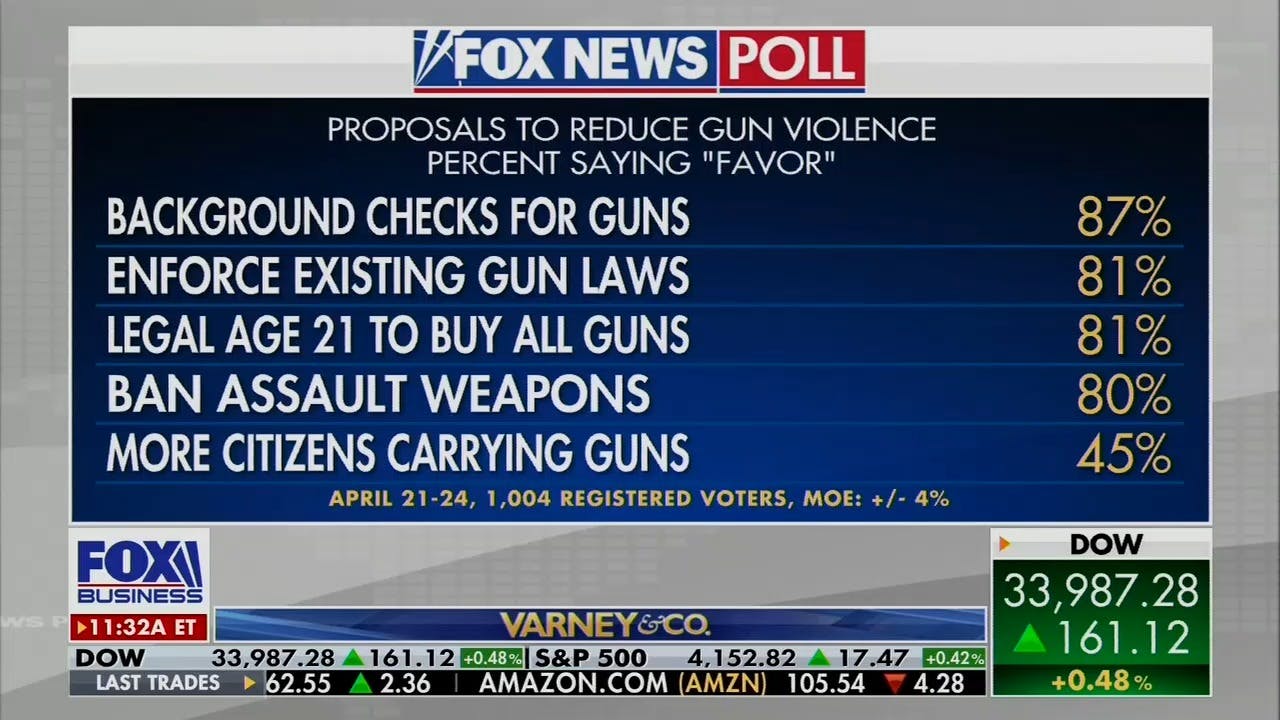
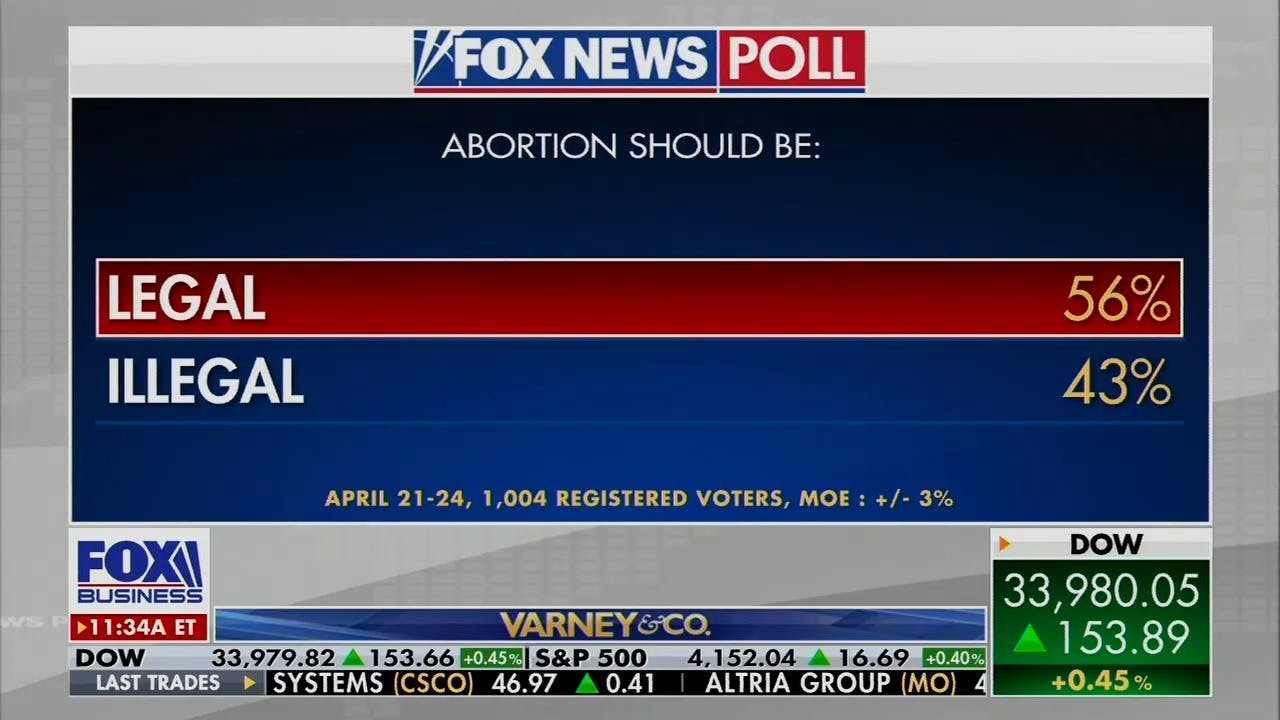
Republicans are calling for more and more guns, and scrambling to ban abortion every place they can. It’s as if someone gave them a shovel and they’re trying to dig to the other side of the earth. Their policies are bad on principle, but they’re not looking too hot electorally either. Consider the latest Fox poll:

Courtesy of Fox
Courtesy of Fox

An astonishingly large number of people in this country want basic gun safety reform: background checks, increasing the legal age to buy guns to 21, enforcing (not repealing) existing gun laws. But the latest Fox poll shows 80 percent—80 percentof people wanting to outright ban assault weapons.

Washington became the tenth state to do just that this week, by the way. “These weapons of war, assault weapons, have no reason other than mass murder,” Governor Jay Inslee said while signing the bills. “Their only purpose is to kill humans as rapidly as possible in large numbers.” It seems that most Americans tend to agree.

The numbers make it clear it’s not just blue states interested in gun control. Take a look at Tennessee, where thousands of people have taken to the streets demanding action against gun violence in the wake of a harrowing school shooting that left three children and three adults dead.

Michigan, meanwhile, which Trump won by the skin of his teeth in 2016, has swung to now be host to a Democratic trifecta that voted for Biden in 2020. Two weeks ago, in the aftermath of a deadly mass shooting at Michigan State University, Governor Gretchen Whitmer signed a slate of gun-related public safety bills, including universal background checks and safe storage laws.

On Friday, Colorado signed its own array of gun safety laws five months after a mass shooting left five people dead and another 25 injured at a gay nightclub. The measures include raising the buying age for guns to 21, establishing a three-day waiting period on purchases, strengthening red flag laws, and rolling back legal protections the gun industry has from being held liable for gun violence.

While Democrats have pursued and delivered on the outright will for more gun regulation, Republicans have spent their time tripping over themselves to bend their knees to the NRA and pledging: “We’re not gonna fix” mass shootings.

Beyond guns, abortion is proving to be just as motivating for voters to vote against Republicans.

In Wisconsin, another Trump-to-Biden state, voters recently flipped the state Supreme Court to liberal control for the first time in 15 years, in anticipation of protecting abortion rights and ameliorating the state’s absurdly gerrymandered districts.

In 2022, all six states with abortion on the ballot voted to affirm abortion rights: California, Vermont, Michigan, Montana, Kentucky, and Kansas.

On Thursday, proposed abortion bans in both Nebraska and South Carolina narrowly failed, as a small group of Republicans dissented, perhaps in awareness of how electorally noxious the bans are (if not perhaps even voting with their morals).

From red states to blue states, the politics of abortion and guns are simply not in Republicans’ favor; which is to say, fewer and fewer states may continue staying as red as they once were, and more and more states may trend bluer and bluer.