Breaking News
Breaking News
from Washington and beyond

Republican Congressman Shoves Activist Trying to Ask Questions

The Republican claimed to respect the activist’s First Amendment rights, then began to push him so he would stop his line of questioning.

Bill Clark/CQ-Roll Call, Inc/Getty Images
Louisiana Republican Representative Clay Higgins

Louisiana Republican Representative Clay Higgins manhandled a protester on Wednesday, after the activist asked other GOP members questions about their personal lives.

In a video that has gone viral, Higgins can be seen grabbing a protester and shoving him away from a press conference, repeatedly saying, “You’re out, you’re out.” At one point, Higgins uses so much force that he lifts the young man off the ground. The protester continues to say, “Get off me!”

The protester has identified himself as a 25-year-old named Jake Burdett. He told Newsweek that he had been in D.C. for a Medicare for All rally hosted by Senator Bernie Sanders. When the event ended, Burdett saw that several Republicans, including Higgins, Lauren Boebert, and Paul Gosar, were holding a press conference, so he went over to ask questions.

In videos he posted on Twitter, Burdett asks Gosar about his apparent ties to neo-Nazi Nick Fuentes and his own family opposing his politics. Burdett also asks Boebert about her divorce and a food poisoning outbreak at her former restaurant Shooters Grill.

In both videos, Higgins approaches Burdett to make him stop asking questions. It’s during the questions to Boebert that Higgins begins shoving Burdett away. Burdett said on Twitter that Capitol Police officers took him to the side and questioned him. A third video shows officers asking him what happened, and someone out of frame says, “He tried to attack a member of Congress,” which was quickly refuted by other protesters. Burdett said he did not see Capitol Police questioning Higgins.

There is widespread outrage online over Higgins’s actions, including a petition calling for him to be charged with assault and battery. Retired U.S. Army General Mark Hertling called Higgins’s actions “BS” and said the representative should be charged.

Higgins did not respond to a request from The New Republic for comment.

But Higgins has a history of taking things way too far. He joined the Opelousas City Police Department in 2004, and within three years, the police chief was prepared to take major disciplinary action against Higgins for using “unnecessary force on a subject” and then later giving false statements during the investigation. Higgins resigned before he could be disciplined.

A few years later, Higgins joined St. Landry Parish sheriff’s office, where he made videos for the local Crime Stoppers program. He repeatedly got into trouble for using aggressive language about suspects in the videos. Another video he made for the state police drew pushback from the ACLU.

The St. Landry Parish sheriff accused Higgins of using his badge and uniform for personal gain, by wearing them in an ad for a security firm and using them to sell personal merchandise. Salon magazine also reported that Higgins would negotiate large speaker’s fees for events, in cash, and one time asked that the fee also cover shopping money for his wife and fuel for a friend’s private plane.
Is Ron DeSantis a Robot? An Investigation (in Pictures)

The Florida governor seems to have a hard time acting fun and normal in public.

Paul Hennessy/SOPA Images/LightRocket/Getty Images

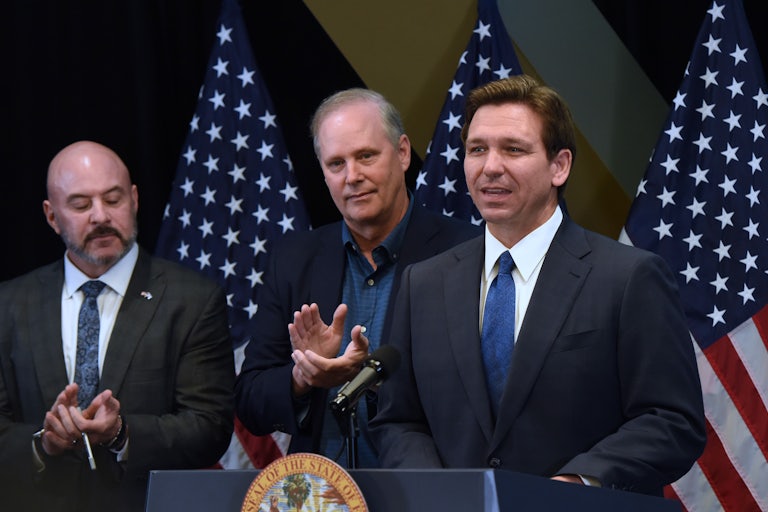
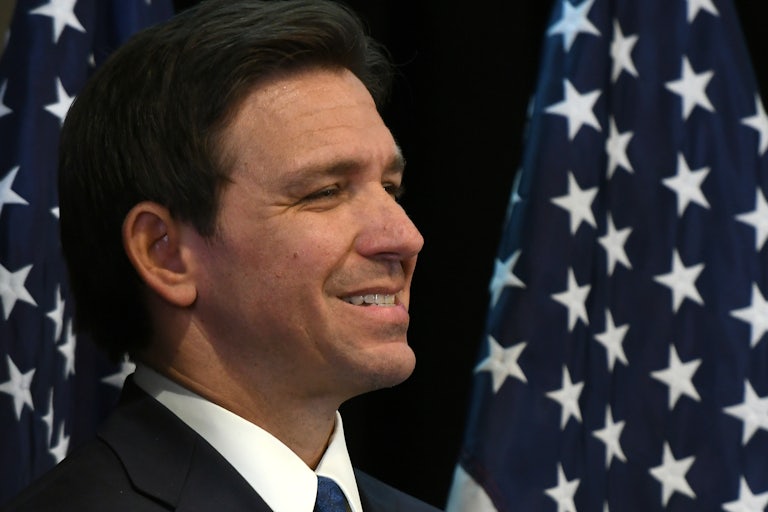
Many politicians have gotten away with behaving slightly weird, if not totally unsettlingly, especially in recent years. Perhaps that’s helped by the former president being as absurdly unusual and villainously criminal as he is. But still, Ron DeSantis is finding a way to make sure his bizarre behavior not only cuts through the headlines but remains burned into our minds forever.

As the Florida governor gets closer to finally announcing his run for president, he has had more and more time in the public eye, which means more opportunities to show how normal and fun he is—in case his vicious agenda against queer people, migrants, women, students, and teachers didn’t already win you over.

Last week, as DeSantis was soft-campaigning in Iowa, he made some friendly banter and refocused people’s attention on his … jovial behavior.

The moment brought back memories of just weeks ago, when DeSantis had a warm back-and-forth with Piers Morgan, in which the Florida governor robotically laughed while denying reports of his eating chocolate pudding with three fingers.

There was also the time DeSantis short-circuited in Tokyo when he was asked about his falling poll numbers in the 2024 primary.

To be clear, DeSantis’s aesthetics are just incidental. Emotion and expression aren’t bad things for a politician to display, even if you laugh like a Chuck-e Cheese animatronic. What’s more important is how little emotion or sorrow DeSantis seems to genuinely express about the pains of our world. Mass shootings, climate disaster, the plight of migrants; the struggle for people to find out who they are and who they love—all things any good-willed politician might express some sort of something about; instead, DeSantis is the front-runner in exacerbating those pains.

So while he may not end up winning the presidency, DeSantis can take solace knowing his leadership in hurting millions of people, with a show-stopping personality to match.

Republicans Literally Laugh Off Idea of Taxing the Rich to Fix Budget

As the debt ceiling crisis continues, we get ever closer to the threat of a national default. And Republicans seem determined to take us there.

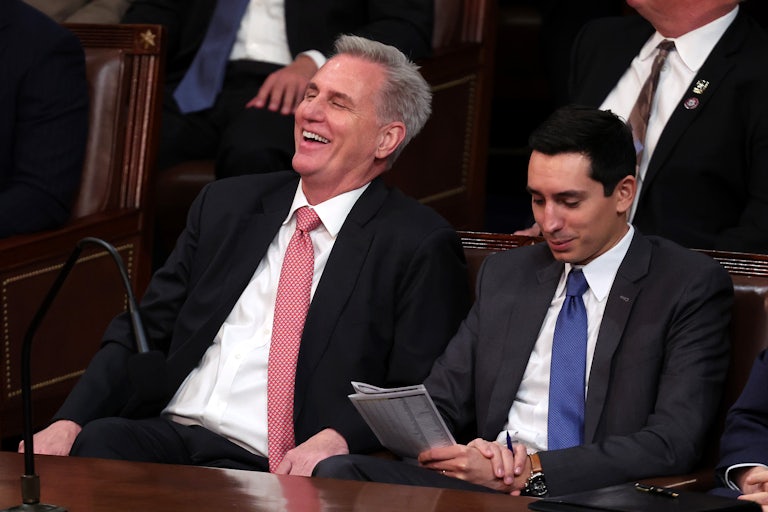
House Speaker Kevin McCarthy laughs
Win McNamee/Getty Images

Republicans have said they want to reduce government spending and increase U.S. revenue—but not if it inconveniences rich people, apparently.

When a reporter asked House Speaker Kevin McCarthy if he would consider raising taxes on wealthy Americans, he answered with a short “No” before the question was even finished. Republicans standing around him groaned and shook their heads. They then began laughing when McCarthy asked where the reporter was earlier.

McCarthy explained that wealth taxes weren’t necessary because the United States has a revenue of 20 percent of gross domestic product, as opposed to 17 percent in previous years. Instead, inflation was due to the Democrats spending $6 trillion after winning the presidential election in 2020.

McCarthy’s statement about revenue is technically true: The U.S. revenues in 2022 totaled 19.6 percent of GDP, according to the Congressional Budget Office, compared to the annual average of 17.4 percent in the five decades prior. Most of that revenue comes from income taxes.

But raising taxes on the wealthy, even by a little bit, would produce huge amounts of revenue. In 2021, Senators Elizabeth Warren and Bernie Sanders proposed charging billionaires a 3 percent wealth tax, and households and trusts worth between $50 million and $1 billion a tax of just 2 percent per year.

This would only apply to a tiny fraction of Americans, but it could produce about $3 trillion in revenue over the next decade, University of Berkeley economists predicted.

In his budget, President Joe Biden proposed increasing taxes on wealthy Americans and corporations and using the revenue to expand health care, childcare assistance, and housing aid. Not only have Republicans fought this plan, but their own budget proposes punishing lower-income Americans to benefit the wealthy.

Republicans’ solution to the debt ceiling crisis is focused on mere pennies in comparison to what a wealth tax would do. The bill calls for work requirements for Medicaid, food stamps, and cash assistance programs—which would barely make a dent in U.S. debt. Work requirements would save the government only about $1 billion per year, according to the CBO, nowhere near how much actually needs to be recouped. And that’s assuming, of course, that such requirements actually work.

The U.S. is just weeks away from defaulting on its debt, but Republicans and Democrats remain at a logjam over how to solve the problem. The GOP seems ready to take it out on the backs of people who can least afford it.

Some Rare, Temporary Good News From the Supreme Court on Guns

The Supreme Court has declined to block an assault weapons ban in Illinois ... for now.

Supreme Court building
Chip Somodevilla/Getty Images

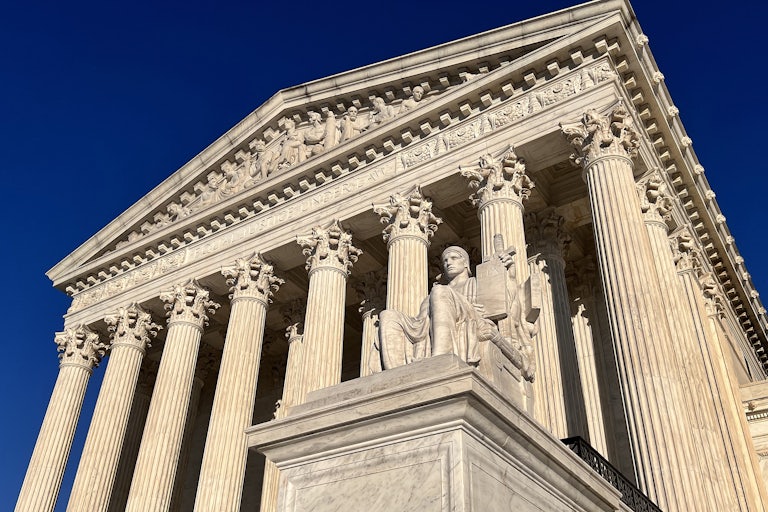
The Supreme Court refused Wednesday to block Illinois’s law banning assault weapons, a rare bit of good news as the U.S. continues to struggle with skyrocketing gun violence.

A total of 10 states and Washington, D.C., have laws banning assault-style weapons. Illinois joined the list in January when Governor J.B. Pritzker signed a bill prohibiting the possession or sale of such firearms, as well as high-capacity magazines. The ban came six months after a mass shooter opened fire on a Fourth of July parade in a Chicago suburb, killing seven people with a legally purchased semiautomatic weapon.

“This assault weapons ban is a step in the right direction,” Pritzker said at the time. “But there’s no magic fix, no single law that will end gun violence once and for all. So we must keep fighting, voting, and protesting to ensure that future generations will only have to read about massacres like Highland Park, Sandy Hook, and Uvalde in their history books.”

Gun rights advocates in Illinois sued to block the law, saying the measure violates their Second Amendment Rights. But the Supreme Court issued a one-sentence unsigned order on Wednesday declining to block the measure.

But the fight in Illinois is not over. There are six cases challenging the law working their way through the appeals process.

The Supreme Court also refused in January to block New York’s expanded gun restrictions, while the legal challenge to the law plays out. The decisions are not necessarily indications that the justices support gun control, however. The court ruled 6-3 in June to strike down a form of gun carry restriction that only six states use, dramatically expanding gun access nationwide. Instead, the New York and Illinois rulings are more likely a sign that the high court is giving lower courts more time to weigh the potential effects of the June ruling.

Meanwhile, the effects of increased gun access are wreaking havoc on the U.S. People are being shot just for approaching the wrong house. There have been 226 mass shootings since the start of the year, according to the Gun Violence Archive. Many states have weakened gun restrictions, and violence soon follows.

Ron DeSantis Signs Drag Ban So Extreme It Could Cancel All Pride Parades in the State

The bill is so vaguely worded that Pride in Florida this year is sure to look different.

Florida Governor Ron DeSantis
Paul Hennessy/SOPA Images/LightRocket/Getty Images

Florida Governor Ron DeSantis signed a bill Wednesday that will effectively stop all Pride parades and festivals in the state, a massive attack on LGBTQ visibility.

The new law prohibits government entities and employees from issuing permits to organizations that may hold “adult live performances” in the presence of minors. Anyone that does can be charged with a misdemeanor. The law is so vaguely worded, and the punishment so high, that at least one Pride Parade has already been canceled this year.

The measure would also ban businesses from allowing minors to attend an “adult live performance,” which is defined as a show performed in front of a live audience that “depicts or simulates nudity, sexual conduct, sexual excitement, or specific sexual activities … lewd conduct, or the lewd exposure of prosthetic or imitation genitals or breasts.” Any business that breaks this law will face a fine of up to $10,000 and could lose its license.

The law’s supporters say that they are not targeting drag queens but instead trying to protect children. But Democratic Representative Fentrice Driskell pointed out that Florida already has laws in place to protect children.

“Even though the plain text of the bill may not say ‘drag’ … there’s a greater context happening here, and we all know it,” she said, just before the bill passed the House last month by a vote of 82–32, along party lines.

Critics have slammed the bill as being overly broad, which could have unintended consequences. Republicans admitted that the measure would prevent performances of The Rocky Horror Picture Show and the musical Hair.

But the measure will also have an intended consequence: “erasing” LGBTQ people from existence. Florida Republican Representative Randy Fine said outright that if passing the bill “means erasing a community because you have to target children, then, damn right, we ought to do it!”

Florida is now the second state to pass a law attacking drag performances, which have become a particular target for the right wing in recent years. In March, Tennessee became the first state to pass such a law, although the measure was blocked by a judge before it could go into effect on the grounds that it was overly broad and violated free speech rights.

DeSantis also signed an anti-trans bill the same day, which allows the state to remove trans kids from their families if they receive gender-affirming care. You can read more about that bill here.