Breaking News
Breaking News
from Washington and beyond

Oath Keepers Founder Sentenced to 18 Years for January 6 Seditious Conspiracy

“These defendants were prepared to fight. Not for their country, but against it.”

Aaron C. Davis/The Washington Post/Getty Images
Stewart Rhodes

Oath Keepers founder Stewart Rhodes was sentenced to 18 years in prison on Thursday for his role in inciting the violent attempt to overturn the 2020 presidential election.

Rhodes and four other members of the far-right paramilitary group were found guilty in November of various crimes relating to the January 6 insurrection. This is one of the first sentences to be handed down for seditious conspiracy in the attack, and the longest of any January 6 defendant to date.

“These defendants were prepared to fight. Not for their country, but against it,” assistant U.S. Attorney Jeffrey Nestler wrote in sentencing memos for the prosecution. “In their own words, they were ‘willing to die’ in a ‘guerrilla war’ to achieve their goal of halting the transfer of power after the 2020 Presidential Election.”

The Oath Keepers were part of the mob that swept into the U.S. Capitol on January 6, 2021, trying to stop the certification of 2020 presidential election results. Prosecutors had argued Rhodes was a key figure in spreading falsehoods that the election had been rigged for Joe Biden, and they asked he be sentenced to 25 years in prison.

Rhodes and Oath Keepers member Kelly Meggs were both found guilty of seditious conspiracy in November. Three other members—Jessica Watkins, Kenneth Karrelson, and Thomas Caldwell—were found guilty of obstruction of an official proceeding and aiding and abetting for their actions on January 6. Meggs and Watkins were also found guilty of conspiracy to obstruct.

Rhodes’s conviction and sentencing is one of the most significant yet to come out of the investigation into the January 6 riot, marking a major win for the Justice Department. Another came in early May when Proud Boys chairman Henry Tarrio was also convicted of seditious conspiracy.

Tarrio and three other members of the far-right, neofascist group were found guilty of seditious conspiracy, as well as conspiracy to obstruct Congress and obstruction of Congress. A fifth group member was also found guilty of obstruction of Congress but not the other charges. There have now been a total of 14 convictions of seditious conspiracy over the January 6 insurrection.

This post has been updated.

Here Are the Two Democrats Who Voted With Republicans to Block Student Debt Relief

At least the Blue Dog Democrats are honest about who they are.

Bill Clark/CQ-Roll Call, Inc/Getty Images; Paul Morigi/Getty Images for Headstrong
From left: Representatives Jared Golden and Marie Gluesenkamp Perez

Perhaps the most lasting legacy of the Blue Dog coalition is Kyrsten Sinema and Henry Cuellar; a senator who spends more time with elite donors than her constituents and an A-rated NRA, anti-choice conservative. And in its nearly three-decade history, the caucus is at an all-time low. Nevertheless, two of its members are committed to bringing it back, by way of some of the worst, most characteristic P.R. possible: voting with Republicans to leave 43 million people under the weight of crippling student debt.

On Wednesday, Maine’s Jared Golden and Washington’s Marie Gluesenkamp Perez joined House Republicans and voted to repeal President Joe Biden’s student debt relief program and to terminate the freeze on federal student loan payments and interests.

The resolution, part of Republicans’ demands in order to agree to raise the debt ceiling, passed 218–203.

Shortly after, Perez took to Twitter to boast, alongside her two Blue Dog co-chairs, about getting “shit done.”

If voting with Republicans to leave the boot of debt on millions of people is a recruiting tool, at least it’s an honest encapsulation of how woefully inept and meager the Blue Dog coalition really is—and what kind of “shit” it has always aspired to get done.

“College costs too much,” Perez tweeted on her official congressional account Thursday morning, but she said there’s no way to reduce debt without also investing in “career & technical education.” It’s not clear why the millennial lawmaker seems unable to conceptualize alleviating the ridiculous student debt as part of the reconstruction plan for a system she admits is broken.

No less is the move disappointing given that Golden and Perez both have around 100,000 student debtors in their districts.

Republicans—some of whom are incredibly wealthy—have continued framing the student debt relief plan as a favor to the rich. But estimates show that 87 percent of the relief would go to individuals earning less than $75,000 a year, while none would go to those earning more than $125,000. Ninety-five percent of the total benefits would go to households making less than $150,000.

Facts and figures aside, as TNR has written previously:

There are millions of people in this country who are trying their best to bloom and live more whole and productive lives but are hindered by the burden of such soulless debt. In the short term, Republicans may frame their ideas as cost-saving, but in reality, such measures will increase medium- and long-term costs on society.

And by joining Republicans in the cynical measure to maintain the soul-splitting burden of debt on millions in this country, Golden and Perez show just how politically inept and practically unimaginative they are. Which, in reality, are prerequisites for being a member of the Blue Dog coalition.

Want to Cut Spending? Here’s How Much of Our Budget Is Going to the Military and Police

If Republicans are serious about wanting to reduce the debt, a new report shows exactly where they could start.

If Congress is looking for a place to cut spending, look no further! A new report from the Institute for Policy Studies found that an estimated $1.1 trillion, or 62 percent of federal discretionary spending, went to militarized programs over the past year.

That includes spending on things like war, weapons development, policing and prisons, and detention and deportation. Only 38 percent of the discretionary budget was left for investment in communities (things like education, childcare, affordable housing, and environmental programs).

As the United States hurtles toward debt default, the IPS report is a good reminder that if the Republican Party really wants to cut spending, it could do so quite easily. But rather than look to the single-largest drain on the public purse, Republicans want to impose harsh work requirements for Medicaid and food stamps, gut clean energy programs, and make life easier for fossil fuel companies..

“Threats to cut spending for vital domestic programs have featured prominently in the debt ceiling debate in recent weeks,” the IPS said in a press statement, “but spending on militarism has been almost entirely exempt from the discussion. Meanwhile, clawing back failed military, homeland security and law enforcement spending could instead fund programs and measures to address the true needs of American communities.”

The IPS report shows just how absurd our national budget priorities really are. Since 2001, discretionary spending on militarism has outpaced investments in communities two-to-one. Spending on federal law enforcement was twice that on childcare and early childhood education programs. Nuclear weapons? Four times what we spend on substance abuse and mental health. Perhaps most damning of all: For every $1 spent on diplomacy and humanitarian aid, the U.S. spent $16 on war and the military.

The report comes just days after a six-month investigation by CBS’s 60 Minutes found that “military contractors overcharge the Pentagon on almost everything.” And this year, about half of the monstrous $842 Pentagon budget will go to defense contractors. According to the IPS, the average taxpayer gave Pentagon contractors $1,087 in 2022.

Lindsay Koshgarian, one of the report’s co-authors, says, “Spending on militarism takes up the majority of the federal discretionary budget, and it has grown faster than all other spending. If we keep up these patterns, we are hurtling toward a future where we can’t afford the basics of a civilized society.”

House Speaker Kevin McCarthy, of course, has said reconsidering military spending in the debt talks is off the table.

Louisiana Republican Breaks Ranks to Kill Anti-Trans Bill, Says He Doesn’t Care What Other People Say

Fred Mills is completely unbothered by the right’s outrage over his vote.

Yana Paskova/Getty Images

A Louisiana Republican state senator broke ranks to kill an anti-trans bill banning gender-affirming care for minors. And he doesn’t care about the online right-wing outrage over it.

Fred Mills cast the deciding vote Wednesday to block a bill that would have banned hormone therapy, puberty blockers, and gender-affirming surgery for transgender minors. The bill had passed the House and was up before the Senate Health and Welfare Committee. Mills joined all four Democrats in voting to defer the bill, effectively killing it for the year. Louisiana is now the only state along the Gulf Coast that still allows gender-affirming care for minors.

“Always in my heart of hearts have I believed that a decision should be made by a patient and a physician. I believe in the physicians in Louisiana,” Mills, a pharmacist, said at the time. “I believe in the scope of practice. I believe in the standard of care.”

Mills explained that part of his decision was based on testimony from medical professionals. Health professionals widely acknowledge that gender-affirming care decreases levels of anxiety, depression, and suicidal thoughts in LGBTQ minors. Doctors generally don’t recommend surgery for people under age 19, and a Louisiana Health Department report found that no Medicaid recipients had received gender reassignment surgery in the state between 2017 and 2021.

A child and adolescent psychiatrist testified in the committee about the standard procedures already in place for gender-affirming care. He pointed out that many medications used for trans care are proven safe and used to treat other, unrelated issues.

Many far-right activists immediately sought to discredit Mills after the news of his vote broke. Greg Price, who works with the right-wing State Freedom Caucus Network, said Mills had received “massive contributions from Big Pharma.” Noted transphobe Matt Walsh said Mills had “sided with the butchers and groomers” and predicted it would end the senator’s career.

But Mills, frankly, doesn’t care. “Why should I?” he told the Louisiana Illuminator. “They don’t live in District 22. They don’t have a 337 area code.”

“I didn’t run for office to serve those people.”

Mills said he heard no evidence of children being harmed by gender-affirming treatment, so he voted based on the data that was presented. Since then, he said many colleagues have thanked him for his decision, including other Republican senators who are not on the committee.

Supreme Court Sides With Corporate America, Weakens Clean Water Act

The conservative court just made it easier for corporations to pollute our bodies of water.

Lev Radin/Pacific Press/LightRocket/Getty Images

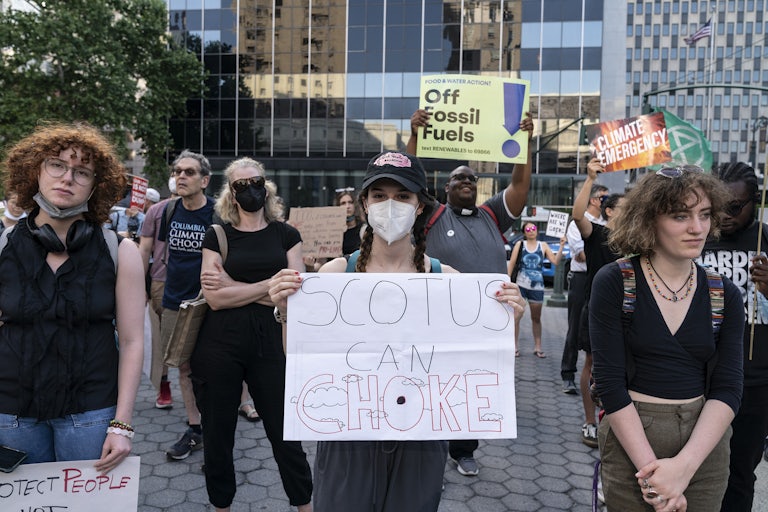
In a time when we see the consequences of corporations decimating the beauty, the harmony, and the value of our natural landscape, we ought to be doing everything we can to fight back and protect the earth. The conservative-led Supreme Court, however, believes otherwise.

On Thursday, the court ruled 5–4 to weaken the already whittled-down Environmental Protection Agency’s ability to regulate water pollution.

The question at hand involved defining “waters of the United States” that qualify for protection by the Clean Water Act. And the court held that the 51-year-old CWA does not enable the EPA to regulate discharges into some wetlands near other bodies of water.

Justice Samuel Alito wrote the opinion that decided the agency has jurisdiction over wetlands only if they have “a continuing surface connection” to larger bodies of water.

Almost 20 years ago, the court ruled that wetlands are covered by the CWA if they have a ”significant nexus” to regulated bodies of water. Various groups, including property and business organizations and fossil fuel interests, have since rallied to weaken that definition—and on Thursday, they ultimately succeeded.

The court decision follows twice-impeached, criminally indicted, and liable-for-sexual-abuse former President Donald Trump rolling back updates to the CWA made under President Obama. Trump limited federal protection to cover only “permanent” bodies of water and not other smaller but still significant waterways, like streams of water that flow only part of the year. Trump’s rule gave states greater authority to determine what should be regulated under the CWA, which meant less protection for our climate.

With the Supreme Court’s ruling, the CWA’s jurisdiction is now all the weaker. Any seasonal streams of ebbing and flowing waterways can be more readily polluted at will by some of the most callously destructive interests in American society.

What is at stake? Look no further than East Palestine, Ohio, where a disastrous Norfolk Southern train derailment months ago has to this day left residents confused, sick, and disenchanted by the government. The derailment implicated and polluted numerous waterways—some that interlink with adjacent smaller streams and wetlands. While residents even now fear corporate-driven cover-ups of more environmental damage than meets the eye, the conservative-led Supreme Court has made it even easier for communities across America to be upended, just as East Palestine was.