Breaking News
Breaking News
from Washington and beyond

Fed Chair Says Trump’s Tariffs Are Definitely Making Inflation Worse

Federal Reserve’s Jerome Powell predicted that Trump’s policies will make the economy a whole lot worse.

Federal Reserve Chair Jerome Powell gives a press conference
Kevin Dietsch/Getty Images

Federal Reserve Chair Jerome Powell confirmed that Trump’s tariffs will make inflation worse.

“How much of the higher inflation forecast for this year is due to tariffs, and since the policy path remains the same, are you effectively reading this as a one-time price level shock?” a reporter asked Powell at his press conference on Wednesday. 

“You may have seen that goods inflation moved up pretty significantly in the first two months of the year.… Some of it—the answer is, clearly, some of it, a good part of it—is coming from tariffs,” Powell replied. “We’ll be working, and so will other forecasts, to try to find the best possible way to separate non-tariff inflation from tariff inflation.”

Powell also noted that Trump’s tariffs have made it harder for the economy to achieve price stability for consumers and for the Fed to get back to its goal of 2 percent inflation. 

“I think we were getting closer and closer to that. I wouldn’t say we were at that. Inflation was running around two and a half percent for some time,” Powell said. “I do think with the arrival of the tariff inflation, further progress may be delayed. The [Summary of Economic Projections] doesn’t really show further downward progress on inflation this year, and that’s really due to the tariffs coming in.” 

Trump has insisted that his tariffs—for now, just 10 percent on imports from China with broader tariffs on the way on April 2—are merely transitionary policies that will help consumers much more than they hurt. “Look, what I have to do is build a strong country,” the president said last week as his tariffs caused the stock market to tumble. “The tariffs could go up as time goes by, and they may go up. We may go up with some tariffs. I don’t think we’ll go down, but we may go up.”

We heard it from the horse’s mouth: Trump is shooting himself and every American consumer in the foot by levying aggressive tariffs on imports, all while promising to lower inflation. He’s insisting that he can have both. That couldn’t be further from the truth. 
Karoline Leavitt Brutally Fact-Checked on Judge Who Blocked Trump

Leavitt went on the offense about the judge who blocked some of Donald Trump’s deportation efforts.

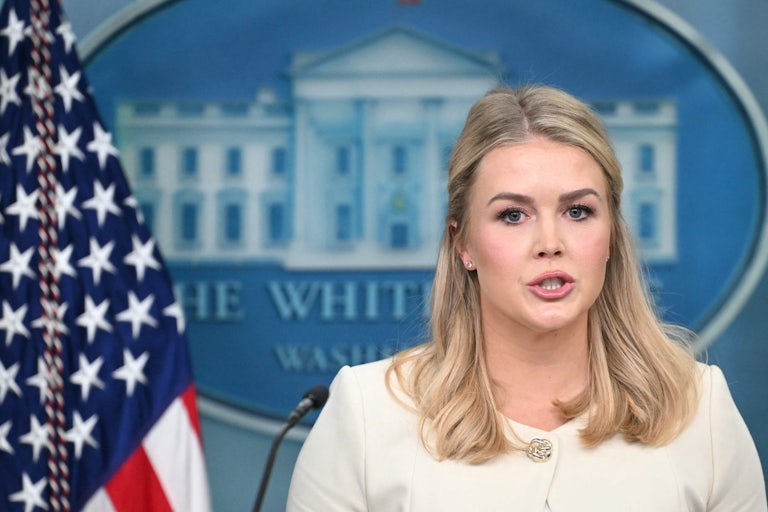
Karoline Leavitt speaks to reporters during a White House press briefing
Mandel Ngan/AFP/Getty Images

President Donald Trump’s administration is going all in on smearing the federal judge who ordered the White House to hold off on its massive deportations—and now it’s just making stuff up.

During a press briefing Wednesday, White House press secretary Karoline Leavitt railed against Judge James Boasberg, who called a hearing after the Trump administration allegedly defied his order to pause deportations under the Alien Enemies Act.

As Trump’s lead propagandist, Leavitt attempted to paint Boasberg as “a Democrat activist,” but unfortunately for her, she got her facts wrong.  

“He was appointed by Barack Obama, his wife has donated more than $10,000 to Democrats, and he has consistently shown his disdain for this president and his policies, and it’s unacceptable,” she said.

NBC News’s Garrett Haake was forced to step in, correcting Leavitt’s mistake. “Judge Boasberg was originally appointed by George W. Bush, and then elevated by Barack Obama,” Haake said. “Just feel like I should clear that up.”

Boasberg was first appointed to D.C. Superior Court in 2002 by Bush, and then appointed to the federal bench by Obama in 2011. In 2014, he was appointed to the U.S. Foreign Intelligence Surveillance Court by Chief Justice John Roberts, where he served a seven-year term. 

Haake also asked whether Trump was serious about pursuing his threat to impeach Boasberg, considering that it would require a whopping 67 votes in the Senate. Roberts issued a rare statement Tuesday admonishing Trump, saying that calling for impeachment was not an “appropriate” response to a ruling the president didn’t like. 

“The president has made it clear that he believes this judge in this case should be impeached. And he has also made it clear that he has great respect for the Chief Justice John Roberts, and its incumbent upon the Supreme Court to rein in these activist judges,” Leavitt said. “These partisan activists are undermining the judicial branch by doing so. We have co-equal branches of government for a reason, and the president feels very strongly about that.”

But the main person undermining the power of the federal judiciary is Trump himself, who has decided to claim that any judge who rules against him is a partisan “lunatic.” He’s helped by members of his administration who execute his, seemingly more often than not, unlawful wishes. 

Within the past few days alone, Trump has been hit by an onslaught of legal decisions blocking his administration on everything from DOGE’s mass firing of probationary workers to the dismantling of the United States Agency for International Development, and the ban on transgender service members in the U.S. military, to name a few. 

During a tense hearing Monday, Boasberg had succinctly summarized the Trump administration’s position on his order, and the rule of law more generally, as “We don’t care, we’ll do what we want.”

Schumer Faces Growing Calls From Democrats to Resign Over Cowardice

Democrats are not happy that Senator Chuck Schumer caved to Donald Trump on the budget.

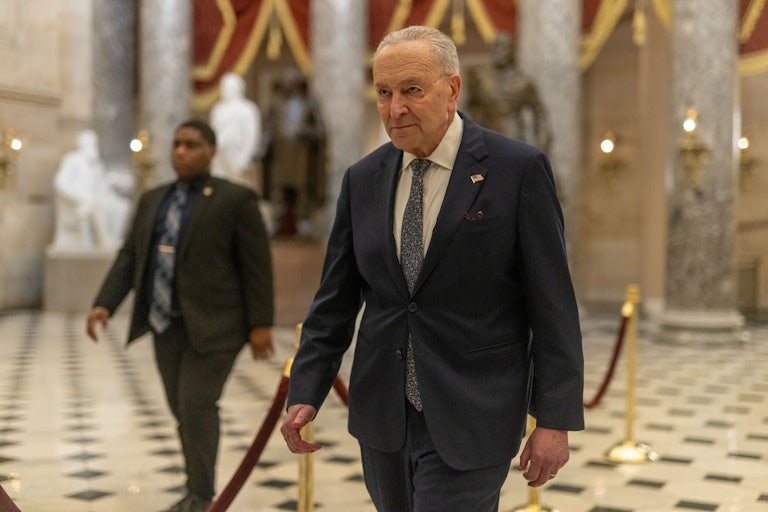
Senator Chuck Schumer walks in the Capitol
Nathan Posner/Anadolu/Getty Images

Democrats aren’t so sure that Senate Minority Leader Chuck Schumer should continue to front the party.

Several Democratic lawmakers in the House of Representatives believe that the New York lawmaker should “step down” after he pushed his caucus to back the GOP budget resolution Friday.

They include Illinois Representative Delia Ramirez and Maryland Representative Glenn Ivey.

“I’ve got no personal beef with Schumer, I think he’s a talented guy, but for me the bigger question is: Is he going to do this again?” Ivey told Axios Wednesday, looking toward the next government funding deadline in September. “When this comes back up in six months, is he going to take the same approach or not? If he’s still on that track, I’m for moving on.”

But Ivey and Ramirez’s colleagues believe that more lawmakers interested in a Schumer resignation are hiding in the woodwork.

“I think there are some already there but just haven’t been asked directly or avoided the question,” an anonymous House Democrat told Axios.

The progressive group Indivisible called on Schumer to “step aside” on Saturday, accusing him of having “surrendered leverage” while handing Donald Trump, Elon Musk, and their congressional allies the keys to dismantle government agencies and public services.

Schumer, along with eight other Democrats in the upper chamber, voted in favor of a budget that will strip billions from Medicaid in order to pay for an extension to Trump’s 2017 tax plan, a proposal that overwhelmingly benefits corporations and is projected to add as much as $15 trillion to the national deficit.

Republicans could not have passed the short-term budget without their help.

Schumer saw the vote as a potential salve on the eve of a government shutdown that he and his allies believed would temporarily hand Trump more control. House Democrats, including former Speaker Nancy Pelosi, strongly disagreed, arguing that the party should instead have pushed for an extension that would give them more time to negotiate the details of the resolution.

Frustration has apparently bubbled all the way to the top. House Minority Leader Hakeem Jeffries dodged a question last week on Schumer’s future, though by Tuesday, he clarified that he still believes Schumer should be involved in Democratic leadership.

Medicaid insures more than 70 million Americans. The popular social program, established in 1965 under President Lyndon B. Johnson, represents nearly $1 out of every $5 spent on health care in the U.S. It pays for more than 41 percent of births in America, according to data from the Kaiser Family Foundation, and is the largest financier of nursing home care in the country, according to HuffPost.

White House Makes Stunning Claim on Zelenskiy-Trump Phone Call

The White House put out an official statement claiming Ukranian President Volodymyr Zelensiky wants the U.S. to take over a key industry.

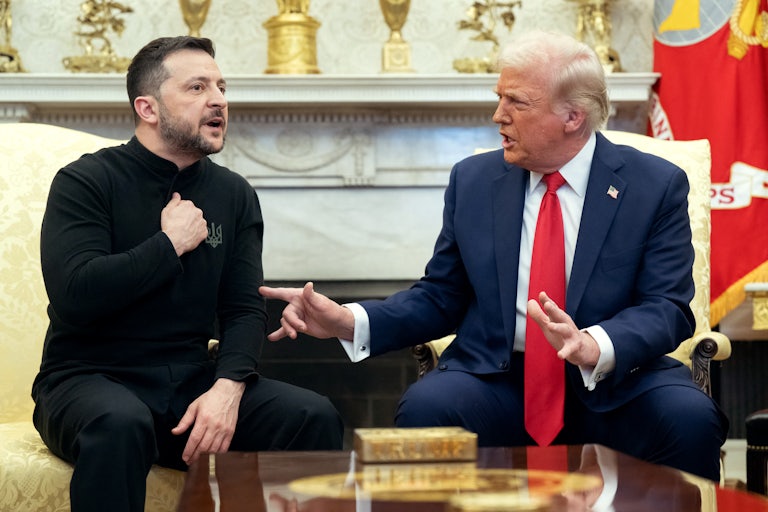
Donald Trump yells at Ukranian President Volodymy Zelenskiy in the White House.
SAUL LOEB/AFP/Getty Images

The White House made a confusing claim on Wednesday: Ukrainian President Volodymyr Zelenskiy is welcoming American ownership of his country’s nuclear and electric power plants.

Trump press secretary Karoline Leavitt proudly announced the news during a press briefing.

On their call, Trump and Zelenskiy “discussed Ukraine’s electrical supply and nuclear power plants,” Leavitt said, according to CBS News’s Jennifer Jacobs. “He said that the United States could be very helpful in running those plants. With his electricity and utility expertise, American ownership of those plants would be the best protection for that infrastructure and support for Ukrainian energy infrastructure.’”

This development leaves many more questions than answers. Why would Zelenskiy make this ask? And what would American ownership actually look like: boots on the ground? Is Trump done being obsessed with the rare earths? All these questions and more remain unanswered as Trump has yet to comment on the statement.

Trump’s Putin Obsession Just Cost the U.S. a Major Deal

Europe is locking the U.S. out of a key defense plan.

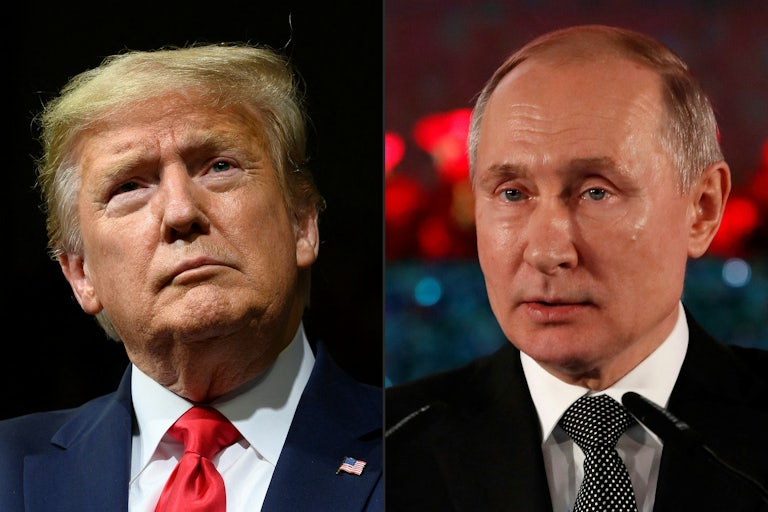
Donald Trump and Vladimir Putin
Jim Watson, Emmanuel Dunand/AFP/Getty Images

Rattling America’s longest-standing alliances is starting to cost the U.S. military industrial complex.

U.S. arms makers were shut out of the European Union’s enormous defense spending plan released Wednesday.

“We must buy more European. Because that means strengthening the European defense technological and industrial base,” said European Commission President Ursula von der Leyen.

The U.K. was similarly frozen out of the deal. Instead, the EU tapped South Korea and Japan to join the military program, which aims to spend more than $800 billion by 2030 as the bloc prepares for potential conflict with Russia.

“We need to see not only Russia as a threat, but also … more global geopolitical developments and where Americans will put their strategic attention,” said European Defense Commissioner Andrius Kubilius, according to Politico.

The sales pitch from American arms manufacturers simply isn’t as persuasive as it was under previous administrations. For decades, purchasing American fighter jets and weapons came with an added bonus of U.S. protection. But as global leaders have witnessed Donald Trump defy long-standing military treatises and aggress U.S. allies, that promise no longer feels like a guarantee.

Trump’s shocking hostility toward Ukrainian President Volodymyr Zelenskiy during critical peace negotiations, his nonsensical trade war, his threats to annex Greenland, his whiplash decisions to suspend and un-suspend military resources and intelligence with Kyiv, and his insistence on making Canada the nation’s fifty-first state have all called the reliability of American protection into question.

And European nations aren’t the only ones thinking of nixing their American contracts. Canadian Prime Minister Mark Carney announced Wednesday that he was reviewing a $13.3 billion contract from 2023 for dozens of Lockheed Martin’s F-35 Lightning II stealth fighters for “geopolitical” reasons, as well as “the possibility of having substantial production of alternative aircraft in Canada.” Portugal announced similar plans last week, apparently wobbling on whether it would replace its aging air force with American made products.

“An important factor in the purchase of the F-35 by European governments was the idea that European defense would be built on a transatlantic basis in terms of strategy, institutions, and capabilities,” Gesine Weber, a Paris-based fellow at the transatlantic think tank, German Marshall Fund, told Politico Wednesday. Weber further noted that Trump’s intention to overhaul NATO makes the purchase of American arms systems “no longer have any added value for Europeans.”

Other defense experts who spoke with the publication were more candid.

“If you keep punching your allies in the face, eventually they’re going to stop wanting to buy weapons from you,” an anonymous Western European defense official told Politico. “Right now we have limited options outside of U.S. platforms, but in the long run? That could change in the coming decades if this combativeness keeps up.”

Foreign sales are crucial to the U.S. arms industry. Historically, two-thirds of EU defense spending has gone to American contractors. Losing that could have ramifications for the U.S. economy.

But despite the Trump agenda, U.S. arms makers are still hoping that the looming threat of war will leave foreign nations with few other options than to buy their goods. Countries that surround Russia, including Poland and Romania, are still rushing to scoop up as many rockets, artillery, tanks, and warplanes into their arsenals as they can.

In December, NATO Chief Mark Rutte told the military alliance that it was time for Europe to “shift to a wartime mindset.”

“Russia is preparing for long-term confrontation, with Ukraine and with us,” Rutte said, urging NATO members to “turbocharge” defense production and spending. “We are not ready for what is coming our way in four to five years.”

Read what else the U.S. is blocked from: