Breaking News
Breaking News
from Washington and beyond

Trump Press Secretary Freaks Out Over Questions About Deportations

Karoline Leavitt snapped at a reporter who asked about people who allegedly had been wrongfully deported.

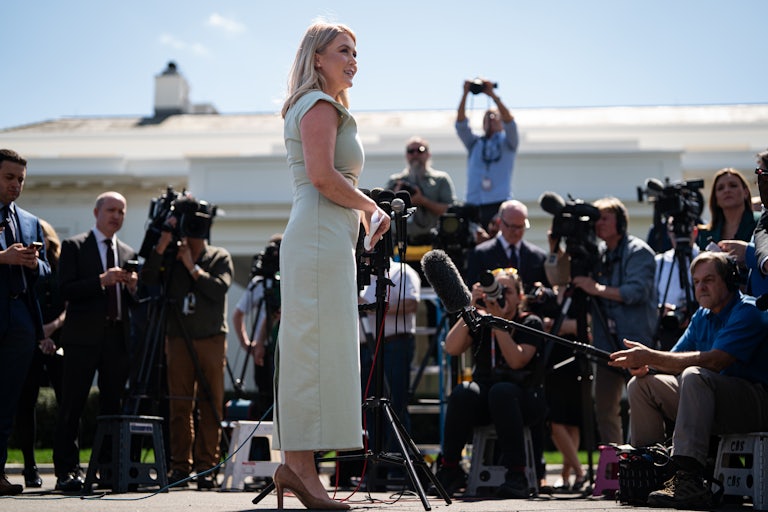
Press Secretary Karoline Leavitt speaks to reporters outside the White House
Saul Loeb/AFP/Getty Images

White House press secretary Karoline Leavitt flailed Monday when asked about the government’s shady system for classifying gang members. Desperate to dodge the question, Leavitt went on a tirade claiming that the reporter had no right to ask about it in the first place.

Outside of the White House, the Independent’s White House correspondent Andrew Feinberg attempted to ask Leavitt about how immigration authorities had been designating individuals as members of the Tren de Aragua gang, and therefore potentially subject to deportation under the Alien Enemies Act. 

Documents in a new court filing from the government stated that for an individual to be classified as a member of TdA, all they need to do is be a Venezeulan person older than 14 years and  score eight points on a survey of different characteristics, including having symbols in their tattoos or wearing certain logos, which were worth four points each. Feinberg did the math. 

“You can get classified by simply having certain symbols in your tattoos and wearing certain streetwear brands—that alone is enough to get someone classified as TdA and sent to El Salvador,” Feinberg said. 

“That’s not true, actually, Andrew,” Leavitt snapped. Feinberg insisted he was simply reading from court documents filed by the government. 

“No, according to Department of Homeland Security and the agents—have you talked to the agents who have been putting their lives on the line to detain these foreign terrorists who have been terrorizing our communities?” Leavitt asked. 

“I–I’m not denying that—” Feinberg said, but Leavitt continued.

“TdA is a vicious gang that has taken the lives of American women, and our agents on the front lines take up deporting these people with the utmost seriousness, and there is a litany of criteria that they use to ensure that these individuals qualify as foreign terrorists, and to ensure, to ensure that they qualify for deportation,” she said. 

“And shame on you, and shame on the mainstream media for trying to cover for these individuals who have—this is a vicious gang, Andrew! This is a vicious gang that has taken the lives of American women!”

“I’m not trying to cover for anyone,” Feinberg insisted, but Leavitt continued to attack Feinberg for even asking about the documents, once again unable to account for the government she purports to represent.

“And you said yourself there are eight criteria on that document! And you are questioning the credibility of these agents who are putting their life on the line to protect your life, and the life of everybody in this group and the life of everybody across the country? And their credibility should be questioned? They finally have a president who is allowing them to do their jobs, and God bless them for doing it,” Leavitt fumed.

Unfortunately for Leavitt, she works with the very journalists who are responsible for asking questions about the government’s wrongdoings—and when it comes to Donald Trump’s mass deportations, there seem to have been some significant ones. 

New documents obtained by the American Civil Liberties Union on Sunday showed that the tattoos ICE is using to identify individuals as TdA gang members included a range of innocuous images such as the Jordan “Jumpman” logo, a crown, a train, and a clock, among other things. Representatives for at least three of the people deported earlier this month claim that they were wrongly classified as gang members over their tattoos. 

Because the 261 detainees deported to El Salvador earlier this month were removed under the AEA, they were stripped of due process and the opportunity to legally challenge their designation as TdA members. Secretary of State Marco Rubio announced that another 17 individuals were deported there on Tuesday, alleging that they were members of MS-13 and TdA—possibly violating a court order

Press Sec. Blatantly Contradicts Trump Defending “Third Term” Comment

Karoline Leavitt appeared to put her foot in her mouth after accidentally contradicting Donald Trump’s own words.

Press Secretary Karoline Leavitt speaks to reporters outside the White House
Al Drago/Bloomberg/Getty Images

Press Secretary Karoline Leavitt is insisting that the media is overreacting to Donald Trump’s theories about staying in office for a third term. Speaking with reporters on Monday, Leavitt seemed to suggest that there was no merit to the idea, or the media’s alarm over it—despite the fact that Trump said he is “not joking” about staying in power.

“Look, you guys continue to ask a question about a third term, and then he answers honestly and candidly with a smile and then everyone here melts down about his answer,” Leavitt said.

Leavitt then pointed to Trump’s interview with reporters aboard Air Force One over the weekend—in which the president raised the idea that “people” were prompting him to run again—as the reason why Americans should not be worried about the unconstitutional effort.

“I have had more people ask me to have a third term, which in a way is a fourth term because the other election—the 2020 election—was totally rigged,” Trump said. “I just don’t want the credit for the second because Biden was so bad, did such a bad job, and I think that’s one of the reasons that I’m popular.… I think we’ve had the best almost hundred days of any president.”

But during a Sunday morning phone call with NBC News’s Kristin Welker, the president insisted that he was actually very serious and “not joking” about potentially circumventing the Constitution in order to lead the country for another four years after his second term ends.

“No, no I’m not joking. I’m not joking,” the president said, during a call in which he agreed with Welker that one such plan to keep him in office involved having Vice President JD Vance front the next Republican presidential ticket with Trump as his number two—roles that they would then switch once back in office.

“That’s one. But there are others too. There are others,” Trump said, refusing to clarify what the other plans are.

The seemingly far-fetched and unconstitutional idea would require the consent of most of the country—if Trump attempted to use traditional methods to stay in the Oval Office.

As outlined in Article 5 of the Constitution, any such change requires at least two-thirds of the Senate and the House to agree on the modification, with that change then requiring ratification by a minimum of three-quarters of states in the nation.

A second approach to repealing the term-limiting amendment could be via a Constitutional Convention, though two-thirds of states would need to support the motion to have one at all, and any proposed changes to an amendment would still require ratification by three-fourths of the states.

Elon Musk’s Video on Wisconsin Election Sure Looks Like a Confession

Elon Musk’s America PAC posted quite an interesting video on that $1 million giveaway ahead of the Wisconsin election.

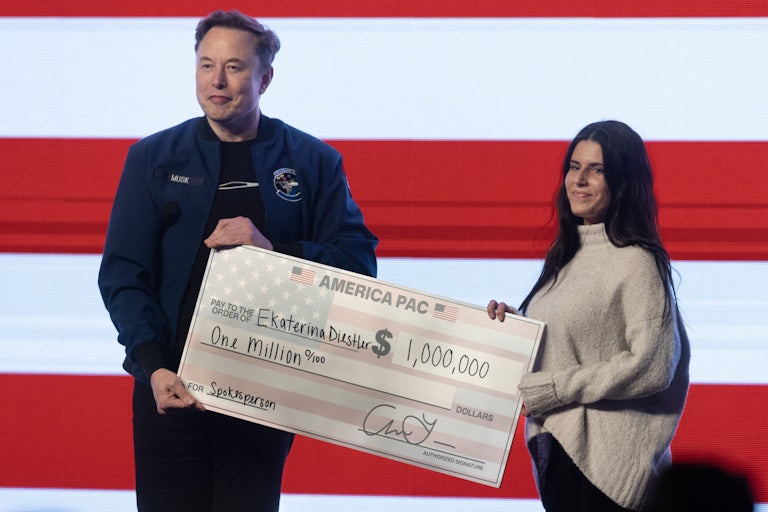
Elon Musk and Ekaterina Diestler hold a very large $1 million check made out to her. The check comes from America PAC. Both of them smile in front of a very large U.S. flag.
Scott Olson/Getty Images
Elon Musk gives $1,000,000 to a Wisconsin voter, Ekaterina Diestler, during a town hall meeting on March 30 in Green Bay, Wisconsin, ahead of the state’s Supreme Court Election.

Elon Musk’s own PAC may have just posted a filmed confession about buying votes in the Wisconsin Supreme Court election this Tuesday.

The world’s richest man has poured nearly $20 million into the state-level race between Trump-endorsed County Judge Brad Schimel and Barack Obama–endorsed County Judge Susan Crawford.

Musk’s America PAC on Monday posted a video featuring Ekaterina Diestler, a Wisconsin woman who won the PAC’s $1 million giveaway on Sunday. Diestler stated that her vote—and not just her petition signature—was how she received the money.

“My name’s Ekaterina Diestler, I’m from Green Bay, Wisconsin,” the woman said in the video. “I did exactly what Elon Musk told everyone to do: Sign the petition, refer friends and family, vote, and now I have a million dollars.” Diestler’s statement clearly says that Elon Musk told her to vote—among other things—for her chance to become a millionaire.

In an effort to drum up support and attention, Musk announced last week that he’d offer up two $1 million checks on X in a lottery-style system to Wisconsin residents, “in appreciation for you taking the time to vote.” Offering people money in exchange for voting is extremely illegal in the United States.

Musk deleted this post 12 hours later, after legal experts pointed out the massive bribe he was orchestrating. He instead changed the language to circumvent that illegality, writing that “entrance is limited to those who have signed the petition in opposition to activist judges.”

“Conditioning entrance to this event and eligibility for the $1 million payout on having voted arguably violates Wisconsin law, which prohibits offering or giving anything of value to induce a person to vote,” campaign finance lawyer Brendan Fischer told The New York Times.

Leaked Memo Reveals Insane Ban on Words Agriculture Department Can Say

The Department of Agriculture is no longer allowed to use the phrase “safe drinking water.”

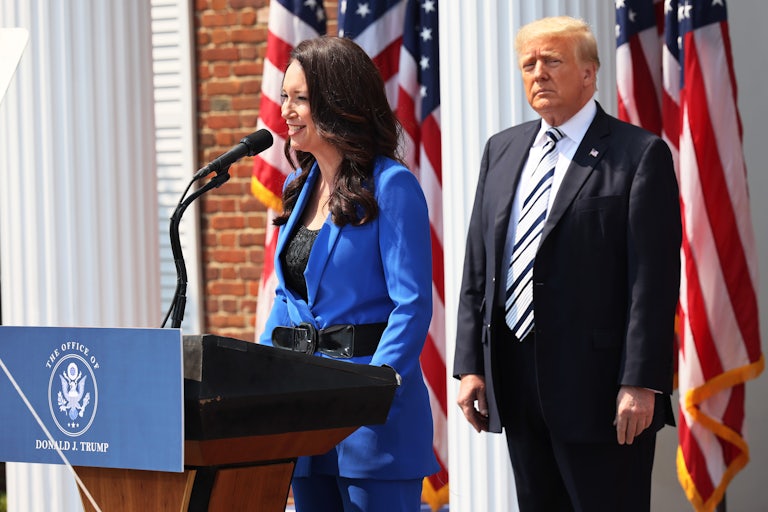
Agriculture Secretary Brooke Rollins speaks at a podium while Donald Trump stands behind her
Michael M. Santiago/Getty Images
Agriculture Secretary Brooke Rollins speaks at a podium while Donald Trump stands behind her.

Forget DEI buzzwords—the Trump administration’s government censorship ordinance is now infringing on language that will make it nearly impossible for agencies to do their job.

A leaked memo from the U.S. Department of Agriculture’s Research Service division revealed Sunday that the agency has banned some key language from its vocabulary, including the words “climate” and “vulnerable,” as well as the phrase “safe drinking water.”

Other baffling entries on the memo’s banned language list are “greenhouse gas emissions,” “methane emissions,” “sustainable construction,” “solar energy,” and “geothermal,” as well as “nuclear energy,” “diesel,” “affordable housing,” “prefabricated housing,” “runoff,” “microplastics,” “water pollution,” “soil pollution,” “groundwater pollution,” “sediment remediation,” “water collection,” “water treatment,” “rural water,” and “clean water,” among dozens of others.

“When evaluating agreements, those entries that include these terms or similar terms cannot be submitted,” wrote Sharon Strickland, the USDA’s Northeast area financial management, travel and agreements section head, in an internal March 20 email. The review will “ensure that we maintain compliance with the Administration’s EOS.”

It’s unclear how the guidance would do anything other than completely hinder the department’s ability to monitor the health and edibility of crops, or aid America’s rural development—some of its primary functions. What is clear, however, is that purging such basic speech will stifle scientific research and discourse.

Donald Trump began censoring the government as soon as he returned to office. In January, the Office of Management and Budget held tens of billions in federal funding hostage, requiring executive branch agencies to purge language related to “environmental justice,” abortion, DEI initiatives, “woke gender ideology,” and “illegal aliens” in their reports and missions. Otherwise, they would forgo their congressionally appropriated funds, per an OMB memo.

That threat has since rolled its way through the American legal system. Last week, an appeals court upheld a block on the sweeping freeze, agreeing with a previous court’s ruling that the 22-state coalition that brought the lawsuit would “irreparably suffer” under Trump’s ordinance.

“These harms included the obligation of new debt; the inability to pay existing debt; impediments to planning, hiring, and operations; and disruptions to research projects by state universities,” wrote Chief Judge David Barron.

Barron’s ruling echoed a similar decision issued by Judge Loren AliKhan in February, in which the federal judge indefinitely blocked Trump’s effort.

“In the simplest terms, the freeze was ill-conceived from the beginning,” AliKhan wrote in her ruling. “Defendants either wanted to pause up to $3 trillion in federal spending practically overnight, or they expected each federal agency to review every single one of its grants, loans, and funds for compliance in less than twenty-four hours. The breadth of that command is almost unfathomable.”

Mike Waltz Used Signal for Plenty of Other Suspicious Group Chats

Trump’s national security adviser, of Signalgate fame, was in lots of sensitive group chats.

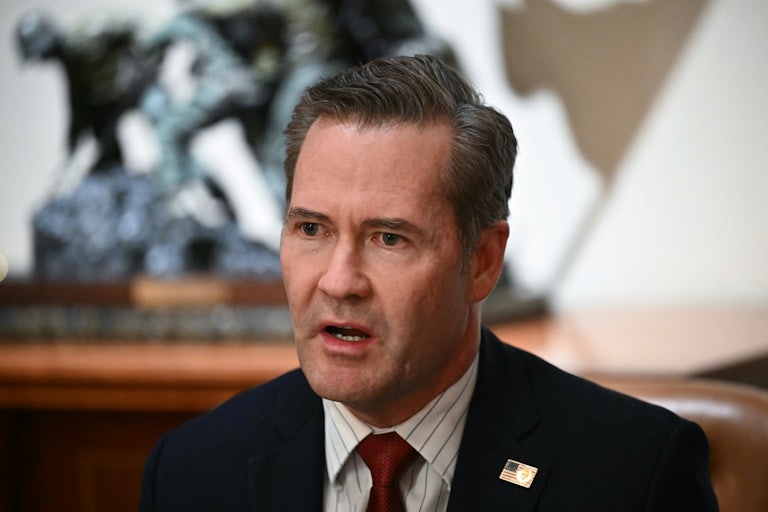
Trump's national security adviser Mike Waltz stares with his mouth open
MANDEL NGAN/AFP/Getty Images

Mike Waltz has multiple Signal group chats in addition to the now infamous “Houthi PC small group” that he added a reporter to earlier this month, according to a report from The Wall Street Journal.

Two officials close to the situation told the Journal that Waltz has started Signal chats with Cabinet members regarding a peace treaty between Russia and Ukraine as well as various other military activities.

While Trump has publicly stood behind Waltz, the president—and the rest of his inner circle—has castigated the national security adviser for the biggest blunder of Trump’s second term (so far). The Journal reports that Trump went on a few different expletive-filled rants about Waltz over the phone last week, and multiple staffers have made their discontent clear. Some noted that if a conservative outlet like Breitbart had broken the Signalgate story rather than The Atlantic, Waltz would be long gone. Others went so far as to spread past clips of Waltz being critical of Trump, alleging he is a neocon unfit to serve the MAGA agenda.

The administration has rejected reports of internal frustrations with Waltz. “The chattering of unnamed sources should be treated with the skepticism of gossip from people lacking the integrity to attach their names,” said National Security Council spokesman Brian Hughes.