Breaking News
Breaking News
from Washington and beyond

The Trump Administration Just Violated Another Court Order

It gets worse: The order found that the administration was covertly withholding millions in FEMA funds from blue states.

Donald Trump walks across the White House lawn
Andrew Harnik/Getty Images

A federal judge ruled Friday that the president violated a court order to stop freezing federal funds by withholding Federal Emergency Management Agency relief to at least 19 states. The judge said that the Trump administration seemed to be making a “covert” effort to punish states whose immigration practices differed from the White House.

U.S. District Judge John McConnell issued an injunction in March on behalf of 23 states that sued the federal government after the White House moved to pause aid to states, ruling that the move ​​“fundamentally undermines the distinct constitutional roles of each branch of our government.”

On Friday, McConnell found that the Trump administration disregarded the court order, with at least 19 states, all of whom with Democratic attorneys general, presenting “undisputed evidence” that they were not receiving FEMA funds already appropriated by Congress.

Oregon, for example, still hasn’t received $120 million in funds meant for winter storms, flooding, landslides, wildfires, and flood mitigation. Hawaii said FEMA has yet to deliver $6 million to rebuild after wildfires devastated Maui in 2023.

For its part, the Trump administration claimed that it was creating a new review process for allocated funding. The states, however, said that they weren’t being given their funds since early February, which McConnell ruled was a clear violation of the order. The judge noted that this appeared to be in accordance with Trump’s executive order barring “sanctuary” states from receiving aid.

This isn’t the first court order that the Trump administration has violated, and it probably won’t be the last. But with a weak Congress, the judiciary is the only check on the president’s power right now, and in this case, millions of Americans struggling to recover from natural disasters are the ones who are suffering. Will there be accountability?
Trump’s Tariff War Tanks Stock Market Even Further

China has hit back at Donald Trump’s tariffs.

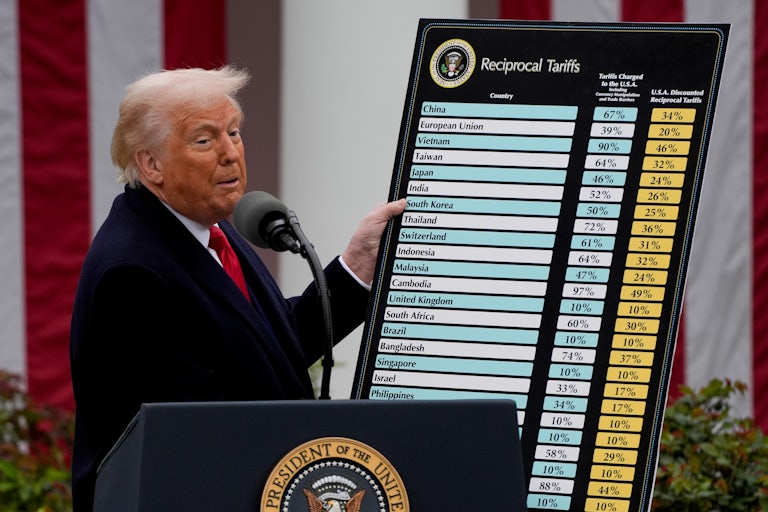
Donald Trump holds up a chart of tariffs while standing at a podium during a press conference in the White House Rose Garden
Kent Nishimura/Bloomberg/Getty Images

The Dow Jones plunged more than 2,000 points, or 5.1 percent, Friday as investors reacted to China’s retaliatory tariffs. The drop-off followed a 1,679-point decline the day before.

Beijing’s Commerce Ministry announced it would impose a 34 percent tariff on imports of all U.S. products as soon as April 10, matching the 34 percent tariff that Donald Trump announced he would impose on Chinese imports as part of his “Liberation Day” tariff strategy.

Despite publicly celebrating the enforcement of his plan, the U.S. president’s nonsensical economic strategy has tanked markets in just two days.

Wall Street’s “fear gauge,” the CBOE S&P 500 Volatility Index (VIX), jumped to 44.4 by Friday afternoon—a 22.8-point jump since Wednesday, and a 26.5-point jump since the beginning of the year, according to data compiled by The Wall Street Journal, putting the economy on track for a bear market.

In a note to investors, JP Morgan said that Trump’s tariffs had a 40 percent chance of slingshotting the U.S. economy into a recession. JP Morgan underscored that the tariffs would cause a price surge—adding two percent to the Consumer Price Index—and additionally raise taxes on Americans by $660 billion a year, “the largest tax increase in recent memory by a longshot,” CNN reported Thursday.

“The impact on inflation will be substantial,” the analysts said, according to the network. “We view the full implementation of these policies as a substantial macroeconomic shock.”

Beyond the economic devastation, Trump’s tariffs have also landed the U.S. in legal hot water. China also announced Friday it would be suing the U.S. via the World Trade Organization, arguing that Trump’s tariff plan “seriously undermines” global trade.

“The United States’ imposition of so-called ‘reciprocal tariffs’ seriously violates WTO rules, seriously damages the legitimate rights and interests of WTO members, and seriously undermines the rules-based multilateral trading system and international economic and trade order,” the Commerce Ministry said. “It is a typical unilateral bullying practice that endangers the stability of the global economic and trade order. China firmly opposes this.”

The Trump administration is also facing lawsuits over the sweeping tariff plan at home.

The New Civil Liberties Alliance sued the president Thursday, claiming that Trump’s decision to invoke the International Emergency Economic Powers Act to enforce the tariffs—which impacts trade with some 200 countries—did not give him the power to “usurp” Congress’s right to control tariffs or “upset the Constitution’s separation of powers.”

In a press release, the right-wing group (which has financial ties to Leonard Leo and the Koch network) argued that the emergency statute “authorizes specific emergency actions like imposing sanctions or freezing assets to protect the United States from foreign threats.”

“It does not authorize the President to impose tariffs,” the NCLA wrote.

Trump Has Bonkers Theory for How Tariffs Will Save TikTok

What can’t Donald Trump’s tariffs fix?

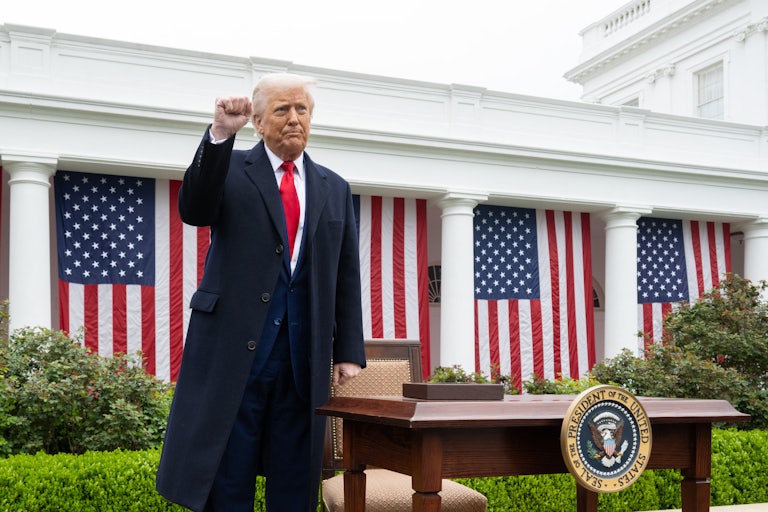
Donald Trump raises his fist while standing next to a desk in the White House Rose Garden
Saul Loeb/AFP/Getty Images

President Donald Trump has once again swooped in to save TikTok, after the president’s sweeping tariffs undermined a deal with China.

“My Administration has been working very hard on a Deal to SAVE TIKTOK, and we have made tremendous progress,” Trump wrote on Truth Social Friday.

The president said that he planned to sign an executive order to delay the enforcement of the U.S. TikTok ban for an additional 75 days.

Trump continued to say that U.S. officials hoped to continue negotiations with China, “who I understand are not very happy about our Reciprocal Tariffs.”

“This proves that Tariffs are the most powerful Economic tool, and very important to our National Security! We do not want TikTok to ‘go dark.’ We look forward to working with TikTok and China to close the Deal. Thank you for your attention to this matter,” Trump wrote.

Trump appeared to suggest that his “reciprocal tariff” policy, which placed a baseline 10 percent tariff on nearly every country in the world, was some kind of chip in negotiations over TikTok’s parent company, Beijing-based ByteDance. In 2024, Congress passed a law that required the firm to sell TikTok’s U.S. operations to a non-Chinese owner, or see it banned in the U.S. Trump has now swooped in twice to rescue the app from going dark (after putting it on Congress’s radar in the first place).

In reality, Trump’s decision to impose steep tariffs on China has only gotten in the way of negotiations. The White House had nearly reached an agreement with China on TikTok, but the country hit the breaks after Trump’s tariff announcement Wednesday, the Associated Press reported.

After Trump imposed a 34 percent tariff on Chinese imports to the U.S. earlier this week, in addition to two previous rounds of 10 percent duties, China responded in kind, levying its own 34 percent tariff on all imports from the U.S. on Friday.

In 2024, the U.S. imported $438.9 billion worth of Chinese goods, and China imported $143.5 worth of American goods, according to the U.S. trade representative.

Trump previously signed an executive order in January to keep the app running for U.S. users for 75 days, “to permit my Administration an opportunity to determine the appropriate course of action with respect to TikTok.” The grace period was set to expire Saturday, April 5.

This story has been updated.

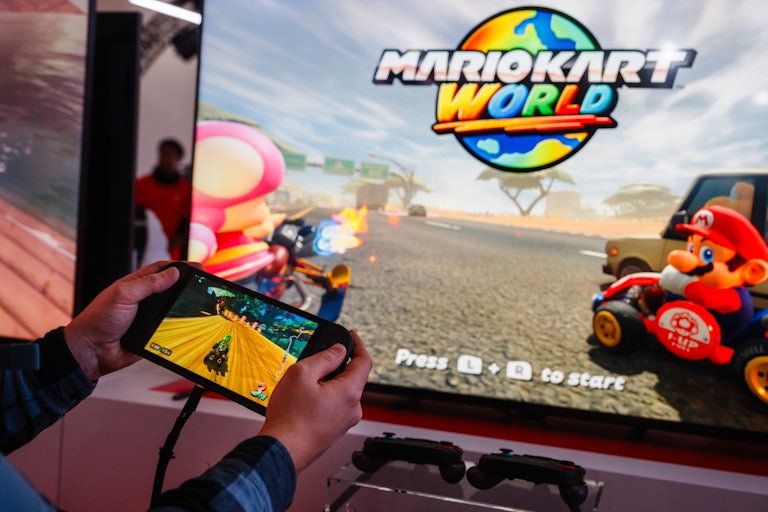
The Latest Victims of Trump’s Tariffs: Gamers

Preorders of the hotly anticipated Nintendo Switch 2 have been delayed as the Japanese company assesses the “potential impact” of the Trump administration’s trade war.

A gamer plays the upcoming Nintendo Switch 2 at a launch event
DIMITAR DILKOFF/AFP via Getty Images)
A gamer plays the upcoming Nintendo Switch 2 at a launch event.

Then they came for the gamers: Nintendo is delaying preorders of the Switch 2 in the wake of Trump’s sweeping, unprecedented tariffs on the entire world. Experts, meanwhile, think the device’s high cost is a direct result of the company anticipating the devastating effect of tariffs.

“Pre-orders for Nintendo Switch 2 in the U.S. will not start April 9, 2025 in order to assess the potential impact of tariffs and evolving market conditions. Nintendo will update timing at a later date,” Nintendo said in a statement from IGN. “The launch date of June 5, 2025 is unchanged.”

The Switch is manufactured in China and Vietnam, countries that Trump placed 34 percent and 46 percent tariffs on, respectively. The Switch 2 is perhaps the most anticipated gaming console release of the year, as the first iteration was the third-bestselling gaming console of all time.

Trump’s tariffs have gamers everywhere bracing for aggressive price increases. “There’s no doubt that Nintendo and Sony bumped prices higher initially to pre-empt potential tariffs,” Niko Partners analyst Daniel Ahmad wrote on X. “They are indeed higher than expected, but I wouldn’t expect the % price increase to be exactly in-line with the tariff.

“When [graphics processing unit] prices increased in February that’s because tariffs on China were 10%. When they increased again in March that’s because they were 20%,” he continued. “Now they’re 54% for China and other Asia markets incl. Vietnam are 46%. Unless reversed, expect all gaming hardware to see jumps.”

Others speculated that Nintendo waited until the very last minute to decide on a price increase due to the intense uncertainty surrounding the tariffs.

“Nintendo appears to be building in a buffer against these potential trade barriers while ensuring they maintain their traditional positive margin on hardware,” NYU professor Joost van Dreunen told IGN. “My view is that they probably had a range of pricing for the U.S. market in play up until the last minute due to the uncertainty on import tariffs.”

This reinforces the very basic economic concept of tariffs being a tax on the consumer more than anything else. And when used as wantonly and spitefully as Trump is using them, the price of everything, everywhere, shoots up.

RFK Jr. Reveals DOGE Fired Some People by Mistake

According to Robert F. Kennedy Jr., Elon Musk’s job cuts aren’t so efficient after all.

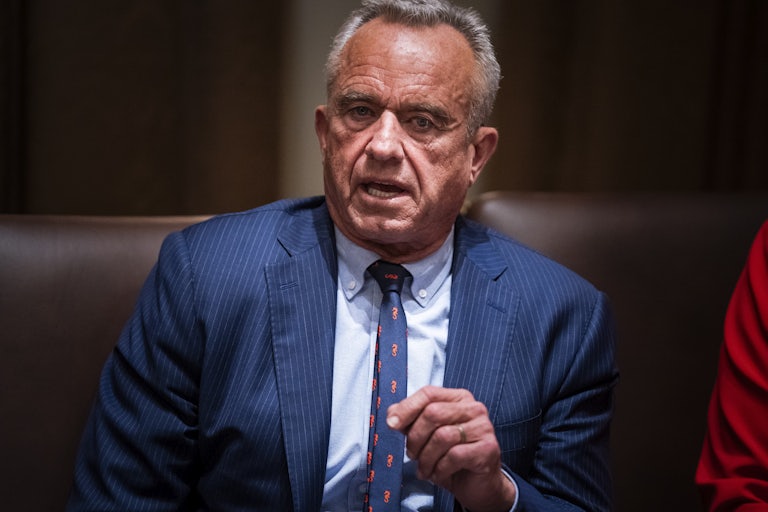
Robert F. Kennedy Jr. speaks during a Cabinet meeting at the White House
Jabin Botsford/The Washington Post/Getty Images

A fifth of the jobs slashed at the Department of Health and Human Services were actually a mistake, Health Secretary Robert F. Kennedy Jr. said.

Under the direction of Elon Musk’s Department of Government Efficiency, the health agency fired some 10,000 employees this week in an ongoing government reduction effort that Kennedy has said could downsize his department’s 82,000-employee workforce by as much as a quarter.

But by Kennedy’s own admission, that process is apparently so haphazard, rushed, and inefficient that it basically has to involve major mistakes that undermine the department’s work.

“Personnel that should not have been cut, were cut,” Kennedy told reporters on Thursday. “We’re reinstating them. And that was always the plan. Part of the DOGE, we talked about this from the beginning, is we’re going to do 80 percent cuts, but 20 percent of those are going to have to be reinstated, because we’ll make mistakes.”

Kennedy noted that some of the employees affected were not in administrative roles, as DOGE had promised, and that the layoff had affected the agency’s research work. One such program included a team of researchers at the Centers for Disease Control and Prevention that monitors lead exposure in children.

“There were some programs that were cut that are being reinstated, and I believe that that’s one,” Kennedy said.

Other shuttered departments were responsible for research and policy recommendations on older adults, disabilities, HIV, minority health, mine safety, and smoking. It is unclear if these are among the research priorities that will return.

The negligent error is just one recent instance in which the “shock and awe” of the Trump administration’s federal makeover has resulted in dud details and mass confusion.

Since January, the Trump administration has fired more than 100,000 federal employees, killing the Education Department and attacking the Environmental Protection Agency. Mass layoffs were also conducted at the Department of Energy in February, where DOGE similarly and mistakenly nixed critical workers focused on nuclear safety.

Bringing those employees back wasn’t as easy as simply having them return to work the next day. Instead, dejected and “shell shocked” employees at the semiautonomous National Nuclear Security Administration were reportedly considering early retirement or looking for work in more stable sectors, unsure if or when the Trump administration might try to dismiss them again, according to The Bulwark.

But tens of thousands more government jobs are expected to be on the chopping block as Trump pursues a second round of “voluntary” buyouts in the coming weeks.

The former commissioner of the Food and Drug Administration, Robert Califf, condemned the Health Department layoffs in a statement on LinkedIn.

“The FDA as we’ve known it is finished, with most of the leaders with institutional knowledge and a deep understanding of product development and safety no longer employed,” Califf wrote, describing the action as “a dark day for public health.”