Breaking News
Breaking News
from Washington and beyond

Trump’s War on Harvard Ramps Up as DOJ Threatens to Pull All Funding

Donald Trump’s administration is now accusing the university of violating civil rights law.

People walk outside the Harvard University library
Heather Diehl/The Boston Globe/Getty Images

Donald Trump’s administration is formally threatening to revoke all of Harvard University’s federal funding over allegations that the elite school violated Title VI.

The Department of Justice’s task force to combat antisemitism sent a formal notice to university President Alan Garber Monday alleging that “Harvard has been in some cases deliberately indifferent, and in others has been a willful participant in anti-Semitic harassment of Jewish students, faculty, and staff.”

“Failure to institute adequate changes immediately will result in the loss of all federal financial resources and continue to affect Harvard’s relationship with the federal government,” the notice said. “Harvard may of course continue to operate free of federal privileges, and perhaps such an opportunity will spur a commitment to excellence that will help Harvard thrive once again.”

In 2024, Harvard received $686 million federal grants, making the government the largest financial source for the school’s many research programs. One in five undergraduate students rely on grants intended for low-income students, according to Politico.

The notice alleged that the administration’s investigation had found that the majority of Jewish students on campus had reported experiencing a negative bias, and nearly a quarter felt unsafe.

The notice also cited the multiweek student encampment to oppose Israel’s ongoing genocide in Gaza, as well as the “lax” discipline against the students who’d participated, wrongly equating pro-Palestinian speech with antisemitic activity.

The notice comes amid ongoing negotiations in a bitter legal battle between Harvard and the Trump administration over allegations of antisemitism. Earlier this month, Trump signaled that negotiations with the university were going well.

This is the latest escalation in Trump’s monthslong petty war with the Ivy League institution after the Trump administration froze $2.2 billion in federal grants in April and threatened to revoke the school’s tax-exempt status. Earlier this month, the president’s efforts to see Harvard banned from accepting international students failed in court.
Supreme Court Takes Up Case That Could Change Elections as We Know It

The Supreme Court has just agreed to hear a Republican challenge to a campaign finance law.

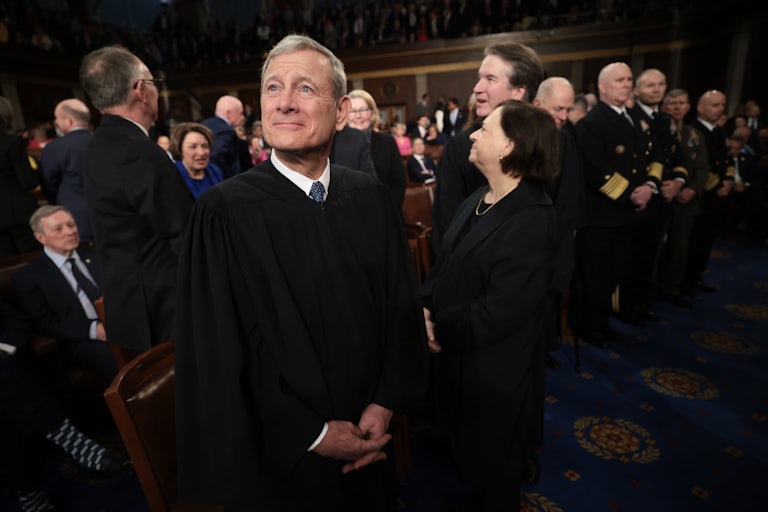
Supreme Court Chief Justice John Roberts smiles and clasps his hands at Trump's joint session to Congress. Behind him are Justices Elena Kagan and Brett Kavanaugh.
Win McNamee/Getty Images
Supreme Court Chief Justice John Roberts

The Supreme Court on Monday agreed to hear a Republican-led case that could upend campaign finance law and allow national party committees to spend even more on elections.

Right now, political parties can spend an unlimited amount on a candidate individually, but are limited in their “coordinated spending”—renting out venues, hiring consultants, or paying for travel. This case, introduced by the National Republican Senatorial Committee, the National Republican Congressional Committee along with then-Senator JD Vance and former Representative Steve Cabot, seeks to overturn that coordinated spending limit.

If ruled in the GOP’s favor, this would be another massive blow to the effort to keep money out of politics. The country’s wealthiest have flaunted their ability to essentially buy elections, or have at least attempted to, for some time now. This most current effort is particularly shameless, given that the high court already upheld the same restrictions in a 2001 ruling. Now it may be repealed with the court’s 6–3 conservative majority.

“The court’s reasoning upholding these party spending limits has been undermined by more recent court campaign finance cases,” UCLA School of Law election expert Rick Hasen told NBC News. “The status quo—where outside groups like super PACs can raise unlimited sums but political parties face much more severe limitations—may create worse conditions in terms of empowering unaccountable groups and increasing negative ads.”

The case is set to be heard in the fall or early 2026.

Iran Leaders Claim Trump’s Bombs Did Nothing, Damning Report Reveals

New information continues to throw Donald Trump’s claims about the effect of the strikes into doubt.

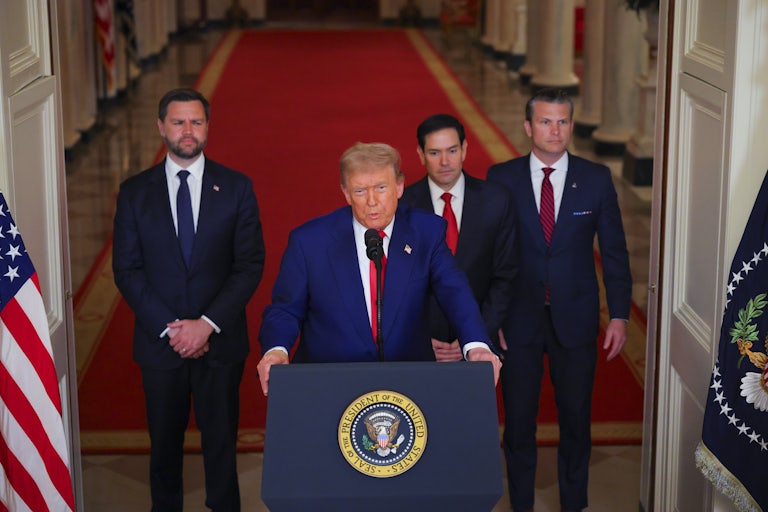
Donald Trump speaks at a podium after airstrikes on Iran. He is flanked by Vice President JD Vance, Secretary of State Marco Rubio, and Secretary of Defense Pete Hegseth
Carlos Barria/Pool/Getty Images

Even the Iranians are surprised by how little damage Donald Trump’s bombs apparently did.

An intercepted communication between Iranian officials indicated that the nuclear facility airstrike had not achieved the level of damage touted by the Trump administration, reported The Washington Post, which spoke with four sources familiar with the classified material.

The president’s attack, conducted earlier this month without the express approval of Congress, damaged facilities in Fordo, Natanz, and Isfahan. Trump celebrated that the attack had “completely and totally obliterated” the three sites in the immediate aftermath, but intelligence assessments have suggested otherwise.

A battle damage assessment by the Pentagon’s intelligence arm determined that the missile barrage only set Iran’s nuclear program back by a few months, rather than the “years” that Trump had advertised.

As with the Pentagon assessment, the White House did not dispute that the Iranian call had taken place, but fervently rejected its findings.

“It’s shameful that The Washington Post is helping people commit felonies by publishing out-of-context leaks,” said White House press secretary Karoline Leavitt. “The notion that unnamed Iranian officials know what happened under hundreds of feet of rubble is nonsense. Their nuclear weapons program is over.”

Whether the sites had been hit by 30,000-pound “bunker buster” bombs was not in doubt, but the exact extent of the damage inflicted on Iran’s nuclear program has been heavily debated since the attack took place.

One Trump administration official brushed off the leaked call details, telling the Post that the Iranians were “wrong” because “we’ve destroyed their metal conversion facility.”

Senior U.S. intelligence officials warned that intercepted phone calls can only relay some information as they lack critical context.

“A single phone call between unnamed Iranians is not the same as an intelligence assessment, which takes into account a body of evidence, with multiple sources and methods,” one official told the Post.

Before the attacks took place, Iran had argued that it was seeking uranium for peaceful purposes, such as expanding its nuclear energy program. The nation has undergone years of nuclear site inspections by the International Atomic Energy Agency, and as of two weeks ago was allowing IAEA inspectors to remain in the country, according to the United Nations entity.

Trump has been irate over the coverage of the bombings, insisting that journalists who reported on the Pentagon leak should be fired. Last week, Leavitt took that to a new level, using two minutes out of the White House press briefing to singularly lambast CNN reporter Natasha Bertand.

Justice Department Announces Chilling Plan to Revoke Citizenship

Trump’s DOJ issued a directive making it a priority to strip some Americans of their citizenship.

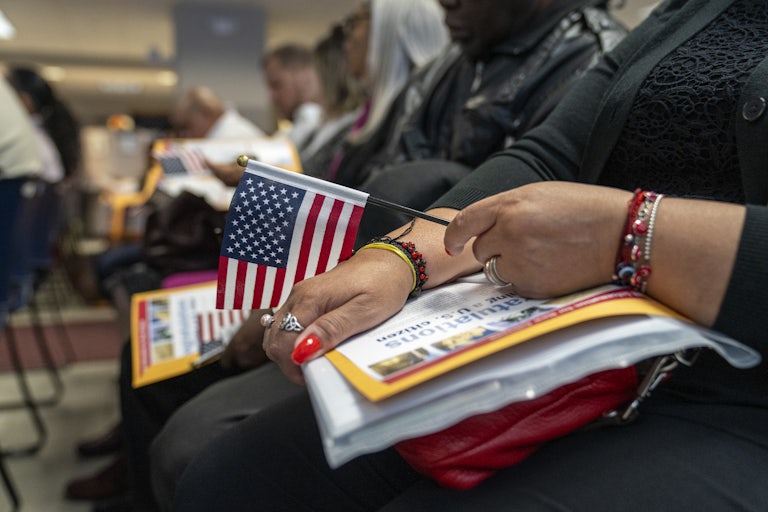
A brown woman seated holds a U.S. flag in her left hand and a stack of papers in her lap. The paper on top reads "Congratulations on Becoming a U.S. Citizen."
Robert Nickelsberg/Getty Images

Under Donald Trump, the Department of Justice is looking to ramp up denaturalization, or the revocation of citizenship, in order to fulfil its mass-deportation immigration agenda.

A June 11 memo from Assistant Attorney General Brett Shumate listed “prioritizing denaturalization” as a key administration directive for the civil division of the DOJ under Trump.

The DOJ’s civil division will now “prioritize and maximally pursue denaturalization proceedings in all cases permitted by law and supported by the evidence.” These include those “who pose a potential danger to national security,” those who engaged in fraud, and those who acquired citizenship through “material misrepresentations,” as well as “any other cases referred to the Civil Division that the Division determines to be sufficiently important to pursue.”

This would mark a notable departure from current norms.

Political scientist Patrick Weil estimates that, between 1907 and 1967, over 22,000 Americans were denaturalized—including, infamously, for political reasons during the first and second red scares. Denaturalization then fell out of use considerably, with only about 11 cases occurring each year from 1990 to 2017.

Denaturalization efforts were expanded under Obama, and increased further under the first Trump administration—which realized, as journalist Rafia Zakaria wrote in The Nation, that civil denaturalization cases have a lower burden of proof than criminal cases and no statute of limitations, making them easier targets.

The June 11 directive recalls Trump aide Stephen Miller’s October 2023 vow that the “denaturalization project” will be “turbocharged” in 2025, as well as Trump’s own statements in support of deporting naturalized citizens and even “homegrown criminals.”

The news comes as threats of denaturalization have become a common cudgel on the MAGA right, whose adherents—from media personalities to lawmakers—have increasingly called for the denaturalization and deportation of their ideological opponents, such as Democratic New York City mayoral nominee Zohran Mamdani, Representative Ilhan Omar, and journalist Mehdi Hasan. It also comes as the Trump administration has conflated pro-Palestinian activism with support for terrorism.

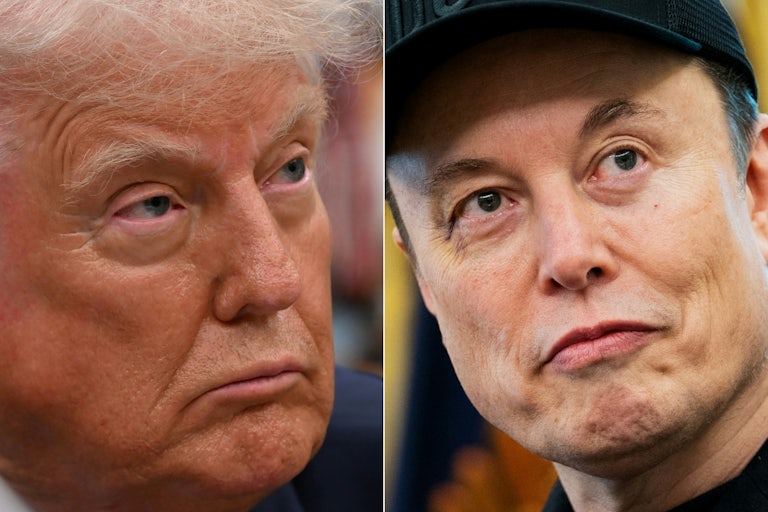
Elon Musk Tears Into Trump Over Budget in Infuriated Posting Spree

Elon Musk’s opposition to the budget is what prompted his very public breakup with Donald Trump.

Donald Trump smiles and leans over while seated at a conference table with Secetary of State Marco Rubio, Defense Secretary Pete Hegseth, Central Intelligence Agency Director John Ratcliffe, and U.S. Ambassador to Israel Mike Huckabee.
Alex Wroblewski, Allison Robbert/AFP/Getty Images

Elon Musk threw himself back into the federal fray over the weekend, drawing more attention to the conservative opposition to the president’s tax extension bill.

Donald Trump’s “big, beautiful bill” would extend his 2017 tax cuts for millionaires and corporations at a cost to critical social programs such as Medicaid. On Saturday, the Congressional Budget Office estimated that the Senate legislation would increase the deficit by more than $3.9 trillion over the next 10 years.

After Democrats forced a full read-through of the 1,018-page text on Saturday (which took approximately 16 hours), Senate Republicans initiated a “vote-a-rama,” in which lawmakers can propose an unlimited number of amendments as they vote back-to-back on the legislation. But by Monday, it wasn’t clear that the upper chamber actually had the support of the nation in moving to pass the bill—CNN data chief Harry Enten analyzed five recent polls that cumulatively indicated the bill is historically unpopular, with 49 percent of the country believing it will hurt their families as opposed to the 23 percent who think it will help them.

And despite publicly stitching up his feud with the president several weeks ago, Musk was right there with the majority of the American public in resisting the bill.

“Polls show that this bill is political suicide for the Republican Party,” Musk posted Saturday, sharing polling from polling firm the Tarrance Group suggesting that 58 percent of all registered voters in the country agreed with his previous assessment that the bill is “pork-filled.”

Musk also retweeted a statement from North American Building Trades Union President Sean McGarvey, who torched Trump’s bill as “a massive insult” to American construction workers, and underscored that “critical infrastructure projects essential to that future are being sacrificed at the altar of ideology.”

“We are especially outraged because all of this, all of these job losses for hardworking Americans, is being done for one reason only: to make room for more tax breaks for the wealthiest corporations and individuals in America,” McGarvey wrote.

The multibillionaire Musk went head-to-head with Trump earlier this month, when he threatened to change the tune of his Republican contributions and instead use his enormous wealth to influence the country to “fire all politicians who betrayed the American people.”

Republicans plan to offset the expensive tax cut by slashing some $880 billion from Medicaid. But Musk’s issue with Trump’s plan has little to do with its slashing of programs aimed at supporting and uplifting the most vulnerable Americans—instead, he’s condemned the bill on the basis that it would effectively undo his work atop the Department of Government Efficiency, which was tasked with paring down government spending.

Musk was Trump’s top financial backer in the 2024 election, spending at least $250 million in the final months of the president’s campaign after Trump was shot in July. Musk had also promised to funnel funds toward other Republicans, declaring in the wake of the November election that his super PACs would “play a significant role in primaries.” In the following months, Musk threatened to use his money to fund primary challengers to Trump’s agenda and go after Democrats, and that he would be preparing “for the midterms and any intermediate elections, as well as looking at elections at the district attorney level.”

Trump’s centerpiece legislation currently faces a self-imposed July 4 deadline.