Breaking News
Breaking News
from Washington and beyond

GOP Voters Are Blowing Up Congressional Phone Lines Over Epstein

Marjorie Taylor Greene explained just how much demands to release the Epstein files have increased.

Representative Marjorie Taylor Greene points while speaking to reporters in the Capitol.
Eric Lee/Bloomberg/Getty Images

Pressure is still mounting against conservatives to release the Epstein files.

On Tuesday, Representative Marjorie Taylor Greene described the demand for transparency as “overwhelming,” noting that the call volume related to Epstein at her office has been “extremely high.”

“Since I became a freshman member of Congress—this is fascinating—I’ve tracked the calls to my office,” Greene told reporters. “I have a whole spreadsheet my staff maintains. They track all the calls coming in from the district and from outside the district. We categorize the issues, from past ones to current ones.

“The call volume on Epstein has been almost 100 percent—district and out of district—since this started. They’re demanding transparency,” she said.

Greene noted that many of her colleagues are “getting beaten up at home in their districts” over the Epstein files, as well.

The Georgia Republican has joined hands with a dozen other lawmakers in a bipartisan effort—H.Res.581, dubbed the Epstein Files Transparency Act—to make the Epstein case files publicly available.

Introduced by Representative Thomas Massie, who has a habit of actually standing up to Donald Trump, the bill aims to “make publicly available in a searchable and downloadable format all unclassified records, documents, communications, and investigative materials in the possession of the Department of Justice, including the Federal Bureau of Investigation and United States Attorneys’ Offices,” relating to child sex traffickers Jeffrey Epstein and Ghislaine Maxwell.

The text of the bill specifies the release of flight logs, travel records, the names of individuals and government officials connected to Epstein’s “criminal activities, civil settlements, immunity or plea agreements, or investigatory proceedings,” the names of corporations or organizations tied to Epstein’s trafficking networks, potential immunity deals or sealed settlements, as well as “internal DOJ communications.”

And if conservative lawmakers were prioritizing transparency, perhaps they would have pushed through a Democratic-led effort to release the Epstein files instead of blocking it last week, before the chamber recessed. The final vote was 211–210: Just one dissenting Republican would have tipped the scales.

Even if the new bill passes, Americans will have to wait a while for answers. Amid the Epstein-induced federal frenzy, House Republicans decided to start the lower chamber’s summer recess early, ushering lawmakers back home and away from the Capitol while the Trump administration flails in response to the mounting scandal.

A Quinnipiac poll published last week found that 63 percent of voters disapprove of the way that the Trump administration has handled the Epstein case, which has so far included the Justice Department backtracking on the existence of certain documents and the president chalking up Epstein’s notoriety to a Democrat-invented “hoax.”

Columbia Just Gave Trump a Truly Terrifying Amount of Power

The university continues to cede control to Donald Trump.

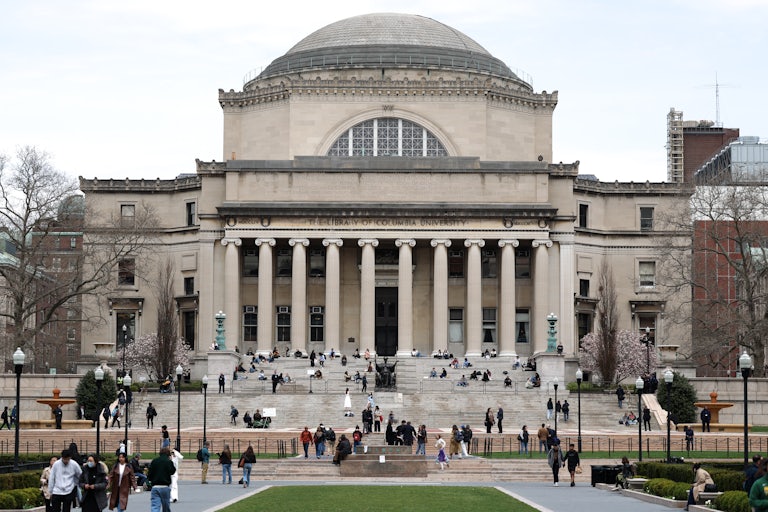
Columbia University campus
Charly Triballeau/AFP/Getty Images

Columbia University has handed the reins of its admission process to the White House.

One of the oldest educational institutions in the country agreed Wednesday to pay the Trump administration $200 million to settle multiple investigations and reinstate billions of dollars’ worth of federal grants.

But the agreement comes with an alarming clause that will deliver granular admissions data on every Columbia applicant to the Trump administration, effectively allowing the White House to decide if the school has admitted enough historically advantaged demographics—or needs to face further investigations.

The school, according to the settlement, must provide admissions data “consistent with 34 C.F.R. § 100.6 and similar regulations” to an independently appointed resolution monitor, alongside analysis of which students were rejected or admitted on the basis of their “race, color, national origin, grade point average” and test performance. The form will be due to the White House by October 1 of each year.

That data will also, subsequently, be made public, according to the settlement details.

But even abiding by the new system won’t save Columbia from future power trips by the White House.

“Nothing in this Agreement prevents the United States (even during the period of the Agreement) from conducting subsequent compliance reviews, investigations, or litigation into Columbia’s future admissions practices to ensure that those practices are in full compliance with all applicable laws and not a proxy for prohibited discrimination,” the settlement reads.

The university, however, did not interpret the contents of the agreement the same way, minimizing the impact of sharing applicants’ sensitive details with the government.

“Critically, Columbia retains control over its academic and operational decisions,” the school wrote in an email blast to students. “As part of the settlement, the University has not admitted wrongdoing and does not agree with the government’s conclusion that it violated Title VI of the Civil Rights Act.”

Columbia has kowtowed and bowed its head repeatedly to the White House since the Trump administration made an example of it earlier this year, repeatedly attacking the institution over its response to a pro-Palestine protest that took place on campus in 2024. The Trump administration has accused Columbia of engaging in antisemitism for apparently failing to subdue the protests as aggressively as Trump would have liked.

On Tuesday, Columbia said it would be disciplining dozens of pro-Palestine protesters who participated in the occupation of Butler Library in May, which saw multiple arrests at the time. A pro-Palestine group on campus, Columbia for Palestine, said that 80 students had been informed of their punishments, and noted that the move marked “the most suspensions for a single political protest in Columbia campus history.”

Last week, Columbia further capitulated to the Trump administration, adopting a new campus-wide definition of antisemitism that conflates hatred of the Jewish people with general opposition to Zionism. It has also said it would no longer engage with the pro-Palestinian group Columbia University Apartheid Divest, permitted federal immigration officials into its buildings, and allowed the administration to attempt to deport foreign students who support the free state of Palestine, though those cases have encountered judicial roadblocks.

As per the terms of the settlement arrangement, Columbia will also institute a new liaison to the Jewish community in University Life.

South Park Eviscerates Trump and His “Teeny-Tiny” Manhood

South Park kicked off its new season with a damning episode showing Donald Trump in bed with Satan.

South Park Episode with a very small Donald Trump in bed next to a very large, muscular Satan.
Screenshot/Bluesky

South Park used its first new episode in two years to openly ridicule President Trump and Paramount, its own parent company. The episode, titled “Sermon on the Mount,” parodies much of the president’s first six months, portraying him literally in bed with Satan.  

In the episode, the parents of South Park protest against Trump’s insertion of prayer into their schools, and Trump threatens to sue them for $5 billion. Jesus himself then appears and asks the parents to simply capitulate.

 “I didn’t want to come back and be in the school, but I had to because it was part of a lawsuit and the agreement with Paramount,” Jesus says. “You guys saw what happened to CBS? Well, guess who owns CBS? Paramount. You really want to end up like Colbert? You guys got to stop being stupid.… He also has the power to sue and take bribes, and he can do anything to anyone. It’s the fucking president, dude.… South Park is over.”

The episode also depicts Trump with an abnormally small penis, which he harasses Satan with while they’re in bed together. 

This episode is particularly audacious, as it comes after Paramount made two major concessions to Trump by ending The Late Show With Stephen Colbert and settling for $16 million because he didn’t like the way 60 Minutes edited an episode with Kamala Harris during the 2024 campaign. This also comes as South Park Digital Studios announced its own $1.5 billion licensing deal with Paramount. 

“Hard to think of anything more defiant in media & entertainment recently than Trey Parker & Matt Stone going scorched earth on Paramount in a South Park season premiere on the heels of netting a $1.5 billion deal with the very same company,” Puck senior correspondent Dyland Byers wrote on X. 

Epstein Victims’ Lawyer Reveals How to Find Trump’s Birthday Letter

Brad Edwards says it’s easy for Congress to get a hold of Jeffrey Epstein’s birthday book, which reportedly includes a letter from Donald Trump.

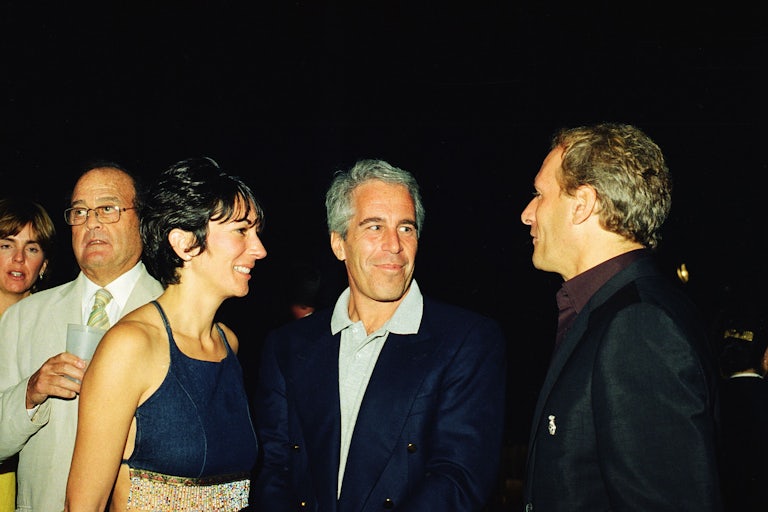
Ghislaine Maxwell, Jeffrey Epstein, and musician Michael Bolton at a party at Mar-a-Lago in February 12, 2000.
Davidoff Studios/Getty Images
Ghislaine Maxwell, Jeffrey Epstein, and musician Michael Bolton at a party at Mar-a-Lago in February 12, 2000

Bradley Edwards, who’s represented hundreds of survivors of sexual abuse by notorious sex criminal Jeffrey Epstein, affirmed that Epstein’s 50th birthday book—which, The Wall Street Journal reported, includes a lewd message from Donald Trump—exists. He also shared exactly where one can find it.

Asked about the book by MSNBC’s Lawrence O’Donnell Wednesday night, Edwards replied, “Yes, I know that the executors of [Epstein’s] estate are in possession of that book, and I think that after they turn it over, it should probably be set in the Smithsonian as an artifact at this point in time.”

Edwards had said moments earlier that anyone interested in seeing the book could simply reach out to Epstein’s executors, Darren Indyke and Richard Kahn, and, “If they didn’t just voluntarily turn over the book out of fear of reprisal, Congress could issue a subpoena to their attorneys at Patterson or at Troutman—those are the two law firms. I know those attorneys. They would turn the book over immediately. Nobody would have to guess. There wouldn’t need to be a lawsuit. There wouldn’t have [to be a] wait to [do] discovery. You would immediately have the answers. You could flip to the page. Is there a letter, is there not a letter?”

O’Donnell observed that the House Oversight Committee, which on Wednesday voted to subpoena the Justice Department for the Epstein files, might be interested in acting on Edwards’s tip. With confidence, Bradley said the lawyers of Epstein’s executors would comply “immediately,” citing his close working relationship with them.

Democratic Representative Rho Khanna, a member of the Oversight Committee who has led charges to force the Epstein files’ release, told MSNBC shortly thereafter that Edwards’s revelation is a “bombshell.” He indicated that the House Oversight Committee would look to subpoena Epstein’s estate for the birthday book, which, he added, would be much easier than subpoenaing the DOJ.

If Epstein’s birthday book is shared with the public, and it indeed includes Trump’s letter as reported by the WSJ (complete with its cryptic message and sketch of a naked woman), it would be a massive embarrassment for the president, who is currently suing the Journal for defamation over the story, which he asserts is “a fake thing.”

And such embarrassments are piling up for Trump in recent days, as his former friendship with Epstein is coming more clearly into view amid his administration’s scandalous lack of transparency on the deceased financier. On Wednesday, the Journal dropped another whopper, reporting that Trump’s Justice Department informed the president in May that his name is in the Epstein files—seemingly explaining the president’s outbursts and his team’s foot-dragging over the Epstein affair.

Trump Explains His Main Issue With AI—and It’s Nuts

“Very stable genius” Donald Trump isn’t totally in love with artificial intelligence.

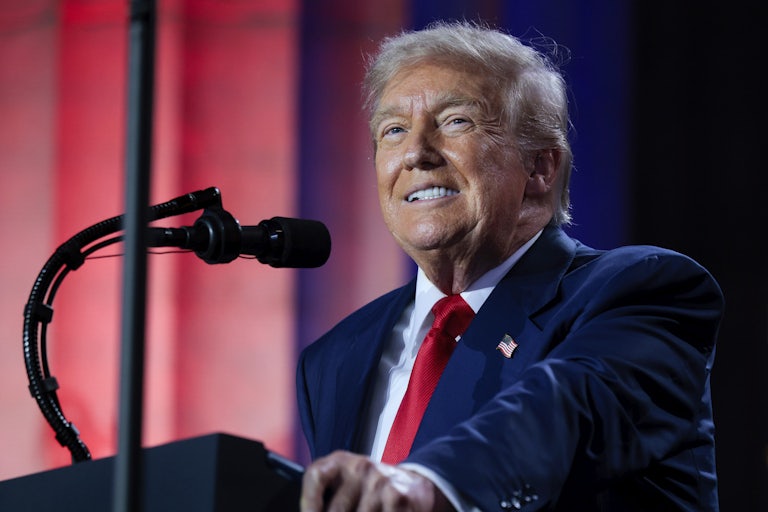
Donald Trump smiles while standing at a podium
Chip Somodevilla/Getty Images

President Donald Trump loves artificial intelligence, calling it “one of the most important technological revolutions in the history of the world” at an AI summit in Washington Wednesday.

But he’s got one big problem with the so-called revolutionary tech: its name.

“Everyone around the globe is talking about artificial intelligence…. ‘Artificial,’ I can’t stand it. I don’t even like the name,” he said. “You know, I don’t like anything that’s artificial. So could we straighten that out please? We should change the name.”

Over laughter, he clarified: “I actually mean that.”

Perhaps the president is taking a page out of naturopathic health crusader and vaccine-denier Robert F. Kennedy Jr.’s book. The health secretary too has a noted dislike of anything artificial, and has mandated that companies remove chemical food dyes from their products as part of his Make America Healthy Again initiative. (Though interestingly, Kennedy has displayed a disturbing willingness to rely on shoddy AI slop at the Department of Health and Human Services.)

Later Wednesday, Trump signed a trio of executive orders that would deregulate the AI industry and “[get] rid of woke,” as he said in his remarks. One order would ban federal agencies from contracting with AI companies that have so-called “ideological biases.”

We’ve been down this road before: After Elon Musk’s xAI chatbot Grok partly blamed Musk and Trump for deaths in the aftermath of the Texas floods, X updated the chatbot to “not shy away from making claims which are politically incorrect.” This resulted in a chatbot that spewed antisemitic dogwhistles and white supremacy and started calling itself “MechaHitler.”

Not quite at Grok level, the president has different nomenclature in mind for the tech.

“I don’t like the name ‘artificial’ anything because it’s not ‘artificial,’ it’s genius. It’s pure genius,” Trump said.

Trump’s choice of name isn’t surprising. The president has long had an affinity for the word genius, calling himself a “very stable genius” in a 2018 tweet about his mental capacities. He also just signed the GENIUS Act, the first major cryptocurrency legislation.

If only he were still in cahoots with former buddy Musk, we could perhaps expect to see the debut of Grok 5: Stable Genius Intelligence.