Breaking News
Breaking News
from Washington and beyond

One Republican Votes Against Releasing Epstein Files for Some Reason

The bill now goes to President Donald Trump for his signature.

A person holds up a sign that says, “Release the files now!” while standing outside the U.S. Capitol
Celal Gunes/Anadolu/Getty Images

The Senate voted unanimously Tuesday to release the Epstein files, sending the measure to Donald Trump’s desk.

Trump has said he will sign the bill. Shortly before the Senate announced the bill had passed, he posted on Truth Social that he didn’t care when the chamber voted on the measure.

I just don’t want Republicans to take their eyes off all of the Victories that we’ve had,” he wrote, citing his tariff policy, his immigration policies, and his budget policy, among others.

After months of dragging their feet, House Republicans—minus one—voted earlier Tuesday to release the Epstein files.

The majority of the caucus sided with Democrats, voting in favor of the Epstein Files Transparency Act (H.R.4405), advancing the effort to the Senate, where its fate has yet to be decided. But Republican Representative Clay Higgins struck out on his own.

The final vote was 427–1. Five representatives did not vote. Lawmakers standing on the Democratic side of the chamber broke out in cheers and applause after the measure passed.

Hours after the bill passed that vote, Senate Minority Leader Chuck Schumer made a motion to pass the motion by unanimous consent once it is transmitted from the House. There were no objections, meaning the bill will automatically go to Trump now.

Higgins wrote moments before the vote that he had been a “no” vote on the matter “since the beginning.”

“What was wrong with the bill three months ago is still wrong today. It abandons 250 years of criminal justice procedure in America,” Higgins argued on social media. “As written, this bill reveals and injures thousands of innocent people—witnesses, people who provided alibis, family members, etc.

“If enacted in its current form, this type of broad reveal of criminal investigative files, released to a rabid media, will absolutely result in innocent people being hurt. Not by my vote,” the Louisiana lawmaker continued. “The Oversight Committee is conducting a thorough investigation that has already released well over 60,000 pages of documents from the Epstein case. That effort will continue in a manner that provides all due protections for innocent Americans.

“If the Senate amends the bill to properly address [the] privacy of victims and other Americans, who are named but not criminally implicated, then I will vote for that bill when it comes back to the House,” he added.

But the victims of Jeffrey Epstein’s child sex trafficking ring are not aligned with Higgins’s opinion. Speaking with reporters before the vote on the steps of the U.S. Capitol, a group of survivors demanded that Congress unequivocally pass the bill and unlock public access to the Epstein case files.

Jeffrey Epstein, a New York socialite who orchestrated an international child sex trafficking ring to service the sick desires of the ultrawealthy, is believed to have abused hundreds of young girls.

His network included an array of high-profile, powerful individuals, including former treasury secretary and ex–Harvard University President Larry Summers, Victoria’s Secret chief executive Les Wexner, Wall Street titan Leon Black, British ex-Prince Andrew (now Andrew Mountbatten-Windsor), and President Donald Trump.

The House Oversight Committee released more than 20,000 documents Wednesday that it had obtained from Epstein’s estate. The documents included multiple mentions of Trump and his ascent to the White House, including one exchange in which Epstein noted: “Of course [Trump] knew about the girls.”

For months, just four House Republicans had penned their signatures on a discharge petition demanding transparency into the investigation of Epstein and his potential associates. Those conservative lawmakers include Representatives Thomas Massie, Marjorie Taylor Greene, Nancy Mace, and Lauren Boebert.

At least two members of that cohort—Mace and Boebert—were personally courted by Trump last week in a last-minute bid to convince them to change their minds about the petition, despite the fact that Trump has repeatedly washed the publicity effort as a Democrat-invented “hoax.”

In the end, Massie was the lone Republican to co-sponsor the Epstein Files Transparency Act.

House Speaker Mike Johnson, who for months parroted Trump’s talking points, sang a very different tune on Tuesday. “Now, at least in recent days, at least every member of the chamber … is in for complete transparency,” he said ahead of the vote.

This story has been updated.
Mike Johnson Lets Slip How He Hopes to Block Epstein Files Release

The measure is expected to pass the House, but the Senate could be a different story.

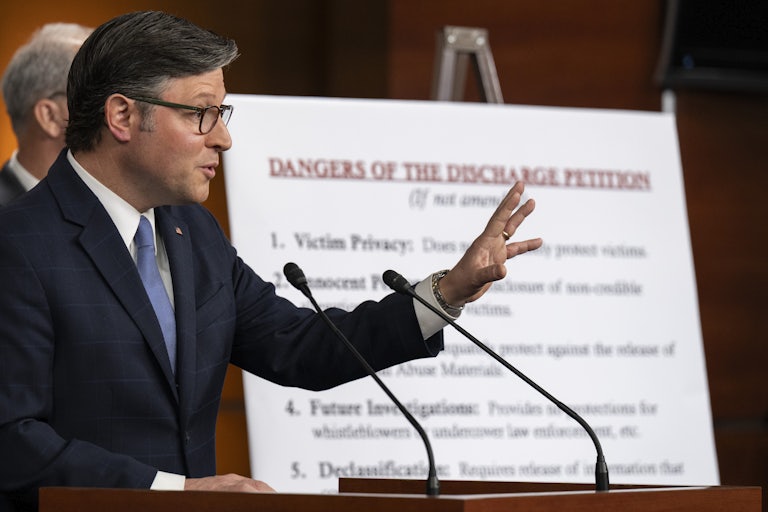
House Speaker Mike Johnson, seen in profile, holds out a hand while speaking at a podium
Roberto Schmidt/Getty Images
House Speaker Mike Johnson

House Speaker Mike Johnson has tapped Senate Majority Leader John Thune to take up the torch of blocking the release of the government’s files on Jeffrey Epstein.

During a press conference Tuesday, Johnson announced that he would support the House petition to release the government’s files on the alleged sex trafficker—but not without throwing one final wrench in the plans of lawmakers who support the measure.

The staunch Donald Trump ally hinted that Republicans would likely attempt to stall the measure in the Senate, saying that he had been in contact with his upper-chamber counterpart to express his lingering concerns about the bill.

“And of course they share those concerns, as well,” Johnson said. “And so I am very confident that when this moves forward in the process, if and when it is processed in the Senate—which is no certainty that that will be—they will take the time methodically to do what we have not been allowed to do in the House: to amend this discharge petition, and to make sure that these protections are there.”

It’s worth noting that if Johnson had simply put this legislation to a vote, instead of requiring lawmakers to seek a discharge petition, he could have potentially amended the bill.

Among supposed concerns about not protecting the identities of victims, or not adequately preventing the release of child sexual abuse materials, Johnson has expressed fears that the release could potentially disclose “non-credible allegations” and risk “creating new victims.”

Representative Thomas Massie, one of the lawmakers behind the petition, said Tuesday Johnson’s so-called concerns were a “red herring” and warned they could simply be another “delay tactic.”

The Kentucky Republican also criticized Johnson’s claim about “non-credible allegations” in a post on X.

“Do not let the Senate add an amendment to avoid disclosing those rich and powerful men who have evaded justice for so many years. Is Johnson calling all victims ‘non-credible?’” Massie wrote.

Johnson’s 180 on the Epstein petition itself isn’t particularly surprising, considering that Trump has also changed his tune, in order to emphasize the convicted sex offender’s ties to Democratic figures. Meanwhile, the Republican Party has fractured over some members’ blatant unwillingness to move forward with the files’ release.

Ahead of the vote, victims rallied for the files’ release, with one calling Trump a “national embarrassment.”

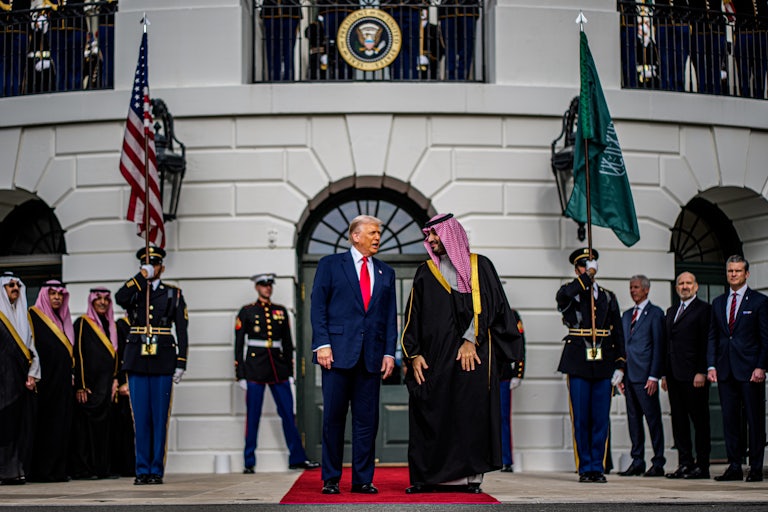
Trump Welcomes Saudi Leader MBS With Red Carpet and Lavish Ceremony

Donald Trump went above and beyond in welcoming Mohammed bin Salman to the White House for the first time since the killing of journalist Jamal Khashoggi.

Donald Trump and Saudi crown prince Mohammed bin Salman stand on a red carpet in front of the White House. Members of the U.S. military and MBS's team stand in the background.
Andrew Harnik/Getty Images

President Trump gave a lavish welcome to Saudi Crown Prince Mohammed bin Salman on his visit to the U.S. Wednesday, complete with a red carpet reception at the White House.

Bin Salman technically isn’t Saudi Arabia’s head of state, as that title belongs to his father, King Salman bin Abdulaziz Al Saud, but that didn’t stop Trump from bringing out military cavalry, sparing no exceptions to the pomp that normally accompanies a state visit.

MBS, as he is commonly known, has not visited the United States since Saudi journalist Jamal Khashoggi, a critic of the crown prince and a Washington Post columnist, was murdered at a Saudi consulate in 2018 and then dismembered with a bone saw. At the White House, Trump glossed over that scandal, saying, “What he’s done is incredible, in terms of human rights and everything else.”

When a reporter asked about the U.S. intelligence’s conclusion that MBS had personally ordered Khashoggi’s killing, Trump asked who the reporter was with and rushed to defend the crown prince.

“He knew nothing about it. You don’t have to embarrass our guest by asking something like that,” Trump said, later adding, “A lot of people didn’t like that gentleman that you’re talking about, whether you like him or didn’t like him, things happen.”

MBS is in Washington for defense and business deals, including the sale of F-35 jets to the country, opposed by Israel, which insists on Saudi Arabia normalizing relations with it beforehand. Saudi Arabia says it wants Israel to make clear and definitive steps toward establishing a Palestinian state before it joins other Arab countries in the Abraham Accords.

In the meantime, though, Trump just cares that Saudi money gets spent in the U.S. and on his family’s businesses. Saudi Arabia’s poor human rights record doesn’t matter to the president, as long he sees oil and dollar signs.

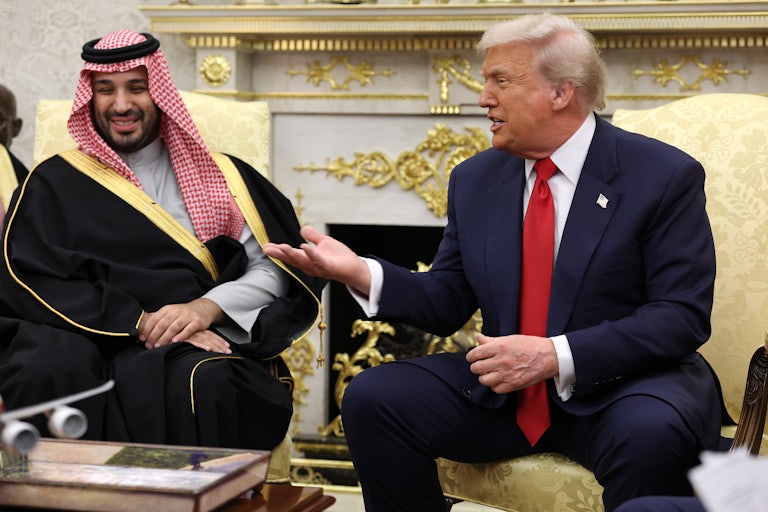
Trump Freaks Out That MBS Might Be Embarrassed by Khashoggi Question

Donald Trump defended the Saudi crown prince, even though the CIA determined he ordered Khashoggi’s killing.

Donald Trump smiles and gestures towards Saudi Crown Prince Mohammed Bin Salman, who smiles and sits next to Trump in the Oval Office
Win McNamee/Getty Images

President Donald Trump offered a mind-boggling defense of Saudi Crown Prince Mohammed bin Salman Tuesday when asked about the foreign kleptocrat’s orchestrating the murder of U.S.-based journalist Jamal Khashoggi in 2018.

During a joint press conference in the Oval Office, Trump responded with hostility when ABC News reporter Mary Bruce asked Trump whether it was “appropriate” for the president’s family to do business in Saudi Arabia while he was in the White House, before turning her attention to the crown prince.

“And your royal highness, the U.S. intelligence concluded that you orchestrated the brutal murder of a journalist. 9/11 families are furious that you are here in the Oval Office. Why should Americans trust you, and the same to you, Mr. President?” Bruce asked, but Trump was already trying to interrupt her.

“No, who are you with?” the president snapped.

“I’m with ABC News, sir,” she replied.

“Who?” he asked.

“ABC News, sir,” she repeated.

“Fake news. ABC fake news. One of the worst, one of the worst in the business,” Trump said.

Trump then launched into a rant claiming he had “nothing to do with the family business” and that his family’s company had done “very little with Saudi Arabia, actually.”

“As far as this gentleman is concerned, he’s done a phenomenal job,” Trump said, referring to MBS. “You’re mentioning somebody that was extremely controversial, a lot of people didn’t like that gentleman that you’re talking about. Whether you like him or didn’t like him, things happen, but he knew nothing about it. And we can leave it at that. You don’t have to embarrass our guest by asking a question like that.”

MBS offered his own response. “I feel painful about families of 9/11 in America, but we have to focus on reality,” he said, claiming that Osama bin Laden had used Saudi citizens in his attacks in order to destroy the relationship between the United States and Saudi Arabia.

“About the journalist, it’s really painful to hear [of] anyone that’s been losing his life for no real purpose or nothing illegal way. And it’s painful for us in Saudi Arabia,” the crown prince said. He claimed that the government had done “all the right steps” in investigating Khashoggi’s death and determined that “nothing happened like that.”

According to a 2021 assessment from the Office of the Director of National Intelligence, MBS had “approved” Khashoggi’s murder in 2018, during Trump’s first term, and supported “using violent measures to silence dissidents abroad.”

Trump Suffers Major Setback in Texas Gerrymandering Scheme

A judge has dumped cold water on Donald Trump’s efforts to influence the 2026 midterm elections.

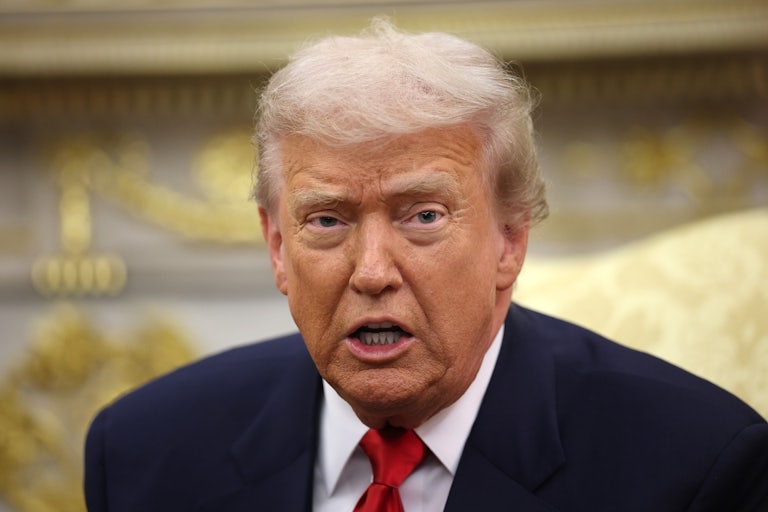
Donald Trump speaks while sitting in the Oval Office
Win McNamee/Getty Images

A federal judge has thrown out Texas’s gerrymandered congressional maps.

Judge Jeffrey V. Brown ruled Tuesday that the Lone Star State must return to its 2021 maps for the 2026 election, writing that “substantial evidence” proved Texas had “racially gerrymandered” its latest districts.

Congressional maps are typically redrawn every 10 years, after new census data is released. But Texas’s decision to do so in the middle of the decade—at Donald Trump’s direction—raised alarm.

Trump had suggested that Texas could give Republicans five more House seats by flipping a handful of blue districts in the Lone Star State next year via “a very simple redrawing.” In July, the Justice Department threatened to take legal action on the matter, asserting that at least four Texas congressional districts were “unconstitutional” since the presence of multiple racial groups had made white people the regional electoral minority.

Mere days after the DOJ letter, Governor Greg Abbott added redistricting to the special session’s legislative agenda.

“Lawmakers reportedly met that request to redistrict on purely partisan grounds with apprehension. When the governor announced his intent to call a special legislative session, he didn’t even place redistricting on the legislative agenda,” Brown wrote in his ruling. “But when the Trump Administration reframed its request as a demand to redistrict congressional seats based on their racial makeup, Texas lawmakers immediately jumped on board.”

Redistricting is perfectly legal—so long as it complies with federal law. Trump’s directive for Texas forced the state to focus on race rather than politics in defiance of national nondiscrimination laws. Brown noted in the legal opinion that if the effort had intended to thwart Democratic strongholds in the state, it would have also targeted majority white Democrat districts,” but those were “conspicuously absent.”

“In other words, the Governor explicitly directed the Legislature to redistrict based on race. In press appearances, the Governor plainly and expressly disavowed any partisan objective and instead repeatedly stated that his goal was to eliminate coalition districts and create new majority-Hispanic districts,” Brown wrote.

Brown determined that reverting to the 2021 map was a more adequate solution than providing the state with another opportunity to draw up a plan, since the 2021 iteration was not only developed by the state legislature (as opposed to the state judiciary) but has successfully been used in two previous congressional elections as well as an ongoing special election.

Democrats celebrated the news.

“Womp, Womp,” responded Texas State Representative Gene Wu, the chair of the state Democratic caucus.

Trump issued similar directives for a handful of other red states, including Indiana, Missouri, Ohio, Illinois, and Florida.

The aggressive redistricting effort elicited shock and contempt from two of the country’s most populous (and Democratic) regions—California and New York. Both states have since launched their own redistricting wars to potentially offset Texas’s altered numbers, though the initiative may seriously offset House seats in the coming years in light of Tuesday’s ruling.

This story has been updated.