Breaking News
Breaking News
from Washington and beyond

Pete Hegseth’s Extreme Plan on Where to Send Boat Survivors Exposed

Pentagon lawyers stunned other government officials with their initial proposal.

Defense Secretary Pete Hegseth
Celal Gunes/Anadolu/Getty Images
Defense Secretary Pete Hegseth

The Department of Defense didn’t have a plan to deal with survivors after launching its boat bombing campaign in the waters around Central America.

The New York Times reports that after a mid-October strike in the Caribbean Sea left two survivors in U.S. military custody, Pentagon lawyers asked their legal counterparts at the State Department if the pair could be sent to the infamous Terrorism Confinement Center in El Salvador, where the Trump administration had already sent numerous immigrants on shaky legal grounds.

Alarmed State Department lawyers quickly rejected that idea, and the two survivors ended up being sent to their home countries of Ecuador and Colombia. Later, on October 29, the Pentagon spoke with diplomats in the region regarding survivors from another strike, and decided that any that were rescued had to be sent back to their home countries or to a third county, but definitely not the U.S.

Why? The DOD wanted to avoid having any survivors in the U.S. legal system because Secretary of Defense Pete Hegseth and other U.S. officials would have to present evidence in court to justify the bombings. The Pentagon has already admitted that it doesn’t know who is on the alleged drug boats it is bombing, which is why it hasn’t tried to prosecute any survivors.

At least some of the people on those boats have been identified as fishermen, and defense officials have not convinced many members of Congress of the legality and justifications for the strikes. Republicans and Democrats alike have criticized them, especially after the revelation that the military bombed survivors of the first boat strike back in September, a possible war crime. Now it seems that Hegseth and the rest of the DOD want to avoid any legal responsibility.
New Poll Reveals Long List of Things Americans Can Barely Afford Now

And they’re blaming Donald Trump.

Defense Secretary Pete HEgseth
Chip Somodevilla/Getty Images

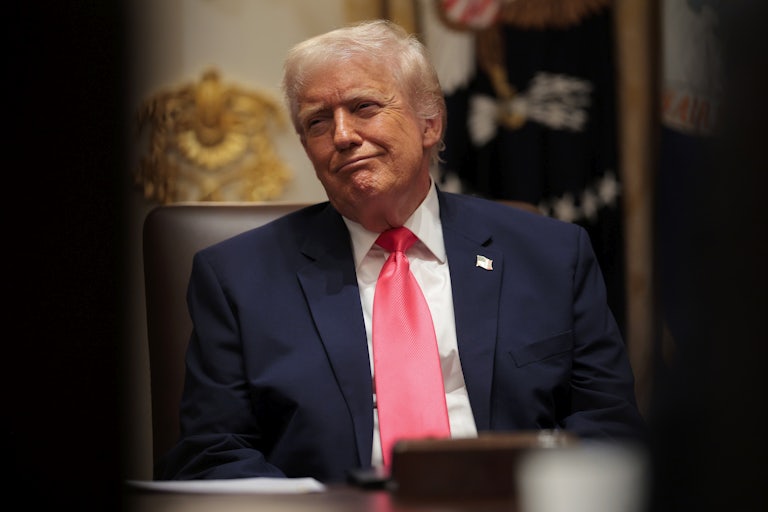
As President Trump recoils at the very mention of affordability, bemoaning it as a Democratic scam (still unclear what that means exactly), over half of the country is struggling to pay for basic necessities—and blaming Trump for it. 

New polling from Politico and Public First shows that nearly half of respondents find it hard to pay for their groceries, and 55 percent of them hold the Trump administration responsible. 

Twenty-seven percent of Americans have skipped a doctor’s appointment or checkup in the last two years because it was too expensive, and 23 percent rejected a prescription for similar reasons. Overall, nearly half of respondents are finding it difficult to afford health care. 

Meanwhile, only 36 percent of Trump’s own voters think that the tariffs will work out in the end. 

The majority of voters blaming their affordability issues on Trump means that his disinformation campaign—doing everything but taking responsibility for the state of the economy—isn’t working on most people. 

Trump went from running on affordability to rejecting the notion entirely. If this polling holds true, that should spell danger for the GOP ahead of the 2026 midterms. 

View the full polling here.  

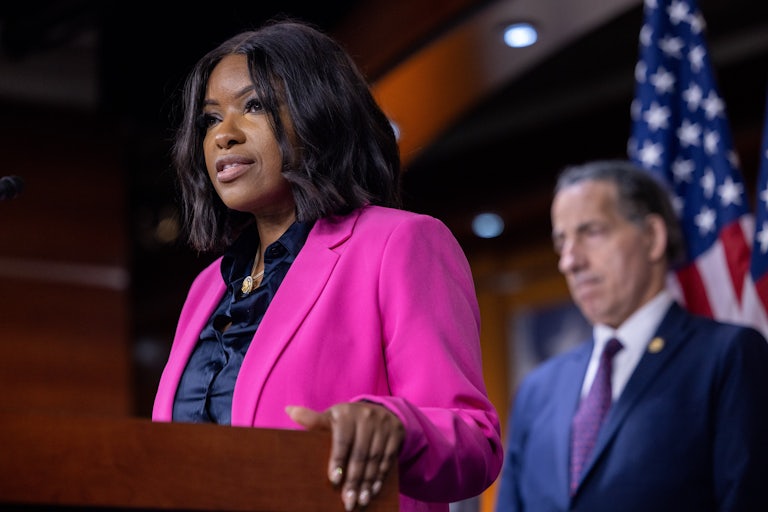
How GOP Secretly Helped Convince Jasmine Crockett to Run for Senate

The National Republican Senatorial Committee pushed polls in Crockett’s favor.

Representative Jasmine Crockett speaks at a podium
Nathan Posner/Anadolu/Getty Images

Republicans are taking credit for Representative Jasmine Crockett’s last-minute decision to run for the United States Senate, as part of their efforts to recruit “very vulnerable Democrats” to run for office, NOTUS reported. 

Crockett’s surprise announcement last week reportedly threw the Democrats’ political calculus into flux—but seems to have delighted the Republicans who’d been secretly working to get her in the race.

Crockett has made a name for herself being a particularly outspoken critic of Trump and his cronies, infuriating MAGA and marking her as a controversial figure in her own party.

A source familiar with the process told NOTUS that GOP machinations to prop up Crockett’s run first began in June, when Texas Democrats met to discuss 2026 midterm elections—and the firebrand Democrat wasn’t invited, or included in any initial polls.  

In July, the National Republican Senatorial Committee published a poll that found that Crockett was the preferred candidate among Democratic voters. “When we saw the results, we were like, ‘OK, we got to disseminate this far and wide,’” the source told NOTUS.

After the NRSC included Crockett’s name in their poll, other surveys started to include her too. The source told NOTUS that those polls were then aggressively seeded into progressive digital spaces by NRSC allies to “orchestrate the pile on” of promising polling numbers and drive the narrative that support for Crockett was “surging.”

The source dubbed the system of trying to pull in a weaker candidate who would lose to the Republican challenger as an “AstroTurf recruitment process.” 

Incumbent Senator John Cornyn, who is running for reelection, dismissed Crockett as “radical, theatrical, and ineffective.” 

Texas Attorney General Ken Paxton, a close ally of President Donald Trump who is currently leading the Republican primary polls, claimed that “everyone knows” Crockett will “be soundly defeated.” Previous polls had indicated that Paxton would fare far worse against state Representative James Talarico, the other Democratic primary candidate, or Collin Allred, who dropped his bid shortly before Crockett jumped into the race. 

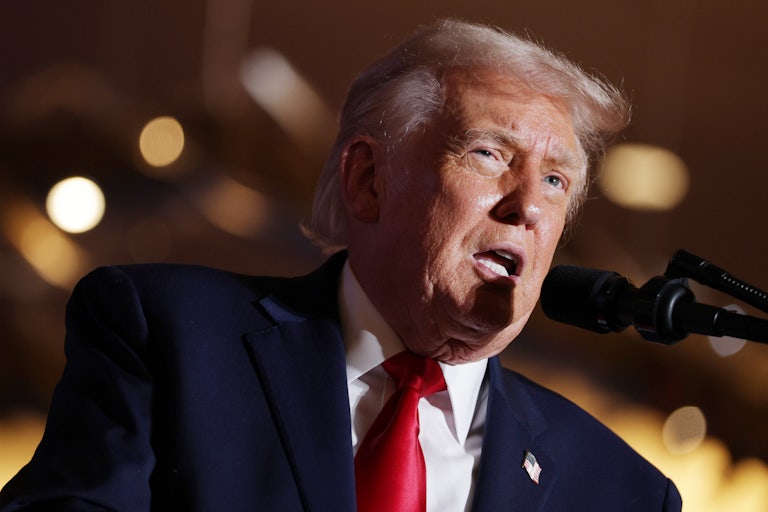
Trump Goes on Dark Rant About People From “Filthy” Countries

This was supposed to be a rally on affordability.

Donald Trump speaking into a microphone
Alex Wong/Getty Images

Donald Trump’s rally in Pennsylvania Tuesday was supposed to be about affordability. Instead, it devolved into him bashing immigrants and using an epithet that he’s previously denied saying.

In Mount Pocono, Trump related to the crowd a meeting in which he said, “Why is it we only take people from shithole countries? Right? Why can’t we have some people from Norway, Sweden, just a few? Let’s have a few. From Denmark, do you mind sending us a few people? Send us some nice people, do you mind?

“But we always take people from Somalia, places that are a disaster, right? Filthy, dirty, disgusting, ridden with crime. The only thing they’re good at is going after ships,” Trump added.

Trump was reported to have made the “shithole countries” remark way back in 2018 during his first term to refer to Haiti and unnamed African countries, but he vehemently denied the reports at the time. Back then, he even kicked out a reporter from the Oval Office for asking whether Trump meant he wanted immigrants from European or predominantly white countries.

Now it seems that the mask is off. For years, Trump has criticized immigrants from nonwhite countries, infamously accusing Haitian immigrants in Springfield, Ohio, of eating cats and dogs, during his 2024 presidential campaign. But he’s always denied using slurs to describe them until now.

Recently, Trump has described Somali immigrants as “garbage” and launched an immigration crackdown in Minnesota, home to the largest Somali community in the United States. It seems that the president thinks that he can fall back on racism to distract from the fact that the country’s economic problems are his fault.

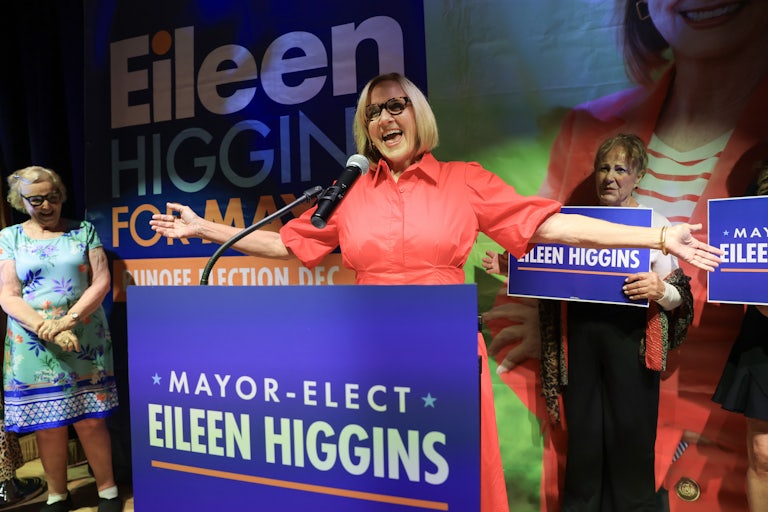
Democrats Pull Off Two Upset Victories as Voters Send Message to Trump

Democrats flipped offices in Miami and Georgia.

Miami Democratic Mayor-Elect Eileen Higgins holds her arms out to the side and speaks at a podium
Joe Raedle/Getty Images
Miami Democratic Mayor-elect Eileen Higgins

More good news for Democrats headed into the midterms: Liberal candidates saw unexpected wins in two Southern states Tuesday night.

Miami residents just elected their first Democratic mayor in almost 30 years. Eileen Higgins, a former Miami-Dade county commissioner, beat Donald Trump–endorsed Republican Emilio González. Higgins won 59 percent of the vote compared to González’s 41 percent.

Both candidates appealed to residents’ economic woes but used different tactics: Higgins emphasized her experience on the County Commission with building infrastructure, streamlining city processes, and building affordable housing. González argued that he would fight overdevelopment and get rid of property taxes. Higgins also loudly criticized Trump’s mass deportation campaign, whereas González pleaded the Fifth, saying he had no control over national policy.

In neighboring Georgia, a special election for a state House seat saw a changed district. Democrat Eric Gisler flipped the previously red seat blue, eking out a win over Republican Mack Guest in a close race.

It’s a major upset: Trump won the district last year by 12 points. Gisler had run for the seat last year and at the time won just 39 percent of the vote. But Tuesday night, he won 51 percent.

Gisler ran on a platform of increasing access to health care, affordable housing, and voting rights. He told the Associated Press that he was grateful for “Democratic enthusiasm” but that he also credited his win to Republicans looking for a change. “A lot of what I would call traditional conservatives held their nose and voted Republican last year on the promise of low prices and whatever else they were selling,” Gisler said. “But they hadn’t received that.”