Breaking News
Breaking News
from Washington and beyond

Ron DeSantis Signs Bill Protecting Elon Musk If His Rockets Explode and Kill Workers

DeSantis signed the bill just one day after his presidential announcement alongside Musk.

Ron DeSantis
Anna Moneymaker/Getty Images

Just a day after Elon Musk and David Sacks hosted Ron DeSantis on Twitter for an exclusive and disastrous presidential announcement, the Florida governor signed a bill shielding Musk’s SpaceX from liability if workers are killed after his rockets blow up (something that Musk is apparently very adept at making happen, from Tesla cars to rocketships, to presidential campaigns).

The Spaceflight Entity Liability Bill expands legal immunities that will shield private space companies, like Musk’s SpaceX and Jeff Bezos’s Blue Origin, from legal responsibility when workers suffer injuries or even die. At its core, the bill broadens when these companies are exempted “from liability for injury to or death of a crew resulting from spaceflight activities.”

And Musk made sure his presence was known throughout the process of the bill. While the bill was advancing through both the state House and Senate, a SpaceX lobbyist, Jeffrey Sharkey, appeared at practically every single committee meeting related to it—lobbying members on at least five separate occasions, in five different state House committees. Other lobbyists from Boeing, Space Florida, and Florida Rising also made their presence known—but not to the extent SpaceX did.

While tycoons imagine a future of taxiing their fellow fat cats to space on a whim, these billionaire-plaything rockets keep exploding. The urge to make a business out of something that is not safe—nor, well, needed at the moment since we can’t even take care of the planet we’re on—helps explain the genesis of the bill. An analysis by the Florida state Senate admits it all quite plainly: “This bill has the potential to limit the cost of litigation to businesses engaging in spaceflight activities.”

The bill mandates “crew” and participants alike fill out a waiver that grants legal immunities to space companies in cases of injury or death.

Moreover, the bill expands the definition of “spaceflight entity” to include any entity authorized to conduct spaceflight activities, beyond ones solely associated with the United States Federal Aviation Administration, opening up which entities in the broader industry will qualify for the expanded immunity. The bill also cuts out language ascribing liability to spaceflight entities for damage caused from “inherent risks” of spaceflight activity; instead, the bill broadens the scope of liability immunity to include all spaceflight activities.

Finally, the bill also amends language that orders entities to be liable for injury if they had actual knowledge, or reasonably should have known, of risks. The new language only orders legal liability for “actual knowledge” of risks, meaning there is no longer any expectation for companies to be responsible for damages from risks they “reasonably should have known” about.

The bill comes after both DeSantis’s annoucement—where hand-picked guests spent more time hailing Musk like God than asking DeSantis questions—and DeSantis’s own campaign released a bizarre post-launch video that showcases Musk as much as (if not more than) DeSantis.

On its way to DeSantis’s desk, buttressed by the heavy lobbyist presence, the bill passed the state Senate 39–0 and state House 107–5. The wildly bipartisan effort to give special legal immunities to the richest people in the world’s pet projects is in part a result of how much money these companies have flooded into both parties.

Musk’s SpaceX has spent some $8 million in lobbying efforts since 2020 and donated another $1 million to members of both parties during the 2022 election cycle alone. Bezos’s Blue Origin has spent some $6.3 million in lobbying efforts since 2020, while sending just over half a million dollars to members of both parties during 2022.

This post has been updated.
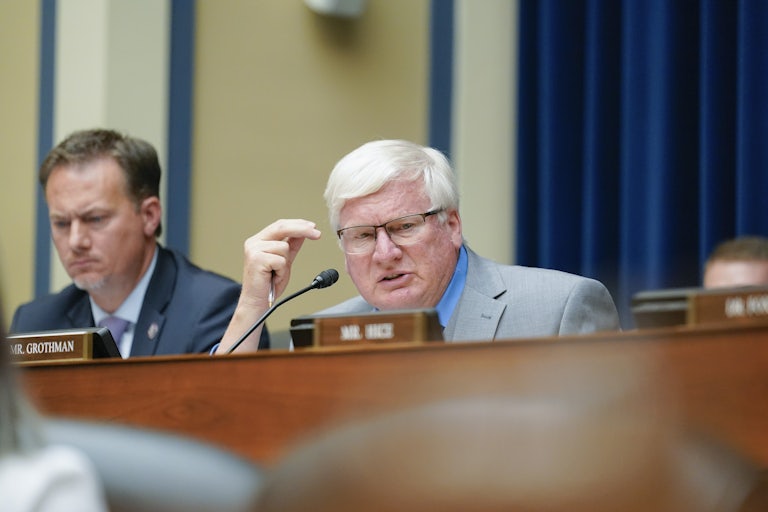
GOP Lawmaker Complains That Biden Isn’t Picking Enough Straight, White Male Judges

Glenn Grothman would like justice for straight white dudes.

Representative Glenn Grothman
Andrew Harnik/Pool/Getty Images

On Thursday, Wisconsin Republican Representative Glenn Grothman used his time on the floor of America’s Capitol to complain that President Joe Biden has not nominated enough straight “white guys” as judges.

“Apparently in his first two years, President Biden had appointed 97 federal judges. Of the 97 federal judges, I was expecting maybe 25 or 30 were white guys, because I know President Biden wasn’t heavy on appointing more white guys,” Grothman started. “Five of the 97 judges were white guys,” he continued with a tinge of disgust. “Of those, two were gay. So, almost impossible for a white guy who’s not gay apparently to get appointed here.”

According to the American Constitution Society, over 68 percent of federal judges are white.

Still, it seems to Grothman that you can either be a straight white guy, or you’re everything else. And, well, he doesn’t seem to be a big fan of “everything else.”

In 2015, Grothman was one of 37 co-sponsors of a House resolution that defined marriage as “consisting only of the union of a man and woman.” The resolution prohibited either the Constitution or even states to be required to recognize marriages of “any other union.”

In 2012, Grothman said Kwanzaa is a fake holiday made up by a college professor and the libs. “Irresponsible public school districts such as Green Bay and Madison … try to tell a new generation that Blacks have a separate holiday than Christians.”

Grothman also has a tenuous relationship with Martin Luther King Jr. Day, arguing that public employees should be forced to work on the holiday. In 2018, at an event on the holiday itself, when asked about some of then-President Trump’s controversial comments—like ones about immigrants from African countries—Grothman offered a puzzling retort. “The past president brought Al Sharpton into the White House something like 80 times,” he told the college crowd. “That was kind of stunning to me, but nobody ever made a big ruckus out of it.”

The derangement goes beyond people’s social lives, into their economic ones.

In 2014, Grothman, then a state Senator, expressed disdain for a Wisconsin law that mandated businesses provide workers with “at least one period consisting of 24 consecutive hours of rest in each calendar week.”

“Right now in Wisconsin, you’re not supposed to work seven days in a row, which is a little ridiculous because all sorts of people want to work seven days a week,” he told HuffPost.

After he voted to repeal Wisconsin’s equal-pay protection law, Grothman said the wage gap wasn’t about workplace discrimination. “You could argue that money is more important for men. I think a guy in their first job, maybe because they expect to be a breadwinner someday, may be a little more money-conscious,” he told The Daily Beast.

Calling for restrictions on food stamps (sound familiar?), Grothman has also encouraged citizens to spy on food stamp recipients’ shopping carts, lest any person be lying about their need for help to buy groceries. He has previously written that some recipients do not look “genuinely poor” enough to be obtaining such benefits.

Oath Keepers Founder Sentenced to 18 Years for January 6 Seditious Conspiracy

“These defendants were prepared to fight. Not for their country, but against it.”

Aaron C. Davis/The Washington Post/Getty Images
Stewart Rhodes

Oath Keepers founder Stewart Rhodes was sentenced to 18 years in prison on Thursday for his role in inciting the violent attempt to overturn the 2020 presidential election.

Rhodes and four other members of the far-right paramilitary group were found guilty in November of various crimes relating to the January 6 insurrection. This is one of the first sentences to be handed down for seditious conspiracy in the attack, and the longest of any January 6 defendant to date.

“These defendants were prepared to fight. Not for their country, but against it,” assistant U.S. Attorney Jeffrey Nestler wrote in sentencing memos for the prosecution. “In their own words, they were ‘willing to die’ in a ‘guerrilla war’ to achieve their goal of halting the transfer of power after the 2020 Presidential Election.”

The Oath Keepers were part of the mob that swept into the U.S. Capitol on January 6, 2021, trying to stop the certification of 2020 presidential election results. Prosecutors had argued Rhodes was a key figure in spreading falsehoods that the election had been rigged for Joe Biden, and they asked he be sentenced to 25 years in prison.

Rhodes and Oath Keepers member Kelly Meggs were both found guilty of seditious conspiracy in November. Three other members—Jessica Watkins, Kenneth Karrelson, and Thomas Caldwell—were found guilty of obstruction of an official proceeding and aiding and abetting for their actions on January 6. Meggs and Watkins were also found guilty of conspiracy to obstruct.

Rhodes’s conviction and sentencing is one of the most significant yet to come out of the investigation into the January 6 riot, marking a major win for the Justice Department. Another came in early May when Proud Boys chairman Henry Tarrio was also convicted of seditious conspiracy.

Tarrio and three other members of the far-right, neofascist group were found guilty of seditious conspiracy, as well as conspiracy to obstruct Congress and obstruction of Congress. A fifth group member was also found guilty of obstruction of Congress but not the other charges. There have now been a total of 14 convictions of seditious conspiracy over the January 6 insurrection.

This post has been updated.

Here Are the Two Democrats Who Voted With Republicans to Block Student Debt Relief

At least the Blue Dog Democrats are honest about who they are.

Bill Clark/CQ-Roll Call, Inc/Getty Images; Paul Morigi/Getty Images for Headstrong
From left: Representatives Jared Golden and Marie Gluesenkamp Perez

Perhaps the most lasting legacy of the Blue Dog coalition is Kyrsten Sinema and Henry Cuellar; a senator who spends more time with elite donors than her constituents and an A-rated NRA, anti-choice conservative. And in its nearly three-decade history, the caucus is at an all-time low. Nevertheless, two of its members are committed to bringing it back, by way of some of the worst, most characteristic P.R. possible: voting with Republicans to leave 43 million people under the weight of crippling student debt.

On Wednesday, Maine’s Jared Golden and Washington’s Marie Gluesenkamp Perez joined House Republicans and voted to repeal President Joe Biden’s student debt relief program and to terminate the freeze on federal student loan payments and interests.

The resolution, part of Republicans’ demands in order to agree to raise the debt ceiling, passed 218–203.

Shortly after, Perez took to Twitter to boast, alongside her two Blue Dog co-chairs, about getting “shit done.”

If voting with Republicans to leave the boot of debt on millions of people is a recruiting tool, at least it’s an honest encapsulation of how woefully inept and meager the Blue Dog coalition really is—and what kind of “shit” it has always aspired to get done.

“College costs too much,” Perez tweeted on her official congressional account Thursday morning, but she said there’s no way to reduce debt without also investing in “career & technical education.” It’s not clear why the millennial lawmaker seems unable to conceptualize alleviating the ridiculous student debt as part of the reconstruction plan for a system she admits is broken.

No less is the move disappointing given that Golden and Perez both have around 100,000 student debtors in their districts.

Republicans—some of whom are incredibly wealthy—have continued framing the student debt relief plan as a favor to the rich. But estimates show that 87 percent of the relief would go to individuals earning less than $75,000 a year, while none would go to those earning more than $125,000. Ninety-five percent of the total benefits would go to households making less than $150,000.

Facts and figures aside, as TNR has written previously:

There are millions of people in this country who are trying their best to bloom and live more whole and productive lives but are hindered by the burden of such soulless debt. In the short term, Republicans may frame their ideas as cost-saving, but in reality, such measures will increase medium- and long-term costs on society.

And by joining Republicans in the cynical measure to maintain the soul-splitting burden of debt on millions in this country, Golden and Perez show just how politically inept and practically unimaginative they are. Which, in reality, are prerequisites for being a member of the Blue Dog coalition.

Want to Cut Spending? Here’s How Much of Our Budget Is Going to the Military and Police

If Republicans are serious about wanting to reduce the debt, a new report shows exactly where they could start.

If Congress is looking for a place to cut spending, look no further! A new report from the Institute for Policy Studies found that an estimated $1.1 trillion, or 62 percent of federal discretionary spending, went to militarized programs over the past year.

That includes spending on things like war, weapons development, policing and prisons, and detention and deportation. Only 38 percent of the discretionary budget was left for investment in communities (things like education, childcare, affordable housing, and environmental programs).

As the United States hurtles toward debt default, the IPS report is a good reminder that if the Republican Party really wants to cut spending, it could do so quite easily. But rather than look to the single-largest drain on the public purse, Republicans want to impose harsh work requirements for Medicaid and food stamps, gut clean energy programs, and make life easier for fossil fuel companies..

“Threats to cut spending for vital domestic programs have featured prominently in the debt ceiling debate in recent weeks,” the IPS said in a press statement, “but spending on militarism has been almost entirely exempt from the discussion. Meanwhile, clawing back failed military, homeland security and law enforcement spending could instead fund programs and measures to address the true needs of American communities.”

The IPS report shows just how absurd our national budget priorities really are. Since 2001, discretionary spending on militarism has outpaced investments in communities two-to-one. Spending on federal law enforcement was twice that on childcare and early childhood education programs. Nuclear weapons? Four times what we spend on substance abuse and mental health. Perhaps most damning of all: For every $1 spent on diplomacy and humanitarian aid, the U.S. spent $16 on war and the military.

The report comes just days after a six-month investigation by CBS’s 60 Minutes found that “military contractors overcharge the Pentagon on almost everything.” And this year, about half of the monstrous $842 Pentagon budget will go to defense contractors. According to the IPS, the average taxpayer gave Pentagon contractors $1,087 in 2022.

Lindsay Koshgarian, one of the report’s co-authors, says, “Spending on militarism takes up the majority of the federal discretionary budget, and it has grown faster than all other spending. If we keep up these patterns, we are hurtling toward a future where we can’t afford the basics of a civilized society.”

House Speaker Kevin McCarthy, of course, has said reconsidering military spending in the debt talks is off the table.